# Technical Document Analysis: AI Architecture Diagram
## Diagram Overview
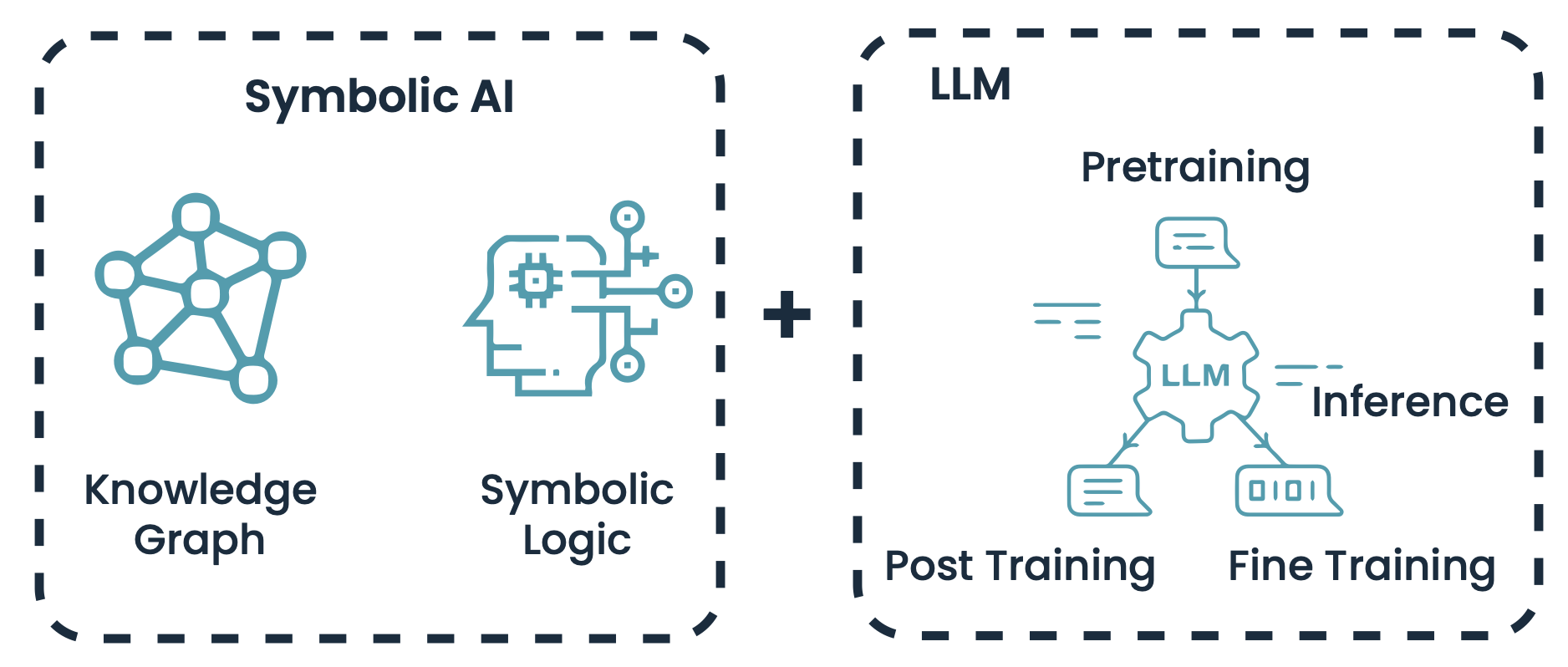
The image presents a comparative architecture diagram of two AI paradigms: **Symbolic AI** and **Large Language Models (LLM)**. The diagram uses dashed borders to delineate distinct sections and employs symbolic icons to represent conceptual components.
---
## Left Section: Symbolic AI
### Components
1. **Knowledge Graph**
- Icon: Network of interconnected nodes (circles) with edges
- Spatial Position: Top-left quadrant of the Symbolic AI section
- Function: Represents structured knowledge relationships
2. **Symbolic Logic**
- Icon: Human head silhouette with circuitry patterns
- Spatial Position: Bottom-left quadrant of the Symbolic AI section
- Function: Represents rule-based reasoning systems
### Connectors
- **Plus Sign (+)** between Symbolic AI and LLM sections
- Indicates integration point between paradigms
---
## Right Section: LLM Architecture
### Training Phases
1. **Pretraining**
- Icon: Speech bubble feeding into gear (LLM core)
- Spatial Position: Top-right quadrant
- Function: Initial model training on broad datasets
2. **Inference**
- Icon: Gear (LLM core) with bidirectional arrows
- Spatial Position: Right-center
- Function: Model deployment for real-time processing
3. **Post Training**
- Icon: Speech bubble with dashed lines
- Spatial Position: Bottom-left of LLM section
- Function: Initial performance evaluation
4. **Fine Training**
- Icon: Binary code (0101) feeding into gear
- Spatial Position: Bottom-right of LLM section
- Function: Specialized model optimization
---
## Key Observations
1. **Paradigm Contrast**
- Symbolic AI emphasizes structured knowledge representation
- LLM focuses on data-driven training pipelines
2. **Integration Point**
- The plus sign suggests potential hybrid architectures
- No explicit connection mechanisms shown between sections
3. **Missing Elements**
- No numerical data or performance metrics
- No explicit legend or color-coding system
- No temporal axis or quantitative measurements
---
## Diagram Structure