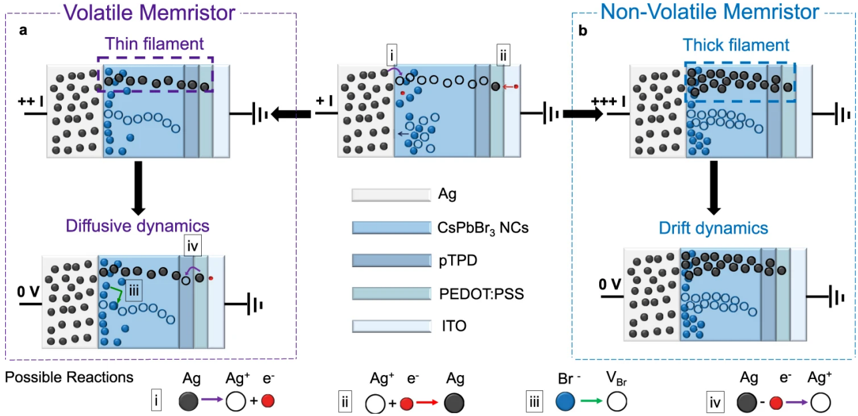
## Diagram: Comparison of Volatile and Non-Volatile Memristor Mechanisms
### Overview
The diagram illustrates the operational mechanisms of **volatile** and **non-volatile memristors**, focusing on ion dynamics, material composition, and electrochemical reactions. It contrasts **diffusive dynamics** (volatile) with **drift dynamics** (non-volatile), highlighting differences in ion transport and material interactions.
---
### Components/Axes
#### Legend (Bottom Center):
- **Ag** (Silver): White circles (Ag⁺ ions), black dots (Ag atoms).
- **CsPbBr₃:NCs** (Cesium Lead Bromide Nanocrystals): Blue rectangles.
- **pTPD** (Poly(3,4-ethylenedioxythiophene):blue-green rectangles.
- **PEDOT:PSS** (Poly(3,4-ethylenedioxythiophene) polystyrene sulfonate): Light blue rectangles.
- **ITO** (Indium Tin Oxide): Gray rectangles.
#### Diagram Sections:
1. **Volatile Memristor (Left Panel)**:
- **Thin Filament**: Purple dashed box.
- **Diffusive Dynamics**: Arrows indicate Ag⁺ ion movement.
- **Possible Reactions**:
- **i**: Ag⁺ + e⁻ → Ag (white circle + black dot → red dot).
- **ii**: Ag⁺ → Ag⁺ + e⁻ (black dot → white circle + red dot).
- **iii**: Ag⁺ diffusion (black dot → green arrow).
- **iv**: Ag⁺ + e⁻ → Ag (black dot + red dot → white circle).
2. **Non-Volatile Memristor (Right Panel)**:
- **Thick Filament**: Blue dashed box.
- **Drift Dynamics**: Arrows indicate Ag⁺ and Br⁻ ion movement.
- **Possible Reactions**:
- **i**: Ag⁺ + e⁻ → Ag (black dot + red dot → white circle).
- **ii**: Ag⁺ → Ag⁺ + e⁻ (black dot → white circle + red dot).
- **iii**: Br⁻ + VBr → Br⁻ (blue dot + green arrow → blue dot).
- **iv**: Ag⁺ + e⁻ → Ag (black dot + red dot → white circle).
---
### Detailed Analysis
#### Volatile Memristor (a):
- **Thin Filament**: Ag⁺ ions (black dots) are confined to a narrow layer, enabling rapid diffusion.
- **Diffusive Dynamics**: Ag⁺ ions (black dots) move via diffusion (green arrow), forming Ag atoms (white circles) upon electron capture (red dot).
- **Reactions**:
- **i**: Ag⁺ + e⁻ → Ag (reduction).
- **ii**: Ag⁺ oxidation (loss of electron).
- **iii**: Ag⁺ diffusion (spatial redistribution).
- **iv**: Ag⁺ + e⁻ → Ag (reduction at a different location).
#### Non-Volatile Memristor (b):
- **Thick Filament**: Ag⁺ (black dots) and Br⁻ (blue dots) ions are present, enabling drift under electric fields.
- **Drift Dynamics**: Ag⁺ (black dots) and Br⁻ (blue dots) move directionally (arrows), with Br⁻ interacting with VBr (green arrow).
- **Reactions**:
- **i**: Ag⁺ + e⁻ → Ag (reduction).
- **ii**: Ag⁺ oxidation.
- **iii**: Br⁻ + VBr → Br⁻ (Br⁻ migration via vacancy).
- **iv**: Ag⁺ + e⁻ → Ag (reduction at a different location).
---
### Key Observations
1. **Material Composition**:
- Volatile memristors use **Ag** and **pTPD/PEDOT:PSS** for ion transport.
- Non-volatile memristors incorporate **CsPbBr₃:NCs** and **ITO** for stability and ion mobility.
2. **Ion Dynamics**:
- Volatile: Relies on **diffusive Ag⁺** movement (short-range, rapid).
- Non-Volatile: Uses **drift dynamics** (long-range, field-driven) for Ag⁺ and Br⁻.
3. **Reaction Pathways**:
- Volatile: Dominated by Ag⁺/Ag redox cycles.
- Non-Volatile: Involves **Ag⁺/Ag** and **Br⁻/VBr** interactions, enabling multi-ion switching.
4. **Structural Differences**:
- Volatile: Thin filament limits ion mobility.
- Non-Volatile: Thick filament allows sustained ion drift.
---
### Interpretation
The diagram demonstrates how **ion dynamics** and **material design** dictate memristor behavior:
- **Volatile memristors** depend on **diffusive Ag⁺** for rapid switching but lack retention (data volatility).
- **Non-volatile memristors** leverage **drift dynamics** (Ag⁺/Br⁻) and **CsPbBr₃:NCs** for stable, long-term memory states. The inclusion of **Br⁻** and **VBr** suggests a mixed-ion conduction mechanism, enhancing endurance and retention.
The legend’s color coding is critical for identifying material roles: **Ag** (redox), **Br⁻** (charge balancing), and **ITO** (electrode). The spatial separation of thin vs. thick filaments underscores the trade-off between speed (volatile) and retention (non-volatile). This aligns with applications in neuromorphic computing, where non-volatile memristors are preferred for persistent memory.