## Heatmap: Longer Inferences
### Overview
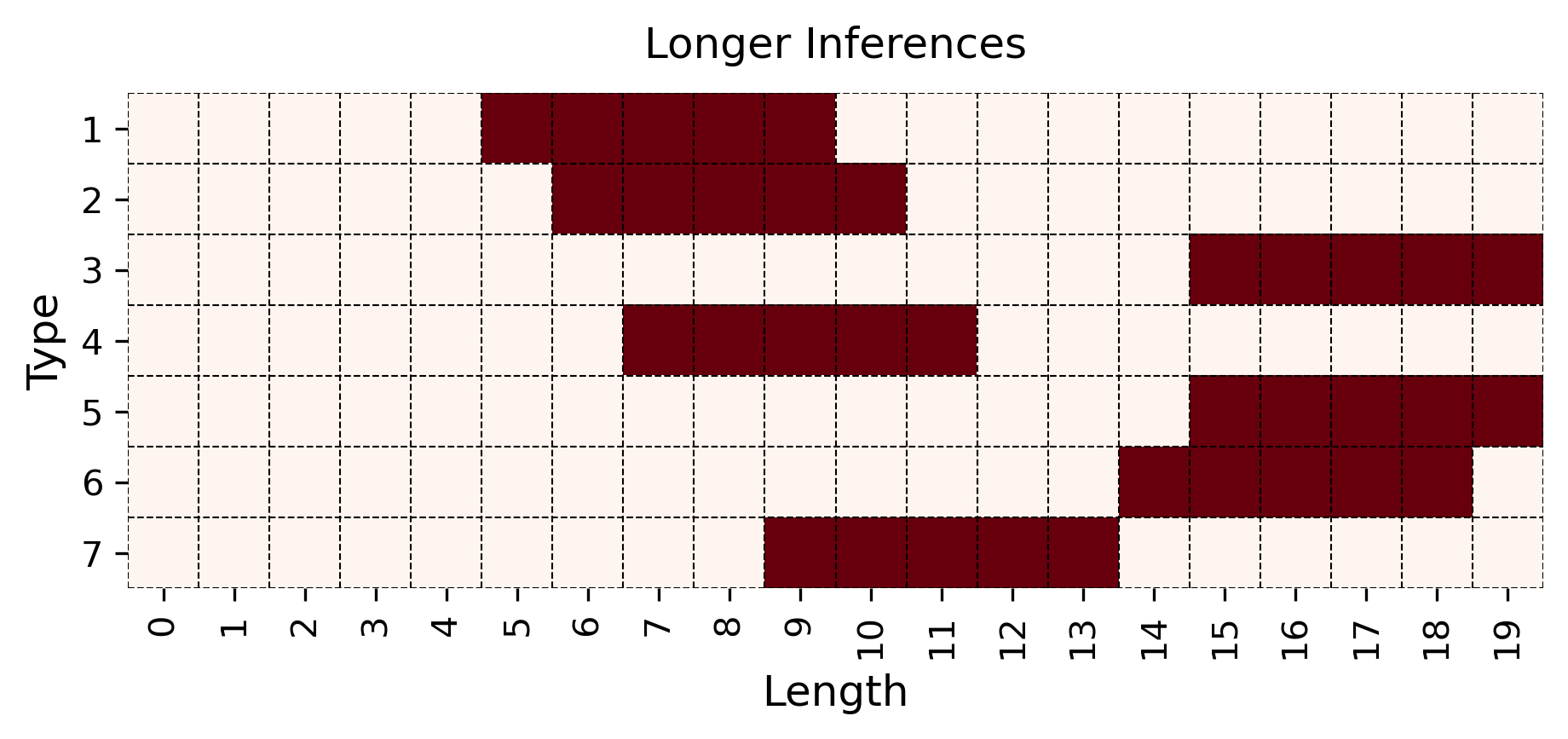
The image is a heatmap chart titled "Longer Inferences." It visualizes the relationship between two categorical variables: "Type" (y-axis) and "Length" (x-axis). The chart uses a binary color scheme to indicate the presence or absence of a condition (likely "longer inferences") for each combination of Type and Length. The active cells are colored dark red, while the inactive cells are a light beige.
### Components/Axes
* **Title:** "Longer Inferences" (centered at the top).
* **Y-Axis:** Labeled "Type." It lists discrete categories numbered from 1 to 7, arranged vertically from top to bottom.
* **X-Axis:** Labeled "Length." It lists discrete numerical values from 0 to 19, arranged horizontally from left to right. The labels are rotated 90 degrees clockwise.
* **Grid:** A dashed grid overlays the entire plot area, creating a matrix of cells corresponding to each (Type, Length) pair.
* **Legend/Color Key:** There is no explicit legend. The color meaning is inferred: dark red indicates an active or "true" state for that cell, while light beige indicates an inactive or "false" state.
### Detailed Analysis
The heatmap shows which "Length" values are associated with each "Type." The dark red blocks represent the active ranges.
* **Type 1:** Active for Lengths **5, 6, 7, 8, 9**. (Range: 5-9)
* **Type 2:** Active for Lengths **6, 7, 8, 9, 10**. (Range: 6-10)
* **Type 3:** Active for Lengths **15, 16, 17, 18, 19**. (Range: 15-19)
* **Type 4:** Active for Lengths **7, 8, 9, 10, 11**. (Range: 7-11)
* **Type 5:** Active for Lengths **15, 16, 17, 18, 19**. (Range: 15-19)
* **Type 6:** Active for Lengths **14, 15, 16, 17, 18**. (Range: 14-18)
* **Type 7:** Active for Lengths **9, 10, 11, 12, 13**. (Range: 9-13)
### Key Observations
1. **Clustered Ranges:** Each Type has a contiguous block of active Lengths, spanning exactly 5 units.
2. **Two Distinct Groups:**
* **Group A (Shorter Lengths):** Types 1, 2, 4, and 7 have active ranges clustered between Lengths 5 and 13.
* **Group B (Longer Lengths):** Types 3, 5, and 6 have active ranges clustered between Lengths 14 and 19.
3. **Overlap and Progression:**
* Within Group A, the active ranges shift rightward (to higher Lengths) as Type increases: Type 1 (5-9) -> Type 2 (6-10) -> Type 4 (7-11) -> Type 7 (9-13).
* Within Group B, the ranges are very similar: Type 6 (14-18), Types 3 & 5 (15-19).
4. **Gaps:** There is a clear gap in the data. No Type has active cells for Lengths 0-4 or for Length 14 in the case of Types 3 and 5.
### Interpretation
This heatmap likely illustrates the output of a classification or analysis system where different "Types" (which could represent models, algorithms, categories, or conditions) are associated with specific ranges of "Length" (which could represent sequence length, inference steps, data size, or time duration).
* **What the data suggests:** The system or phenomenon being measured produces "longer inferences" (the active state) only within specific, bounded length intervals for each type. The clear separation into two groups (A and B) suggests a fundamental dichotomy in the data or the types themselves—perhaps two different classes of problems, two different operational modes, or two distinct populations.
* **How elements relate:** The Type is the primary determinant of the Length range. The progression within Group A suggests a systematic relationship where increasing Type number correlates with a shift toward slightly longer inference lengths.
* **Notable anomalies:** The most striking feature is the complete absence of activity for Lengths 0-4 across all Types. This could indicate a minimum threshold for the measured phenomenon. The identical ranges for Types 3 and 5 are also notable, suggesting these two types behave identically with respect to this metric. The gap at Length 14 for Types 3 and 5, while Type 6 is active there, is a specific point of divergence within Group B.