## Diagram: Memory Bank System Architecture
### Overview
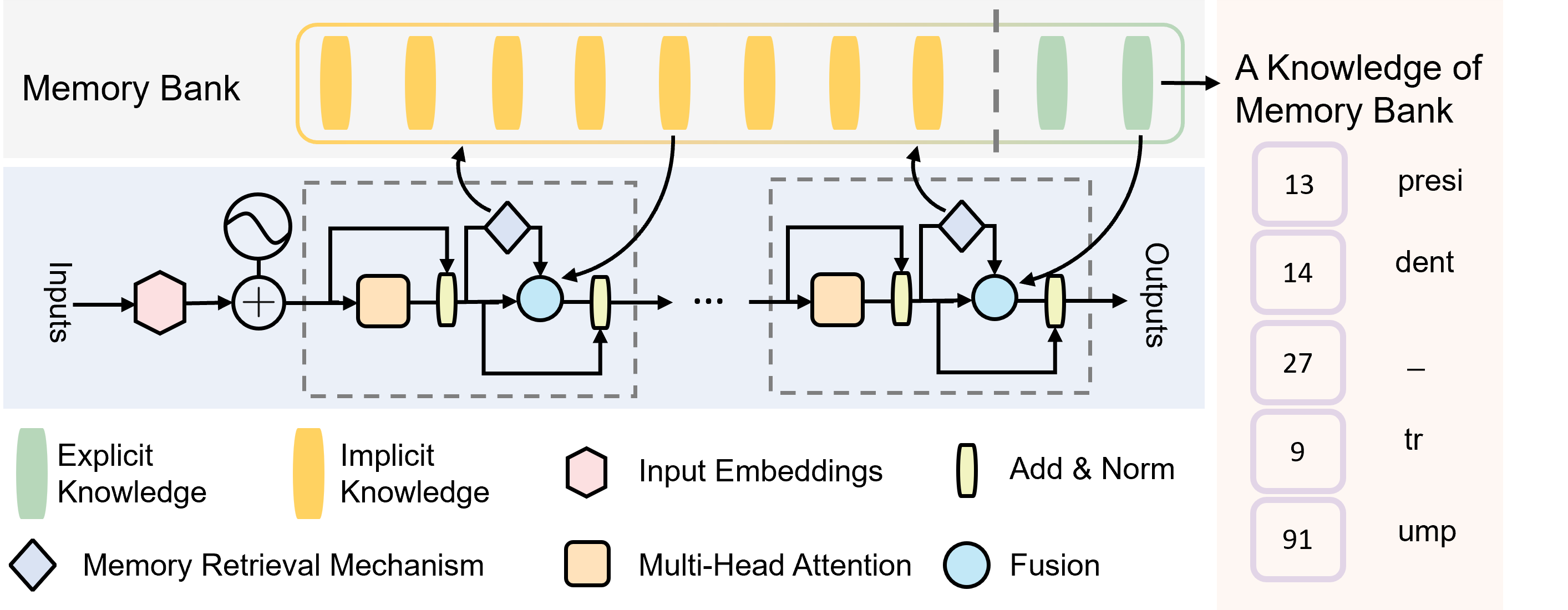
The diagram illustrates a memory bank system with explicit and implicit knowledge components, input processing mechanisms, and memory retrieval/output pathways. It includes a legend for color-coded elements and a table of memory bank entries.
### Components/Axes
- **Legend**:
- Green: Explicit Knowledge
- Yellow: Implicit Knowledge
- Blue Diamond: Memory Retrieval Mechanism
- Pink Hexagon: Input Embeddings
- Orange Square: Multi-Head Attention
- Light Yellow: Add & Norm
- Blue Circle: Fusion
- **Memory Bank**:
- Top section with alternating yellow (implicit) and green (explicit) vertical bars.
- Right side labeled "A Knowledge of Memory Bank" with a table of entries:
| Number | Term |
|--------|-------|
| 13 | presi |
| 14 | dent |
| 27 | - |
| 9 | tr |
| 91 | ump |
- **Flow Pathways**:
- Inputs → Input Embeddings (pink) → Multi-Head Attention (orange) → Fusion (blue) → Memory Retrieval (blue diamond) → Outputs.
- Outputs loop back to the memory bank.
### Detailed Analysis
- **Memory Bank**:
- Explicit knowledge (green) and implicit knowledge (yellow) are spatially separated but interconnected.
- The table on the right lists memory entries with numerical addresses (e.g., 13, 14) and associated terms (e.g., "presi," "dent"). The term "-" at address 27 suggests an empty or undefined slot.
- **Input Processing**:
- Inputs are first embedded (pink hexagon) and processed through multi-head attention (orange square), which splits into parallel pathways.
- Add & Norm (light yellow) layers normalize data before fusion (blue circle) combines features.
- **Memory Retrieval**:
- The blue diamond symbolizes a retrieval mechanism that accesses stored knowledge, with outputs feeding back into the memory bank.
### Key Observations
1. **Dual Knowledge Representation**: Explicit (green) and implicit (yellow) knowledge are distinct but integrated via fusion.
2. **Attention Mechanism**: Multi-head attention (orange) enables parallel processing of input embeddings.
3. **Cyclic Feedback**: Outputs loop back to the memory bank, suggesting dynamic updates to stored knowledge.
4. **Memory Table Ambiguity**: The term "-" at address 27 and the purpose of numerical addresses (e.g., 91) require further context.
### Interpretation
The diagram represents a hybrid memory-augmented neural network. Explicit knowledge (green) likely stores structured, factual data, while implicit knowledge (yellow) handles learned patterns. The multi-head attention mechanism allows the system to focus on different input aspects, and fusion integrates these features for memory retrieval. The cyclic feedback loop implies the system adapts its memory based on outputs, enabling continuous learning. The table’s numerical addresses may correspond to specific memory slots, but their exact semantics (e.g., "ump" at 91) are unclear without additional context. The absence of a value at address 27 could indicate a placeholder or error.
**Note**: The diagram lacks explicit numerical trends or data series, focusing instead on architectural components and their relationships.