## Stacked Histograms: Distribution of Progress Ratio Across Varying Noise Ratios
### Overview
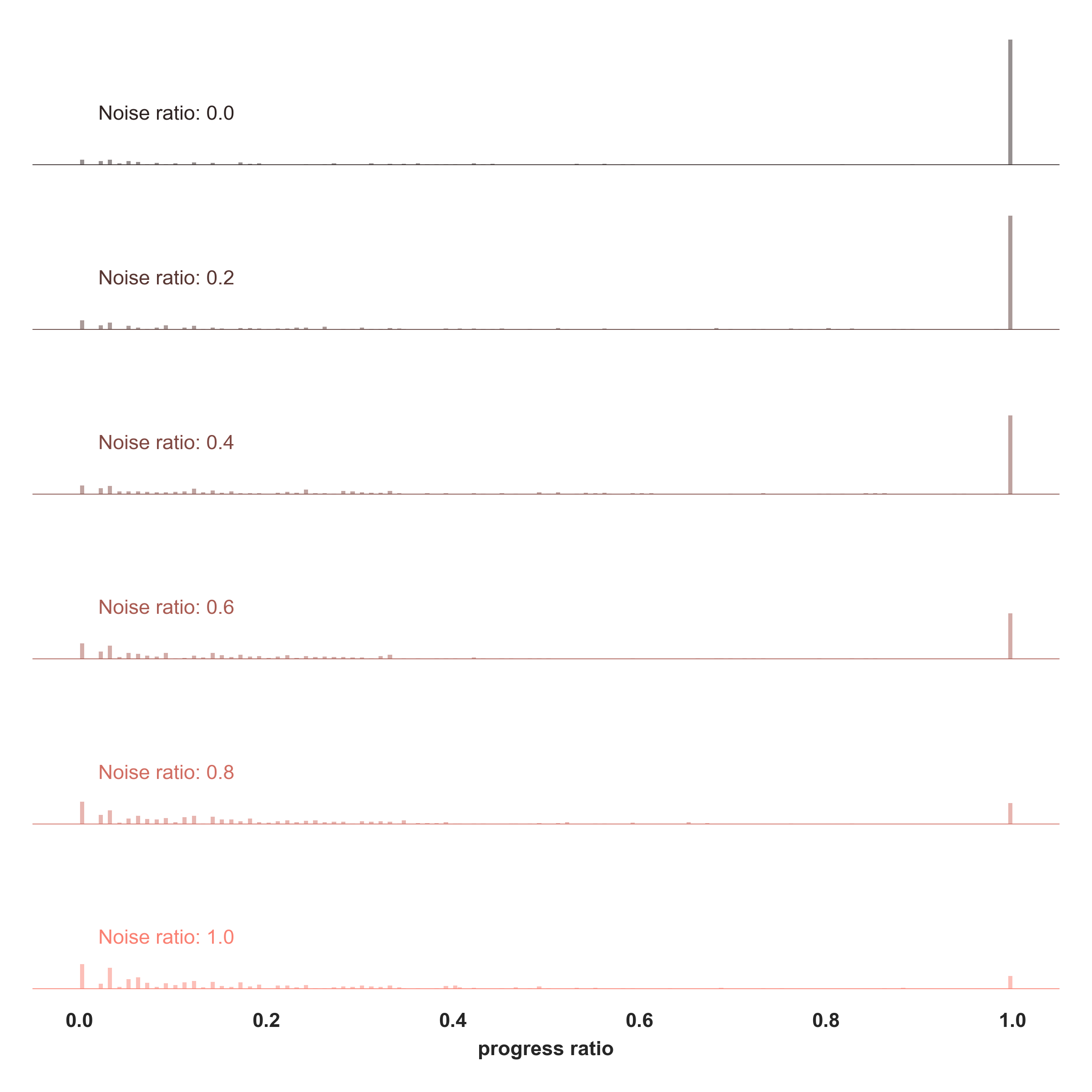
The image presents six individual histograms, stacked vertically, each depicting the distribution of a "progress ratio" under a specific "Noise ratio". The "Noise ratio" is a categorical variable ranging from 0.0 to 1.0, incrementing by 0.2. The horizontal axis, labeled "progress ratio", is shared across all plots and spans from 0.0 to 1.0. Each histogram primarily shows a bimodal distribution, with a significant concentration of values at `progress ratio = 1.0` and another cluster of values near `progress ratio = 0.0`. The color of the histogram bars and their baselines changes progressively from dark grey to reddish-brown as the "Noise ratio" increases.
### Components/Axes
* **Overall Structure:** Six distinct histogram plots are arranged vertically, each corresponding to a unique "Noise ratio" condition.
* **Horizontal Axis (X-axis):**
* **Title:** "progress ratio" (positioned centrally below the bottommost histogram).
* **Markers:** 0.0, 0.2, 0.4, 0.6, 0.8, 1.0. The axis represents a continuous range from 0.0 to 1.0.
* **Vertical Axis (Y-axis):**
* No explicit title or numerical markers are provided. The height of the bars implicitly represents the frequency or count of observations within each bin.
* **Categorical Labels (Left-aligned, positioned above each respective plot):**
* "Noise ratio: 0.0" (topmost plot)
* "Noise ratio: 0.2"
* "Noise ratio: 0.4"
* "Noise ratio: 0.6"
* "Noise ratio: 0.8"
* "Noise ratio: 1.0" (bottommost plot)
* **Color Scheme:** The visual representation of the histograms employs a color gradient for the bars and their baselines, correlating with the "Noise ratio":
* **Noise ratio 0.0:** Dark grey bars and baseline.
* **Noise ratio 0.2:** Medium grey-brown bars and baseline.
* **Noise ratio 0.4:** Light grey-brown bars and baseline.
* **Noise ratio 0.6:** Light brown bars and baseline.
* **Noise ratio 0.8:** Pale reddish-brown bars and baseline.
* **Noise ratio 1.0:** Reddish-brown bars and baseline.
### Detailed Analysis
Each histogram illustrates the distribution of "progress ratio" values, predominantly concentrated at the extremes of the 0.0 to 1.0 range.
1. **Noise ratio: 0.0** (Topmost plot, dark grey bars)
* **Trend:** The distribution is overwhelmingly concentrated at `progress ratio = 1.0`, represented by the tallest bar in the entire image. A very small cluster of bars is visible near `progress ratio = 0.0`, with the tallest of these appearing around `progress ratio = 0.02` to `0.04`, reaching approximately 5-10% of the height of the bar at 1.0. Frequencies for "progress ratio" values between approximately 0.1 and 0.9 are negligible, appearing as tiny, almost imperceptible lines along the baseline.
* **Approximate Relative Frequencies:** `progress ratio = 1.0` (highest frequency, ~1.0 relative); `progress ratio ≈ 0.02-0.04` (~0.05-0.1 relative frequency); other values (near zero).
2. **Noise ratio: 0.2** (Second plot from top, medium grey-brown bars)
* **Trend:** The distribution remains dominated by the bar at `progress ratio = 1.0`, though its relative height appears slightly reduced compared to the 0.0 case. The cluster of small bars near `progress ratio = 0.0` shows a slight increase in height and possibly a marginal spread. The tallest bar in this cluster, still around `progress ratio = 0.02` to `0.04`, now reaches approximately 10-15% of the height of the bar at 1.0.
* **Approximate Relative Frequencies:** `progress ratio = 1.0` (high frequency, slightly less than 0.0 case); `progress ratio ≈ 0.02-0.04` (~0.1-0.15 relative frequency); other values (near zero).
3. **Noise ratio: 0.4** (Third plot from top, light grey-brown bars)
* **Trend:** The bar at `progress ratio = 1.0` continues to be the most prominent, but its relative height has further decreased. The cluster of bars near `progress ratio = 0.0` shows a more noticeable increase in height and spread. The tallest bar in this cluster, still around `progress ratio = 0.02` to `0.04`, now reaches approximately 15-20% of the height of the bar at 1.0.
* **Approximate Relative Frequencies:** `progress ratio = 1.0` (decreasing high frequency); `progress ratio ≈ 0.02-0.04` (~0.15-0.2 relative frequency); other values (near zero).
4. **Noise ratio: 0.6** (Fourth plot from top, light brown bars)
* **Trend:** The bar at `progress ratio = 1.0` is still dominant but shows a further reduction in relative height. The cluster of bars near `progress ratio = 0.0` is now more pronounced, with several bars reaching significant heights. The tallest bar in this cluster, around `progress ratio = 0.02` to `0.04`, appears to be approximately 20-25% of the height of the bar at 1.0. The spread of these lower-end bars also seems to extend slightly further, possibly up to `progress ratio = 0.1`.
* **Approximate Relative Frequencies:** `progress ratio = 1.0` (further decreasing high frequency); `progress ratio ≈ 0.02-0.04` (~0.2-0.25 relative frequency); other values (near zero, with slight increase in spread near 0.0).
5. **Noise ratio: 0.8** (Fifth plot from top, pale reddish-brown bars)
* **Trend:** The bar at `progress ratio = 1.0` has significantly reduced in relative height, though it remains the single tallest bar in this specific plot. The cluster of bars near `progress ratio = 0.0` is now quite prominent, with multiple bars of varying heights. The tallest bar in this cluster, still around `progress ratio = 0.02` to `0.04`, is now roughly 30-40% of the height of the bar at 1.0. The spread of these bars extends more clearly up to `progress ratio = 0.1` and possibly very small frequencies up to `0.2`.
* **Approximate Relative Frequencies:** `progress ratio = 1.0` (significantly reduced high frequency); `progress ratio ≈ 0.02-0.04` (~0.3-0.4 relative frequency); `progress ratio ≈ 0.0-0.1` (more distributed frequencies).
6. **Noise ratio: 1.0** (Bottommost plot, reddish-brown bars)
* **Trend:** The bar at `progress ratio = 1.0` is at its lowest relative height among all plots, though it still represents a distinct peak. The cluster of bars near `progress ratio = 0.0` is now very prominent and spread out. The tallest bar in this cluster, still around `progress ratio = 0.02` to `0.04`, appears to be approximately 50-60% of the height of the bar at 1.0. The distribution near 0.0 is wider, with noticeable bars extending up to `progress ratio = 0.1` and very small bars up to `0.2` or `0.3`.
* **Approximate Relative Frequencies:** `progress ratio = 1.0` (lowest high frequency); `progress ratio ≈ 0.02-0.04` (~0.5-0.6 relative frequency); `progress ratio ≈ 0.0-0.1` (widest and most prominent distribution).
### Key Observations
* **Bimodal Nature:** All distributions are distinctly bimodal, with peaks at `progress ratio = 1.0` and a cluster of frequencies near `progress ratio = 0.0`.
* **Inverse Relationship with `progress ratio = 1.0`:** As the "Noise ratio" increases from 0.0 to 1.0, the relative frequency (height) of the bar at `progress ratio = 1.0` consistently decreases.
* **Direct Relationship with `progress ratio ≈ 0.0`:** Conversely, as the "Noise ratio" increases, the frequencies of "progress ratio" values near 0.0 (specifically around 0.02-0.04) increase in height and become more spread out, extending further along the x-axis towards 0.1 and beyond.
* **Shift in Dominance:** At low noise ratios (0.0, 0.2), the `progress ratio = 1.0` peak is overwhelmingly dominant. As noise increases, the cluster near `progress ratio = 0.0` gains significant prominence, reducing the relative dominance of the `progress ratio = 1.0` peak.
* **Color Progression:** The subtle color change of the plots from dark grey to reddish-brown visually reinforces the increasing "Noise ratio" parameter.
### Interpretation
This data likely illustrates the impact of increasing "Noise ratio" on a system's ability to achieve a desired "progress ratio". The "progress ratio" can be interpreted as a measure of task completion or success, where 1.0 represents full completion and values near 0.0 represent minimal or no progress.
* **Ideal Conditions (Noise ratio: 0.0):** With no noise, the system performs exceptionally well, almost always achieving full progress (`progress ratio = 1.0`). Only a negligible fraction of instances result in minimal progress. This suggests a highly efficient and robust system in an ideal environment.
* **Degradation with Noise:** As the "Noise ratio" increases, the system's performance degrades. The probability of achieving full progress (`progress ratio = 1.0`) steadily declines, while the probability of making minimal or no progress (`progress ratio ≈ 0.0`) increases. This indicates that noise directly interferes with the system's operational success.
* **Impact on Failures:** The broadening of the distribution near `progress ratio = 0.0` with increasing noise suggests that failures are not always absolute (i.e., exactly 0.0 progress) but can manifest as a range of very low progress values. This implies that noise can cause partial failures or significant setbacks rather than just complete halts.
* **Resilience at High Noise:** Even at the highest "Noise ratio" (1.0), achieving full progress (`progress ratio = 1.0`) remains the single most frequent outcome, albeit with a significantly reduced proportion compared to noiseless conditions. This could suggest a degree of inherent resilience or a mechanism that still allows for successful completion in a substantial number of cases, even under extreme noise, although a large proportion of attempts now result in minimal progress.
In summary, the data clearly demonstrates that increasing noise negatively impacts the system's ability to achieve full progress, shifting outcomes towards minimal progress, while still maintaining a notable, though diminished, capacity for complete success even under high noise conditions.