\n
## Diagram: Shape and Fill Variation
### Overview
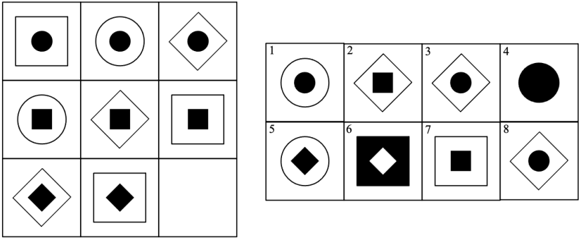
The image presents two sets of 3x3 grids, each containing shapes (square, circle, diamond) with varying fill patterns (solid black, black within a white shape, white within a black shape). The right grid is numbered 1-8. The left grid appears to be a reference or source for the variations presented in the right grid.
### Components/Axes
There are no explicit axes or legends. The components are:
* **Shapes:** Square, Circle, Diamond
* **Fill Patterns:** Solid Black, Black within White, White within Black
* **Grids:** Two 3x3 grids. The right grid is numbered 1 through 8.
### Detailed Analysis or Content Details
**Left Grid:**
* Row 1: Square with black fill, Circle with black fill, Diamond with black fill.
* Row 2: Circle with black fill, Diamond with black fill, Square with black fill.
* Row 3: Diamond with black fill, Square with black fill, Circle with black fill.
**Right Grid (Numbered 1-8):**
* 1: Circle with black fill.
* 2: Square with white fill inside a black square.
* 3: Diamond with black fill.
* 4: Circle with solid black fill.
* 5: Circle with white fill inside a black circle.
* 6: Square with white fill inside a black square.
* 7: Square with black fill.
* 8: Diamond with white fill inside a black diamond.
### Key Observations
* The right grid appears to sample variations from the left grid.
* Each shape (square, circle, diamond) appears in both solid black and with a white fill inside a black shape.
* The left grid presents a systematic arrangement of shapes with solid black fill.
* The right grid presents a more varied arrangement, including shapes with white fill inside black shapes.
### Interpretation
The image likely represents a visual pattern recognition or classification task. The left grid could be a source of basic elements, and the right grid presents a set of variations derived from those elements. The numbering suggests that these variations are intended to be identified or categorized. The variations in fill pattern (solid black, black within white, white within black) add a layer of complexity to the visual task. The image could be used to test visual attention, discrimination, or memory. It is a set of visual stimuli, and does not contain any quantitative data.