## Diagram Type: Commutative Cube Diagram in K-Theory
### Overview
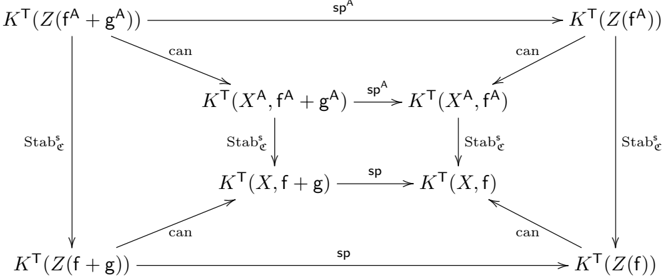
This image presents a three-dimensional commutative diagram, often referred to as a commutative cube, from the field of mathematics, likely specifically algebraic K-theory or a related area. The diagram illustrates relationships between eight different K-theory groups (the vertices of the cube) connected by various homomorphisms (the edges of the cube). The commutativity implies that any two paths of arrows starting from the same object and ending at the same object yield the same composition of maps.
### Components and Flow
The diagram consists of eight objects (vertices) and twelve morphisms (arrows). The objects are K-theory groups, denoted by `K^T(...)`. The morphisms are labeled `sp^A`, `sp`, `Stab_C^s`, and `can`.
#### Vertices (Objects)
The eight vertices are arranged in two planes, a "top" plane and a "bottom" plane, each with a "front" and "back" row.
* **Top-Back-Left:** `K^T(Z(f^A + g^A))`
* **Top-Back-Right:** `K^T(Z(f^A))`
* **Top-Front-Left:** `K^T(X^A, f^A + g^A)`
* **Top-Front-Right:** `K^T(X^A, f^A)`
* **Bottom-Back-Left:** `K^T(Z(f + g))`
* **Bottom-Back-Right:** `K^T(Z(f))`
* **Bottom-Front-Left:** `K^T(X, f + g)`
* **Bottom-Front-Right:** `K^T(X, f)`
#### Edges (Morphisms)
The edges connect these vertices and are labeled as follows:
**Horizontal Maps (Specialization):**
* **Top-Back:** From `K^T(Z(f^A + g^A))` to `K^T(Z(f^A))`, labeled `sp^A`.
* **Top-Front:** From `K^T(X^A, f^A + g^A)` to `K^T(X^A, f^A)`, labeled `sp^A`.
* **Bottom-Back:** From `K^T(Z(f + g))` to `K^T(Z(f))`, labeled `sp`.
* **Bottom-Front:** From `K^T(X, f + g)` to `K^T(X, f)`, labeled `sp`.
**Vertical Maps (Stabilization):**
* **Back-Left:** From `K^T(Z(f^A + g^A))` to `K^T(Z(f + g))`, labeled `Stab_C^s`.
* **Back-Right:** From `K^T(Z(f^A))` to `K^T(Z(f))`, labeled `Stab_C^s`.
* **Front-Left:** From `K^T(X^A, f^A + g^A)` to `K^T(X, f + g)`, labeled `Stab_C^s`.
* **Front-Right:** From `K^T(X^A, f^A)` to `K^T(X, f)`, labeled `Stab_C^s`.
**Diagonal/Depth Maps (Canonical):**
* **Top-Left:** From `K^T(Z(f^A + g^A))` to `K^T(X^A, f^A + g^A)`, labeled `can`.
* **Top-Right:** From `K^T(Z(f^A))` to `K^T(X^A, f^A)`, labeled `can`.
* **Bottom-Left:** From `K^T(Z(f + g))` to `K^T(X, f + g)`, labeled `can`.
* **Bottom-Right:** From `K^T(Z(f))` to `K^T(X, f)`, labeled `can`.
### Detailed Analysis of Commutativity
The diagram's structure implies that all six faces of the cube are commutative diagrams.
1. **Top Face:** The composition `can ∘ sp^A` (from `K^T(Z(f^A + g^A))` to `K^T(X^A, f^A)`) is equal to `sp^A ∘ can`.
2. **Bottom Face:** The composition `can ∘ sp` (from `K^T(Z(f + g))` to `K^T(X, f)`) is equal to `sp ∘ can`.
3. **Left Face:** The composition `Stab_C^s ∘ can` (from `K^T(Z(f^A + g^A))` to `K^T(X, f + g)`) is equal to `can ∘ Stab_C^s`.
4. **Right Face:** The composition `Stab_C^s ∘ can` (from `K^T(Z(f^A))` to `K^T(X, f)`) is equal to `can ∘ Stab_C^s`.
5. **Back Face:** The composition `Stab_C^s ∘ sp^A` (from `K^T(Z(f^A + g^A))` to `K^T(Z(f))`) is equal to `sp ∘ Stab_C^s`.
6. **Front Face:** The composition `Stab_C^s ∘ sp^A` (from `K^T(X^A, f^A + g^A))` to `K^T(X, f)`) is equal to `sp ∘ Stab_C^s`.
### Interpretation
This diagram likely illustrates the compatibility of several types of maps in equivariant K-theory (`K^T`).
* The objects `K^T(...)` are K-theory groups associated with certain spaces or pairs, possibly involving group actions (indicated by the `T` superscript) and potentials or functions (`f`, `g`, `f^A`, `g^A`). The notation `Z(...)` and `(X, ...)` suggests different geometric constructions, perhaps related to zero loci or relative K-theory.
* The maps `sp` and `sp^A` are likely **specialization maps**, relating a general situation (involving `f+g` or `f^A+g^A`) to a more special one (involving only `f` or `f^A`).
* The maps `Stab_C^s` are likely **stabilization maps**, relating the theory for a space `X^A` (or `Z(...)`) to the theory for a base space `X` (or `Z(...)`), possibly involving a vector bundle or a representation, indicated by the subscript `C` and superscript `s`.
* The maps `can` are **canonical maps**, representing natural transformations between different K-theory constructions (e.g., from the K-theory of a zero locus `Z` to the relative K-theory of a pair `(X, ...)`).
The commutativity of the cube asserts that these three types of operations—specialization, stabilization, and the canonical comparison—are compatible with each other. For example, specializing and then stabilizing is the same as stabilizing and then specializing.