\n
## Diagram: UnifiedQuadGraph Architecture
### Overview
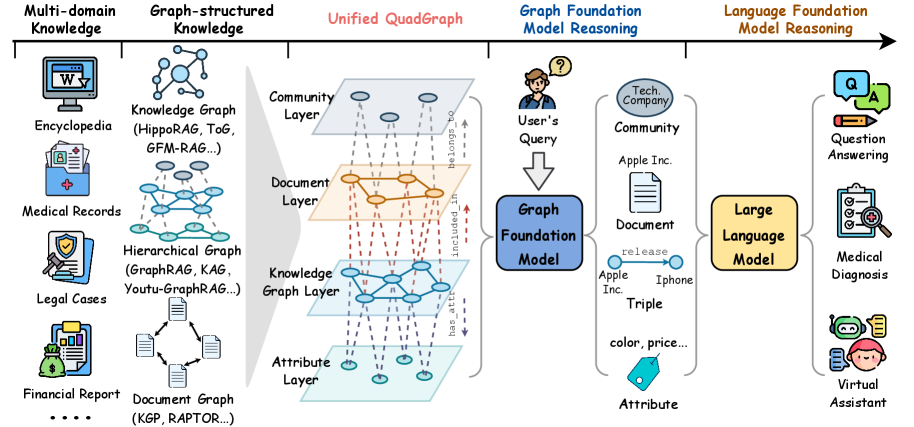
The image depicts a diagram illustrating the architecture of a UnifiedQuadGraph system, which integrates multi-domain knowledge through graph-structured knowledge and leverages both graph foundation model reasoning and language foundation model reasoning. The diagram shows the flow of information from various knowledge sources, through the UnifiedQuadGraph, and finally to applications like question answering, medical diagnosis, and virtual assistance.
### Components/Axes
The diagram is divided into five main sections, moving from left to right:
1. **Multi-domain Knowledge:** Sources of knowledge including Encyclopedia, Medical Records, Legal Cases, and Financial Reports.
2. **Graph-structured Knowledge:** Represents the knowledge as graphs, including Knowledge Graph (HippoRAG, ToG, GFM-RAG…), Hierarchical Graph (GraphRAG, KAG, Youtu-GraphRAG…), and Document Graph (KGP, RAPTOR…).
3. **UnifiedQuadGraph:** The central component, structured into four layers: Community Layer, Document Layer, Knowledge Graph Layer, and Attribute Layer.
4. **Graph Foundation Model Reasoning:** Utilizes a Graph Foundation Model to process information.
5. **Language Foundation Model Reasoning:** Utilizes a Large Language Model to process information.
The diagram also includes example applications on the right side: Question Answering, Medical Diagnosis, and Virtual Assistant.
### Detailed Analysis or Content Details
**1. Multi-domain Knowledge (Leftmost Section):**
* **Encyclopedia:** Represented by a book icon.
* **Medical Records:** Represented by a medical chart icon with a red cross.
* **Legal Cases:** Represented by a book with a gavel icon.
* **Financial Report:** Represented by a document with a dollar sign icon.
* The text "...." indicates that there are more knowledge sources not explicitly shown.
**2. Graph-structured Knowledge (Second Section):**
* **Knowledge Graph:** Labeled with "(HippoRAG, ToG, GFM-RAG…)"
* **Hierarchical Graph:** Labeled with "(GraphRAG, KAG, Youtu-GraphRAG…)"
* **Document Graph:** Labeled with "(KGP, RAPTOR…)"
**3. UnifiedQuadGraph (Central Section):**
* **Community Layer:** Top layer, represented by light purple rounded rectangles connected by dotted lines.
* **Document Layer:** Second layer, represented by tan rounded rectangles connected by dotted lines.
* **Knowledge Graph Layer:** Third layer, represented by light blue rounded rectangles connected by dotted lines.
* **Attribute Layer:** Bottom layer, represented by cyan rounded rectangles connected by dotted lines.
* Arrows labeled "belongs to" connect the Community Layer to the Document Layer.
* Arrows labeled "included in" connect the Document Layer to the Knowledge Graph Layer.
* Arrows labeled "has attribute" connect the Knowledge Graph Layer to the Attribute Layer.
**4. Graph Foundation Model Reasoning (Fourth Section):**
* **User's Query:** Represented by a person icon with a question mark.
* **Tech. Company:** Labeled as "Community" and an example is given as "Apple Inc."
* **Document:** Labeled as "Document" and an example is given as "iPhone".
* **Triple:** Labeled as "Triple" and an example is given as "color, price…".
* **Attribute:** Labeled as "Attribute".
* An arrow connects the User's Query to the Graph Foundation Model.
* The Graph Foundation Model is represented by a rectangular box.
**5. Language Foundation Model Reasoning (Rightmost Section):**
* **Large Language Model:** Represented by a rectangular box.
* **Question Answering:** Represented by a chat bubble icon with a "Q&A" label.
* **Medical Diagnosis:** Represented by a medical icon with a stethoscope.
* **Virtual Assistant:** Represented by a robot icon.
* An arrow connects the Large Language Model to the applications.
### Key Observations
The diagram emphasizes the integration of diverse knowledge sources into a unified graph structure. The QuadGraph architecture appears to be designed to leverage both graph-based and language-based reasoning for various downstream tasks. The use of examples like "Apple Inc." and "iPhone" suggests a focus on real-world applications. The dotted lines within the QuadGraph indicate relationships and information flow between the different layers.
### Interpretation
The UnifiedQuadGraph architecture aims to overcome the limitations of traditional knowledge representation and reasoning systems by combining the strengths of graph-based and language-based approaches. By structuring knowledge as a graph, the system can capture complex relationships and dependencies between entities. The use of foundation models allows the system to leverage pre-trained knowledge and perform reasoning tasks more effectively. The diagram suggests a pipeline where user queries are processed through the graph foundation model, then potentially refined by the language foundation model, before being used to generate responses or perform actions. The architecture is designed to be flexible and adaptable to various domains and applications, as evidenced by the diverse knowledge sources and example applications shown in the diagram. The layering of the QuadGraph (Community, Document, Knowledge, Attribute) suggests a hierarchical organization of information, allowing for reasoning at different levels of abstraction. The diagram is a high-level conceptual overview and does not provide specific details about the implementation or performance of the system.