TECHNICAL ASSET FINGERPRINT
cab71b58b1a0c50646de13f2
Click to view fullscreen
Press ESC or click to close
FOUND IN PAPERS
EXPERT: healer-alpha-free VERSION 1
RUNTIME: free/openrouter/healer-alpha
INTEL_VERIFIED
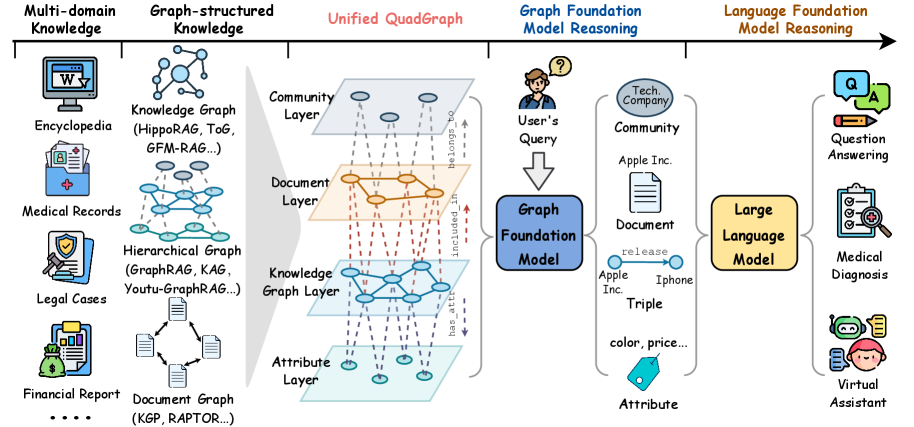
## Diagram: System Architecture for Integrating Multi-Domain Knowledge with Graph and Language Models
### Overview
This diagram illustrates a conceptual system architecture for processing diverse, multi-domain knowledge through graph-based structures and unified reasoning models to power various AI applications. The flow moves from left to right, starting with raw knowledge sources, structuring them into different graph types, unifying them into a "QuadGraph," and then using specialized foundation models (Graph and Language) to perform reasoning for end-user tasks.
### Components/Axes
The diagram is organized into five major vertical sections, indicated by headers at the top:
1. **Multi-domain Knowledge** (Far Left)
2. **Graph-structured Knowledge** (Left-Center)
3. **Unified QuadGraph** (Center)
4. **Graph Foundation Model Reasoning** (Right-Center)
5. **Language Foundation Model Reasoning** (Far Right)
**Key Labeled Components & Icons:**
* **Multi-domain Knowledge Sources (Left Column):**
* Encyclopedia (Icon: Computer monitor with a 'W')
* Medical Records (Icon: Folder with a medical cross)
* Legal Cases (Icon: Shield with a gavel)
* Financial Report (Icon: Document with a dollar sign)
* An ellipsis (...) indicating other domains.
* **Graph-structured Knowledge Types (Second Column):**
* Knowledge Graph (HippoRAG, ToG, GFM-RAG...) (Icon: Network diagram)
* Hierarchical Graph (GraphRAG, KAG, Youtu-GraphRAG...) (Icon: Tree-like network)
* Document Graph (KGP, RAPTOR...) (Icon: Documents connected by arrows)
* **Unified QuadGraph (Center):** A layered structure with four planes:
* **Community Layer** (Top, light blue plane)
* **Document Layer** (Second, orange plane)
* **Knowledge Graph Layer** (Third, blue plane)
* **Attribute Layer** (Bottom, light green plane)
* **Relationships:** Dashed lines connect nodes across layers with labels: "belongs to" (between Community and Document layers), "includes" (between Document and Knowledge Graph layers), and "has attr." (between Knowledge Graph and Attribute layers).
* **Graph Foundation Model Reasoning (Right-Center):**
* **User's Query** (Icon: Person with a question mark) feeds into a blue box labeled **Graph Foundation Model**.
* **Example Output/Process:** A bracket shows the model processing a query about "Tech. Company" and "Community," leading to "Apple Inc." and a "Document" icon. It further breaks down into a "Triple" (Apple Inc. -> release -> Iphone) and an "Attribute" (color, price...).
* **Language Foundation Model Reasoning (Far Right):**
* A yellow box labeled **Large Language Model**.
* **Application Icons:**
* Question Answering (Icon: Speech bubbles with Q&A)
* Medical Diagnosis (Icon: Clipboard with a magnifying glass)
* Virtual Assistant (Icon: Chatbot head)
### Detailed Analysis
The diagram depicts a pipeline for transforming raw information into actionable AI reasoning.
1. **Knowledge Ingestion & Structuring:** Diverse data sources (encyclopedias, medical records, etc.) are first converted into various graph-based representations (Knowledge Graphs, Hierarchical Graphs, Document Graphs). Each graph type is suited for different structural aspects of the data.
2. **Unification into QuadGraph:** These disparate graph structures are integrated into a single, multi-layered "QuadGraph." This unified structure explicitly models:
* **Communities** (high-level clusters or entities).
* **Documents** (the source text or data).
* **Knowledge Graph** (extracted entities and relationships).
* **Attributes** (specific properties of entities).
The labeled relationships ("belongs to," "includes," "has attr.") define the hierarchical and associative links between these layers.
3. **Dual-Model Reasoning:** The unified QuadGraph serves as the knowledge base for two specialized foundation models:
* The **Graph Foundation Model** directly reasons over the structured graph data. The example shows it can take a user query, identify relevant entities (Apple Inc.), retrieve associated documents, and extract structured triples (subject-predicate-object) and attributes.
* The **Large Language Model (LLM)** is positioned as the final reasoning and interface layer, taking the structured outputs or context from the graph model to perform natural language tasks like answering questions, assisting in diagnosis, or acting as a virtual assistant.
### Key Observations
* **Layered Abstraction:** The QuadGraph is the central innovation, proposing a four-layer abstraction to unify different graph paradigms.
* **Explicit Relationships:** The dashed lines with directional labels ("belongs to," "includes") are critical for understanding the data model's logic.
* **Complementary AI Models:** The architecture suggests a division of labor: the Graph Foundation Model handles structured, relational reasoning, while the LLM handles unstructured language understanding and generation.
* **End-to-End Flow:** The diagram clearly maps a path from raw, siloed data to practical AI applications, emphasizing the role of structured knowledge in enhancing LLM capabilities.
### Interpretation
This diagram presents a blueprint for a **hybrid neuro-symbolic AI system**. It argues that to build robust, knowledgeable AI assistants, one must:
1. **Structure Heterogeneous Knowledge:** Move beyond treating all data as plain text by explicitly modeling entities, relationships, hierarchies, and attributes from diverse domains.
2. **Unify Representations:** Create a common, multi-faceted graph structure (the QuadGraph) that can serve as a single source of truth for downstream models.
3. **Employ Specialized Reasoners:** Use a graph-native model for precise, logical reasoning over the structured knowledge, and couple it with a powerful LLM for flexible interaction and synthesis.
The underlying message is that pure LLMs may lack the precise, grounded reasoning that comes from explicit knowledge structures. This architecture aims to bridge that gap, enabling more accurate, explainable, and trustworthy AI systems for complex tasks in medicine, law, finance, and general assistance. The inclusion of specific research project names (e.g., HippoRAG, GraphRAG) grounds the conceptual diagram in current academic and industrial research trends.
DECODING INTELLIGENCE...