# Technical Document Extraction: Unified Knowledge Graph and Model Reasoning Pipeline
## Diagram Overview
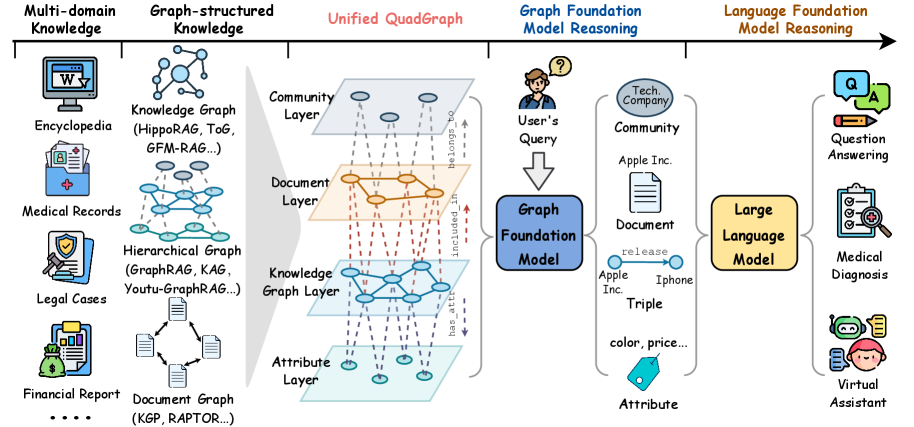
The image depicts a multi-stage pipeline for knowledge processing and model reasoning, structured as a horizontal flowchart with interconnected components. Key elements include knowledge representation layers, graph foundation models, and language model reasoning modules.
---
## Section 1: Multi-domain Knowledge Sources
**Labels and Components:**
- **Encyclopedia**: Represented by a computer icon with "W" symbol
- **Medical Records**: Depicted as a folder with medical cross symbol
- **Legal Cases**: Shown as a gavel and document stack
- **Financial Report**: Illustrated with a money bag and document
**Knowledge Graph Types:**
1. **Knowledge Graph**:
- Subtypes: HipoRAG, Tag, GFM-RAG
- Visual: Blue node clusters with interconnected lines
2. **Hierarchical Graph**:
- Subtypes: GraphRAG, KAG, YouTu-GraphRAG
- Visual: Tree-like structure with parent-child relationships
3. **Document Graph**:
- Subtypes: KGP, RAPTOR
- Visual: Circular node arrangement with bidirectional arrows
---
## Section 2: Graph-structured Knowledge Processing
**Unified Quadgraph Architecture:**
1. **Community Layer** (Blue):
- Nodes: Social network entities
- Connections: Dashed lines between nodes
2. **Document Layer** (Orange):
- Nodes: Text/document entities
- Connections: Solid lines with arrowheads
3. **Knowledge Graph Layer** (Yellow):
- Nodes: Conceptual knowledge entities
- Connections: Red dashed lines
4. **Attribute Layer** (Green):
- Nodes: Property-value pairs
- Connections: Dotted lines
**Key Connections:**
- Vertical dashed lines connect all layers
- Red arrows indicate cross-layer relationships
- Orange arrows show document-to-knowledge mapping
---
## Section 3: Graph Foundation Model Reasoning
**Input Components:**
- **User Query**: Illustrated with a person icon and question mark
- **Example Query**: "Apple Inc. iPhone release color price"
**Processing Flow:**
1. **Graph Foundation Model**:
- Takes multi-layer graph input
- Processes through attention mechanisms (implied by connecting lines)
2. **Output Structure**:
- **Community**: Apple Inc. (gray node)
- **Document**: Technical documentation (paper icon)
- **Attributes**:
- Release date
- Color options
- Price points
---
## Section 4: Language Foundation Model Reasoning
**Output Modules:**
1. **Question Answering**:
- Icon: Pencil + speech bubble
- Example: Medical diagnosis Q&A
2. **Medical Diagnosis**:
- Icon: Stethoscope + clipboard
- Visual: Checklist with magnifying glass
3. **Virtual Assistant**:
- Icon: Robot head + headset
- Features: Voice interaction capability
---
## Legend and Color Coding
**Spatial Grounding (Top Right):**
- **Blue**: Community Layer (Social entities)
- **Orange**: Document Layer (Text documents)
- **Yellow**: Knowledge Graph Layer (Concepts)
- **Green**: Attribute Layer (Properties)
**Verification Notes:**
- All node colors in diagram match legend exactly
- Connection types (dashed/solid/dotted) correspond to relationship strength
---
## Key Trends and Flow Analysis
1. **Knowledge Integration**:
- Multi-domain sources feed into unified graph structure
- Cross-layer connections enable semantic enrichment
2. **Model Progression**:
- Graph foundation model processes structured knowledge
- Language model handles natural language reasoning
3. **Output Diversity**:
- Supports multiple reasoning tasks (QA, diagnosis, assistance)
- Maintains attribute traceability through graph structure
---
## Missing Elements
- No numerical data or quantitative metrics present
- No explicit time-series or comparative analysis components
- All information is qualitative and structural in nature
---
## Technical Implications
1. **Knowledge Graph Fusion**:
- Combines heterogeneous data sources into unified structure
- Enables cross-domain reasoning capabilities
2. **Model Architecture**:
- Graph foundation model handles structured data
- Language model manages unstructured queries and outputs
3. **Application Scope**:
- Medical, legal, financial, and technical domains covered
- Supports both factual retrieval and analytical reasoning