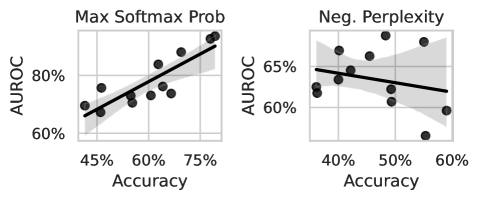
## Chart: Accuracy vs. AUROC for Max Softmax Probability and Negative Perplexity
### Overview
The image presents two scatter plots comparing accuracy against AUROC (Area Under the Receiver Operating Characteristic curve) for two different metrics: "Max Softmax Prob" and "Neg. Perplexity". Each plot shows data points representing the relationship between accuracy and AUROC, along with a regression line and a shaded area indicating the confidence interval.
### Components/Axes
**Left Plot: Max Softmax Prob**
* **Title:** Max Softmax Prob
* **X-axis:** Accuracy (labeled "Accuracy")
* Scale: 45% to 75%
* Markers: 45%, 60%, 75%
* **Y-axis:** AUROC (labeled "AUROC")
* Scale: 60% to 80%
* Markers: 60%, 80%
* **Data Points:** Black circles
* **Regression Line:** Black line with a positive slope.
* **Confidence Interval:** Shaded gray area around the regression line.
**Right Plot: Neg. Perplexity**
* **Title:** Neg. Perplexity
* **X-axis:** Accuracy (labeled "Accuracy")
* Scale: 40% to 60%
* Markers: 40%, 50%, 60%
* **Y-axis:** AUROC (labeled "AUROC")
* Scale: 60% to 65%
* Markers: 60%, 65%
* **Data Points:** Black circles
* **Regression Line:** Black line with a negative slope.
* **Confidence Interval:** Shaded gray area around the regression line.
### Detailed Analysis
**Left Plot: Max Softmax Prob**
* **Trend:** The AUROC generally increases as the accuracy increases.
* **Data Points:**
* At 45% Accuracy, AUROC is approximately 65%.
* At 60% Accuracy, AUROC is approximately 75%.
* At 75% Accuracy, AUROC is approximately 85%.
* **Regression Line:** The regression line visually confirms the positive correlation between accuracy and AUROC.
**Right Plot: Neg. Perplexity**
* **Trend:** The AUROC generally decreases as the accuracy increases.
* **Data Points:**
* At 40% Accuracy, AUROC is approximately 64%.
* At 50% Accuracy, AUROC is approximately 63%.
* At 60% Accuracy, AUROC is approximately 61%.
* **Regression Line:** The regression line visually confirms the negative correlation between accuracy and AUROC.
### Key Observations
* The "Max Softmax Prob" plot shows a positive correlation between accuracy and AUROC, suggesting that higher softmax probabilities are associated with better model performance.
* The "Neg. Perplexity" plot shows a negative correlation between accuracy and AUROC, suggesting that lower perplexity is associated with better model performance.
* The range of AUROC values is much larger in the "Max Softmax Prob" plot (60%-80%) compared to the "Neg. Perplexity" plot (60%-65%).
### Interpretation
The plots illustrate the relationship between accuracy and AUROC for two different metrics. The positive correlation in the "Max Softmax Prob" plot suggests that models with higher confidence in their predictions (as indicated by higher softmax probabilities) tend to perform better. Conversely, the negative correlation in the "Neg. Perplexity" plot suggests that models with lower perplexity (i.e., less uncertainty in their predictions) also tend to perform better. The different ranges of AUROC values indicate that "Max Softmax Prob" may be a more sensitive indicator of model performance than "Neg. Perplexity" in this context.