## Photograph: Mechanical/Electronic System Components
### Overview
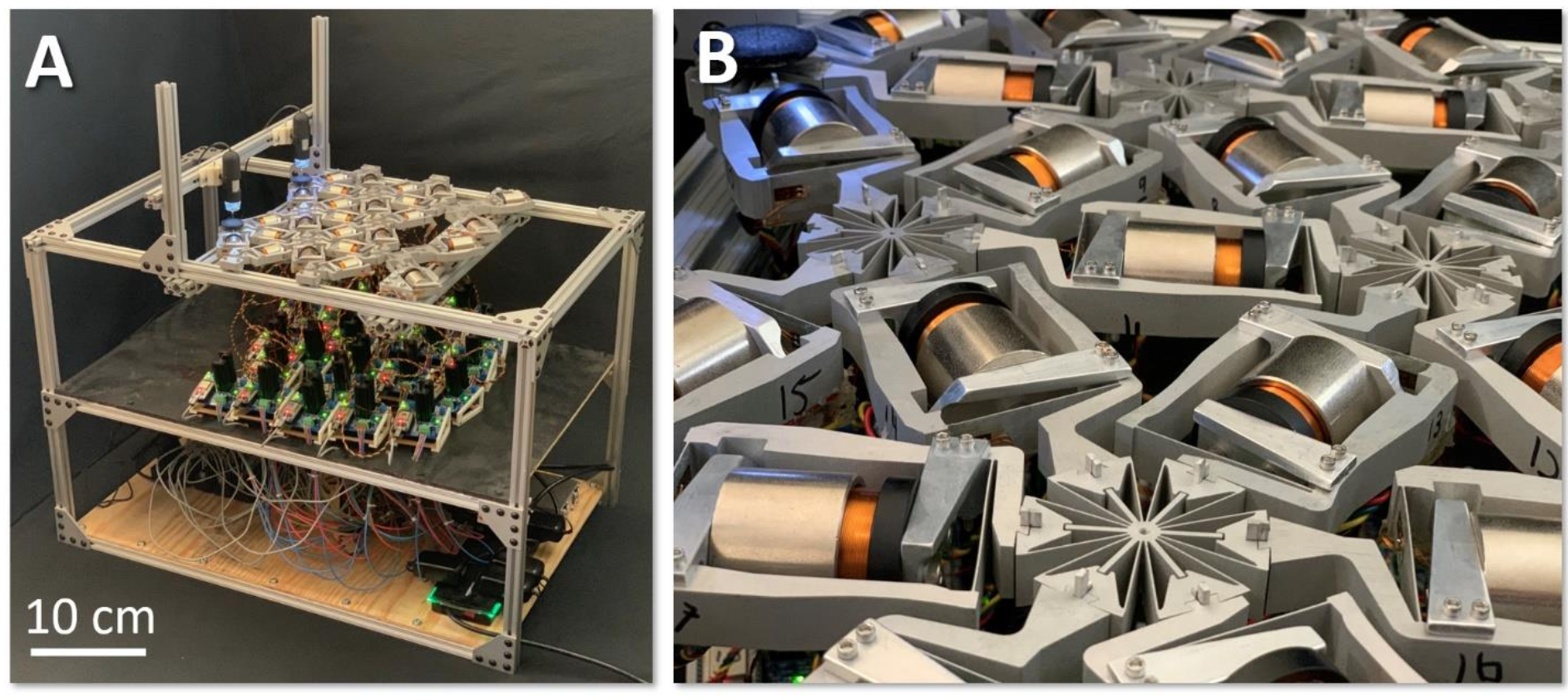
The image shows two views of a mechanical/electronic system. **Part A** displays a modular framework with electronic components, wiring, and a 10 cm scale. **Part B** reveals a dense array of cylindrical mechanical parts housed in geometric enclosures. No textual labels, legends, or axis markers are visible beyond the scale.
### Components/Axes
- **Part A**:
- **Structure**: Metal frame with three shelves.
- **Top Shelf**: Grid of small rectangular modules with protruding cylindrical elements (possibly actuators or sensors).
- **Middle Shelf**: Circuit boards with green/black components (likely microcontrollers or sensors).
- **Bottom Shelf**: Wooden base with tangled multicolored wires (red, blue, yellow) and black power supplies.
- **Scale**: "10 cm" label in bottom-left corner.
- **Part B**:
- **Components**: Cylindrical metallic objects (likely motors or actuators) with orange inner rings, housed in angular gray enclosures.
- **Arrangement**: Hexagonal/tessellated pattern with interlocking parts.
- **Details**: No visible labels, but components are numbered (e.g., "15", "13", "16") in black marker.
### Detailed Analysis
- **Part A**:
- The 10 cm scale provides spatial context for the system’s size.
- Wiring complexity suggests a distributed control system.
- No textual identifiers for components or modules.
- **Part B**:
- Components are uniformly designed with standardized mounting points.
- Numbers (e.g., "15", "13") may indicate part IDs or assembly sequence.
- Orange inner rings could denote bearings or seals.
### Key Observations
1. **No textual data**: Beyond the 10 cm scale, no labels, legends, or axis titles are present.
2. **Modular design**: Both parts emphasize repeatable, interconnected components.
3. **Ambiguity in function**: Without labels, the exact purpose of the system (e.g., robotics, automation) is inferred from component types.
### Interpretation
The system appears to be a prototype or testbed for mechanical/electronic integration. The modular design in **Part A** suggests scalability, while **Part B**’s dense arrangement implies mass production or dense sensor/actuator arrays. The absence of textual identifiers highlights a focus on visual or numerical coding (e.g., part numbers). The 10 cm scale anchors the system’s physical dimensions, critical for engineering documentation.
**Note**: No numerical data, trends, or categorical labels are extractable due to the lack of textual elements beyond the scale.