## Bar Chart: Probability Distribution
### Overview
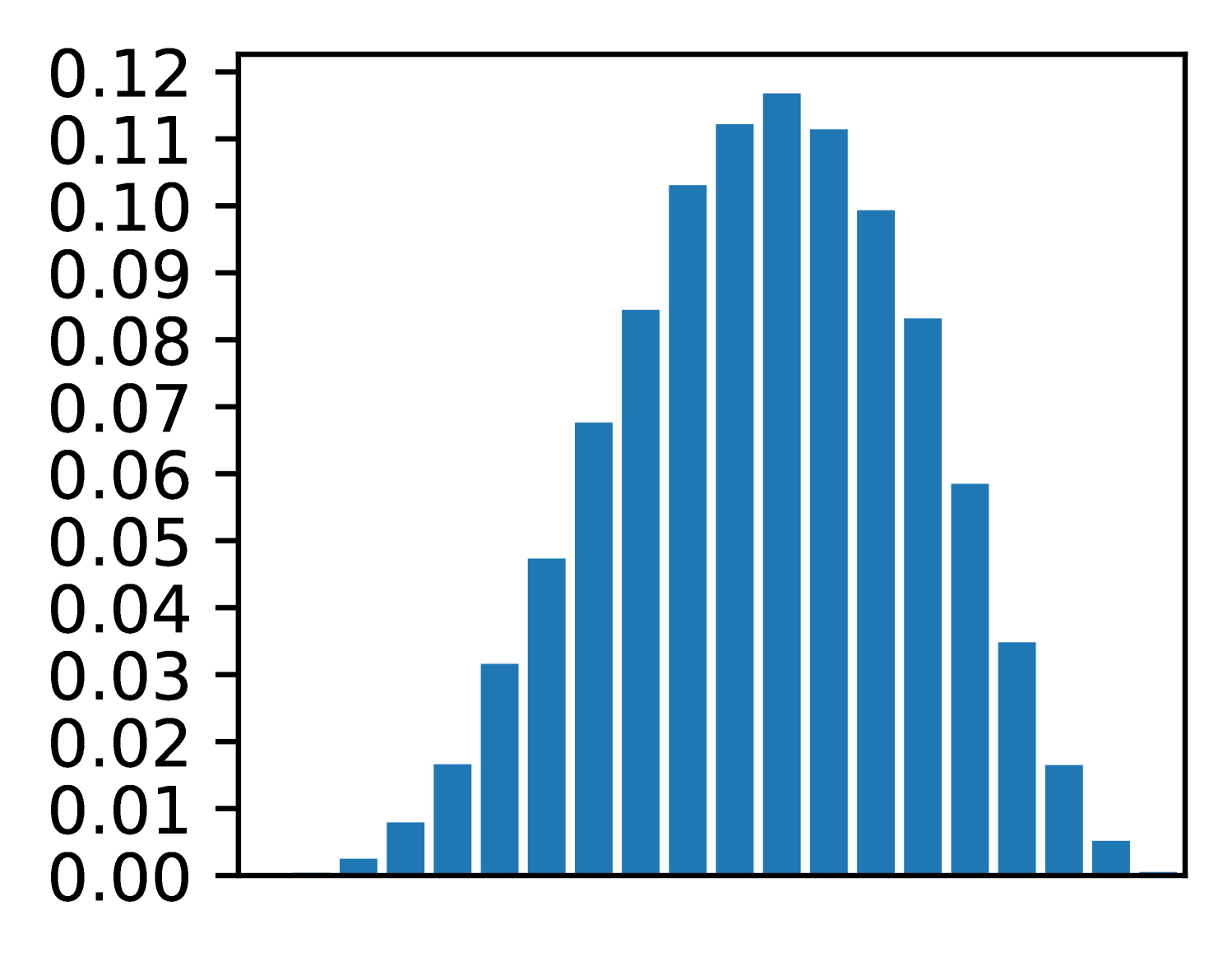
The image is a bar chart representing a probability distribution. The y-axis represents probability values ranging from 0.00 to 0.12. The x-axis is not explicitly labeled, but it represents discrete categories or values. The blue bars indicate the probability associated with each category. The distribution appears to be approximately normal or Gaussian.
### Components/Axes
* **Y-axis (Probability):** Ranges from 0.00 to 0.12, with increments of 0.01.
* 0.00
* 0.01
* 0.02
* 0.03
* 0.04
* 0.05
* 0.06
* 0.07
* 0.08
* 0.09
* 0.10
* 0.11
* 0.12
* **X-axis:** The x-axis is not labeled, but it represents discrete categories or values.
* **Bars:** Blue bars represent the probability associated with each category on the x-axis.
### Detailed Analysis
The bar heights, and therefore probabilities, are as follows (approximate due to visual estimation):
* Bar 1: ~0.002
* Bar 2: ~0.008
* Bar 3: ~0.016
* Bar 4: ~0.032
* Bar 5: ~0.048
* Bar 6: ~0.068
* Bar 7: ~0.084
* Bar 8: ~0.102
* Bar 9: ~0.112
* Bar 10: ~0.110
* Bar 11: ~0.100
* Bar 12: ~0.088
* Bar 13: ~0.070
* Bar 14: ~0.050
* Bar 15: ~0.035
* Bar 16: ~0.018
* Bar 17: ~0.008
* Bar 18: ~0.002
### Key Observations
* The distribution is centered around the 9th bar, which has the highest probability (~0.112).
* The probabilities decrease symmetrically as you move away from the center in either direction.
* The distribution is unimodal, with a single peak.
* The shape of the distribution resembles a normal distribution.
### Interpretation
The bar chart represents a discrete probability distribution, likely an approximation of a continuous distribution. The shape suggests that the underlying data might be normally distributed. The x-axis represents different possible outcomes or categories, and the height of each bar indicates the likelihood of that outcome occurring. The distribution is centered, meaning that outcomes near the center are more probable than those further away. The symmetry suggests that deviations from the center are equally likely in both directions.