## Complex Plane Diagram: Geometric Representation of Points on a Circle
### Overview
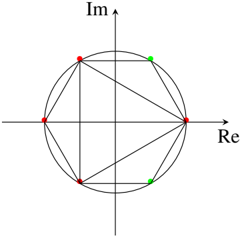
The image is a technical diagram plotted on a two-dimensional Cartesian coordinate system representing the complex plane. It features a circle centered at the origin, with several points marked on its circumference. These points are connected by straight lines, forming an inscribed geometric shape. The diagram is used to visualize relationships between complex numbers.
### Components/Axes
* **Axes:**
* **Horizontal Axis:** Labeled **"Re"** at the right end, representing the Real axis.
* **Vertical Axis:** Labeled **"Im"** at the top end, representing the Imaginary axis.
* The axes intersect at the origin (0,0), which is the center of the circle.
* **Circle:** A single circle is drawn, centered at the origin. Its radius is not explicitly labeled, but it is visually consistent with a unit circle (radius = 1).
* **Points:** There are six distinct points plotted on the circumference of the circle. They are marked with filled circles and are color-coded:
* **Red Points (4 total):**
1. At the intersection of the circle and the positive Real axis (rightmost point). Coordinates: (1, 0).
2. At the intersection of the circle and the negative Real axis (leftmost point). Coordinates: (-1, 0).
3. In the upper-left quadrant.
4. In the lower-left quadrant.
* **Green Points (2 total):**
1. In the upper-right quadrant.
2. In the lower-right quadrant.
* **Lines:** Straight lines connect the points, forming a closed, irregular hexagon. The connections create a star-like pattern within the circle. The specific connections are:
* The rightmost red point connects to the upper-left red point and the lower-left red point.
* The leftmost red point connects to the upper-right green point and the lower-right green point.
* The upper-left red point connects to the lower-left red point.
* The upper-right green point connects to the lower-right green point.
### Detailed Analysis
* **Spatial Grounding & Point Identification:**
* The **rightmost red point** is at the 0° position on the unit circle (1, 0).
* The **leftmost red point** is at the 180° position (-1, 0).
* The **upper-left red point** is at approximately 120° (cos(120°), sin(120°)) = (-0.5, √3/2 ≈ 0.866).
* The **lower-left red point** is at approximately 240° (cos(240°), sin(240°)) = (-0.5, -√3/2 ≈ -0.866).
* The **upper-right green point** is at approximately 60° (cos(60°), sin(60°)) = (0.5, √3/2 ≈ 0.866).
* The **lower-right green point** is at approximately 300° (cos(300°), sin(300°)) = (0.5, -√3/2 ≈ -0.866).
* **Geometric Pattern:** The lines connect points that are 120° apart on the circle, forming two interlocking equilateral triangles. One triangle is formed by the three red points at 0°, 120°, and 240°. The other triangle is formed by the points at 60°, 180°, and 300° (which includes the leftmost red point and the two green points). The color coding (red vs. green) appears to separate the vertices of these two distinct triangles.
### Key Observations
1. **Symmetry:** The diagram exhibits rotational symmetry of order 2 (180°). The pattern of points and lines looks identical if rotated 180° around the origin.
2. **Color Coding:** The use of red and green is deliberate and consistent. Red marks the vertices of one inscribed equilateral triangle (0°, 120°, 240°). Green marks two vertices of the second, rotated equilateral triangle (60°, 300°), with the third vertex of that triangle (180°) also colored red. This suggests the color may indicate a property other than pure geometric grouping, such as the sign of a real or imaginary component, or membership in a specific solution set.
3. **No Numerical Labels:** The axes have no tick marks or numerical scales beyond the implied unit circle. The analysis relies on visual estimation of angles and coordinates.
### Interpretation
This diagram is a classic representation of the **sixth roots of unity** plotted on the complex plane. The points correspond to the solutions of the equation \( z^6 = 1 \).
* The six points are: \( 1, e^{i\pi/3}, e^{i2\pi/3}, -1, e^{i4\pi/3}, e^{i5\pi/3} \).
* The lines connecting them illustrate the geometric relationships between these roots. Specifically, connecting every other root (a step of 2 in the sequence) forms two separate equilateral triangles, which is a fundamental property of the sixth roots.
* The color differentiation (red vs. green) likely separates the roots into two groups based on a specific criterion. A common interpretation is that the red points (0°, 120°, 180°, 240°) are the roots that are also **cube roots of unity** (solutions to \( z^3 = 1 \) and \( z^3 = -1 \)), while the green points (60°, 300°) are the remaining roots that are not cube roots. This is a Peircean investigative reading: the diagram doesn't just show six points; it visually argues for a deeper algebraic structure by highlighting a subset with a shared property.
* The absence of explicit numerical labels indicates the diagram's purpose is to convey conceptual and geometric relationships rather than precise computational data. It serves as a visual proof or aid for understanding the symmetry and grouping inherent in complex roots.