## Screenshot: Retro Arcade Game Interface
### Overview
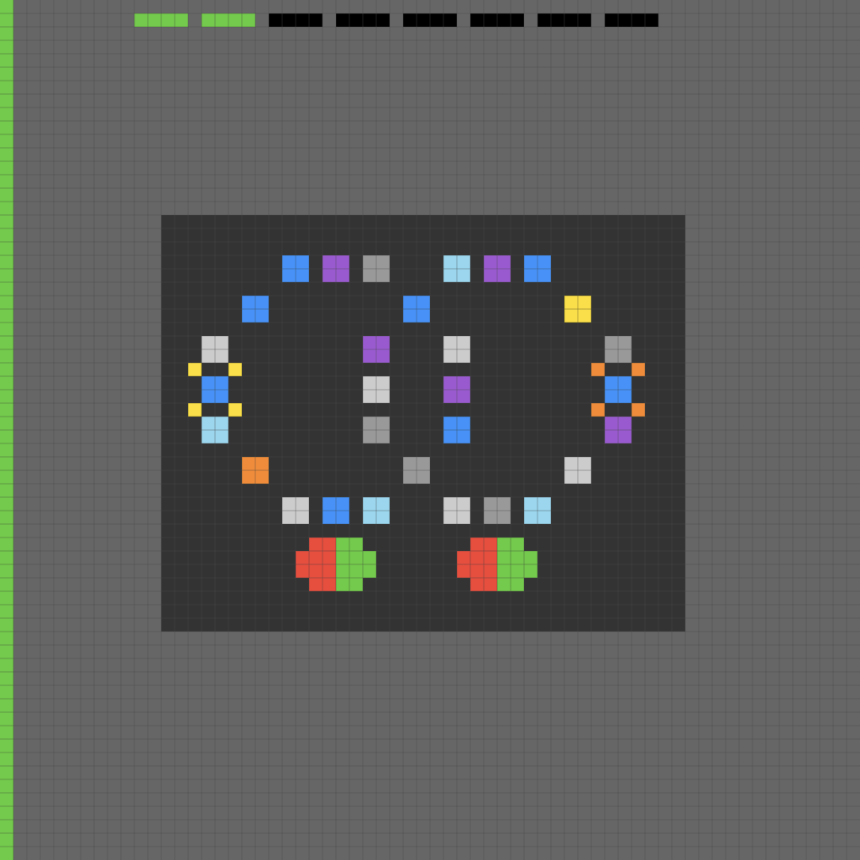
The image depicts a retro-style arcade game interface with a grid-based layout. The central focus is a symmetrical arrangement of colored blocks forming a pattern, a spaceship-like object at the bottom, and a score display at the top. The background is a dark gray grid, and the interface uses pixelated graphics typical of 1980s arcade games.
### Components/Axes
- **Grid**: A 10x10 matrix of squares (approximate) forming the play area.
- **Spaceship**: A red and green pixelated object positioned at the bottom center.
- **Blocks**: Colored squares (blue, purple, gray, yellow, orange, red, green) arranged in a symmetrical pattern.
- **Score Display**: Located in the top-left corner, showing "SCORE: 000000" and "LEVEL: 001".
- **Legend**: No explicit legend is present, but colors correspond to block types (e.g., red/green for the spaceship, blue/purple for blocks).
### Content Details
- **Score**: "000000" (no numerical value beyond the placeholder).
- **Level**: "001" (indicating the first level).
- **Block Pattern**: Symmetrical arrangement with alternating colors. The pattern includes:
- Blue, purple, and gray blocks forming a circular or spiral design.
- Yellow and orange blocks at the edges.
- Red and green blocks at the bottom (spaceship).
- **Spaceship**: Positioned centrally at the bottom, with a red and green color scheme.
### Key Observations
1. **Symmetry**: The block pattern is mirrored along the vertical axis, suggesting a puzzle or symmetry-based gameplay mechanic.
2. **Spaceship Placement**: The red/green spaceship is centered, likely the player-controlled object.
3. **Score/Level**: The score is at the starting value (000000), and the level is 001, indicating the game has just begun.
4. **Color Coding**: Blocks use distinct colors (blue, purple, gray, yellow, orange, red, green), but no legend explains their purpose.
### Interpretation
This image represents a classic arcade game setup, likely a puzzle or shooter game where the player interacts with the block pattern. The symmetrical design suggests the objective may involve matching, rotating, or destroying blocks. The spaceship’s position implies it may move horizontally to target blocks. The absence of a legend or instructions leaves the exact mechanics ambiguous, but the score and level indicators confirm progression tracking. The retro aesthetic and grid-based layout align with early arcade games like *Tetris* or *Breakout*, though the specific mechanics remain unclear without additional context.