\n
## Scatter Plot with Marginal Distributions: Clinical Knowledge Confidence vs. Target Length
### Overview
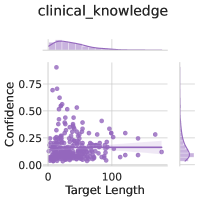
The image is a statistical visualization, specifically a scatter plot with marginal distribution histograms (or density plots), titled "clinical_knowledge". It displays the relationship between the confidence score of a model or system (y-axis) and the length of a target text or sequence (x-axis) for a dataset related to clinical knowledge. The plot reveals a dense cluster of data points at lower values for both variables, with a general trend of decreasing confidence as target length increases.
### Components/Axes
* **Title:** "clinical_knowledge" (centered at the top).
* **Y-Axis:**
* **Label:** "Confidence"
* **Scale:** Linear, ranging from 0.00 to 0.75, with major tick marks at 0.00, 0.25, 0.50, and 0.75.
* **X-Axis:**
* **Label:** "Target Length"
* **Scale:** Linear, ranging from 0 to approximately 200, with major tick marks at 0 and 100.
* **Data Series:** A single series of data points represented as small, semi-transparent purple circles. The transparency helps visualize density in overlapping areas.
* **Reference Line:** A faint, horizontal grey line is present at approximately y = 0.20, likely indicating a median, mean, or baseline confidence level.
* **Marginal Distributions:**
* **Top Plot:** A distribution (likely a histogram or kernel density estimate) for the "Target Length" variable. It is right-skewed, with the highest density near 0 and a long tail extending to the right.
* **Right Plot:** A distribution for the "Confidence" variable. It is left-skewed, with the highest density concentrated between 0.00 and 0.25, peaking near 0.1-0.2.
### Detailed Analysis
* **Data Point Distribution:** The vast majority of data points are densely clustered in the bottom-left quadrant of the plot. This corresponds to short target lengths (approximately 0 to 50) and low confidence scores (approximately 0.00 to 0.30).
* **Trend Verification:** There is a visible, general downward trend in the scatter plot. As the "Target Length" increases along the x-axis, the "Confidence" values on the y-axis tend to decrease. The cloud of points becomes sparser and generally lower for target lengths beyond 100.
* **Outliers:** A few scattered points exist with moderate to high confidence (0.40 - 0.70) even at longer target lengths (e.g., near 100 and 150). These are exceptions to the dominant trend.
* **Marginal Plot Details:**
* The **Target Length** distribution confirms the right skew: most targets are short, with frequency dropping off sharply as length increases.
* The **Confidence** distribution confirms the concentration of low scores: the peak is near the 0.1-0.2 range, aligning with the dense cluster in the main plot and the position of the horizontal reference line.
### Key Observations
1. **Inverse Relationship:** There is a clear, albeit noisy, inverse relationship between target length and confidence. Longer clinical knowledge targets are associated with lower confidence scores from the evaluated system.
2. **High-Density Cluster:** The system's performance is most frequently characterized by low confidence on short text sequences.
3. **Performance Ceiling:** Very few data points achieve confidence above 0.50, and none appear to reach 0.75, suggesting an upper limit to the system's confidence for this task.
4. **Reference Line Context:** The horizontal line at ~0.20 sits within the densest part of the confidence distribution, suggesting it may represent a typical or baseline confidence level for this dataset.
### Interpretation
This visualization suggests a fundamental challenge in the evaluated system's handling of clinical knowledge: **confidence degrades as the complexity or length of the target information increases.**
* **Possible Explanations:** The pattern could indicate that the model struggles with longer, more complex clinical statements, perhaps due to limitations in context window, reasoning over extended text, or the inherent difficulty of maintaining high confidence for detailed medical information. The dense cluster at low length/low confidence might represent very short, ambiguous, or highly specific snippets where the model is uncertain.
* **Outlier Significance:** The few high-confidence, long-target points are critical. They may represent well-established, formulaic clinical facts (e.g., standard dosages, clear diagnostic criteria) that the model can handle reliably despite their length. Analyzing these outliers could reveal what types of long-form clinical knowledge the system *can* process effectively.
* **Practical Implication:** For applications relying on this system (e.g., clinical decision support, information extraction), outputs involving longer text passages should be treated with lower inherent confidence. The results may warrant stricter verification or human review, especially for critical information. The plot provides a quantitative basis for setting confidence thresholds or flagging outputs based on target length.