\n
## Screenshot: Question and Answer Pairs
### Overview
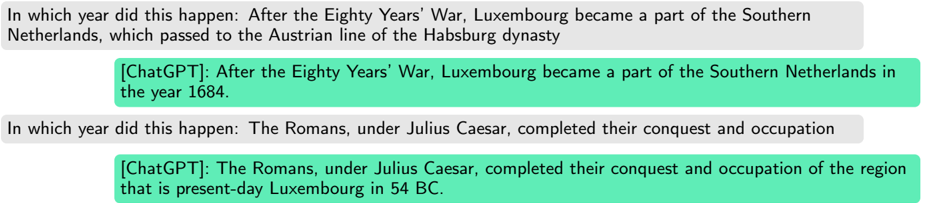
The image is a screenshot displaying two question-and-answer pairs, seemingly generated by a chatbot (identified as "[ChatGPT]"). Each pair consists of a user question in a light gray box and the corresponding ChatGPT response in a light green box.
### Components/Axes
There are no axes or traditional chart components. The screenshot is structured around question-answer blocks.
### Detailed Analysis or Content Details
**Pair 1:**
* **Question:** "In which year did this happen: After the Eighty Years' War, Luxembourg became a part of the Southern Netherlands, which passed to the Austrian line of the Habsburg dynasty"
* **ChatGPT Response:** "[ChatGPT]: After the Eighty Years' War, Luxembourg became a part of the Southern Netherlands in the year 1684."
**Pair 2:**
* **Question:** "In which year did this happen: The Romans, under Julius Caesar, completed their conquest and occupation"
* **ChatGPT Response:** "[ChatGPT]: The Romans, under Julius Caesar, completed their conquest and occupation of the region that is present-day Luxembourg in 54 BC."
### Key Observations
The responses provided by ChatGPT are direct answers to the questions posed. The responses include specific years: 1684 and 54 BC. The formatting is consistent across both pairs, with the question in a gray box and the answer in a green box, both clearly labeled with their source.
### Interpretation
The screenshot demonstrates a question-answering interaction with a chatbot. The chatbot successfully extracts the relevant year from the provided historical context in both cases. The use of "BC" indicates the chatbot understands and can handle dates before the Common Era. The responses are concise and directly address the questions, suggesting the chatbot is capable of understanding and processing historical information. The screenshot provides evidence of the chatbot's ability to provide factual information based on historical events.