\n
## Screenshot: Historical Q&A Chat Interface
### Overview
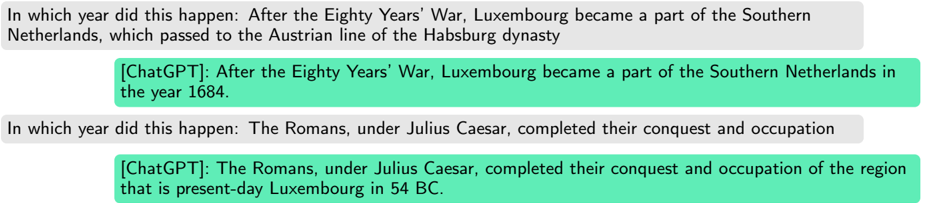
The image is a screenshot of a chat interface displaying two question-and-answer pairs. The questions pertain to historical events related to Luxembourg, and the answers are provided by an AI labeled "[ChatGPT]". The interface uses a simple, clean design with text bubbles.
### Components/Axes
* **Interface Elements:** The image shows a chat log with two distinct exchanges.
* **Visual Structure:**
* **Question Bubbles:** Light gray background, left-aligned text. They contain the user's query.
* **Answer Bubbles:** Light green background, left-aligned text. They are prefixed with the label "[ChatGPT]:".
* **Text Language:** All text in the image is in English.
### Content Details
**First Exchange:**
* **Question (Gray Bubble):** "In which year did this happen: After the Eighty Years' War, Luxembourg became a part of the Southern Netherlands, which passed to the Austrian line of the Habsburg dynasty"
* **Answer (Green Bubble):** "[ChatGPT]: After the Eighty Years' War, Luxembourg became a part of the Southern Netherlands in the year 1684."
**Second Exchange:**
* **Question (Gray Bubble):** "In which year did this happen: The Romans, under Julius Caesar, completed their conquest and occupation"
* **Answer (Green Bubble):** "[ChatGPT]: The Romans, under Julius Caesar, completed their conquest and occupation of the region that is present-day Luxembourg in 54 BC."
### Key Observations
1. **Format Consistency:** Both exchanges follow an identical visual and structural format.
2. **Content Focus:** Both questions are historical fact-based queries about the territory of modern-day Luxembourg.
3. **Answer Specificity:** The answers provide specific years (1684 AD and 54 BC) in response to the "In which year" prompt.
4. **Labeling:** The responding entity is explicitly labeled as "[ChatGPT]" in each answer bubble.
### Interpretation
This screenshot captures a specific interaction pattern with a large language model. The user is testing or querying the model's knowledge of historical chronology related to a specific geographic region (Luxembourg). The model's responses are direct and factual, providing the requested year for each event.
The first event (1684) refers to the post-war geopolitical reorganization of Europe, specifically the transfer of sovereignty following the Treaty of Nijmegen. The second event (54 BC) refers to the Roman conquest of Gaul under Julius Caesar, which included the area of modern Luxembourg. The accuracy of these dates would require verification against historical sources, but the model's responses demonstrate its ability to retrieve and present specific chronological data from its training corpus. The interface design is minimalist, focusing entirely on the text-based Q&A without additional metadata like timestamps or user identifiers.