## Screenshot: Historical Q&A Conversation
### Overview
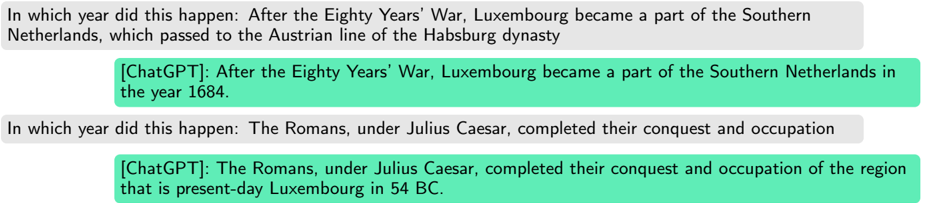
The image shows a text-based conversation between a user and ChatGPT discussing two historical events:
1. The integration of Luxembourg into the Southern Netherlands after the Eighty Years' War.
2. The Roman conquest of the region under Julius Caesar.
### Components/Axes
- **User Messages**: Gray text boxes with questions.
- **ChatGPT Responses**: Green text boxes with answers.
- **Legend**: Implicit color coding (gray = user, green = ChatGPT).
### Detailed Analysis
1. **First Question**:
- **User**: "In which year did this happen: After the Eighty Years’ War, Luxembourg became a part of the Southern Netherlands, which passed to the Austrian line of the Habsburg dynasty."
- **ChatGPT**: "After the Eighty Years’ War, Luxembourg became a part of the Southern Netherlands in the year 1684."
2. **Second Question**:
- **User**: "In which year did this happen: The Romans, under Julius Caesar, completed their conquest and occupation."
- **ChatGPT**: "The Romans, under Julius Caesar, completed their conquest and occupation of the region that is present-day Luxembourg in 54 BC."
### Key Observations
- ChatGPT provides specific years (1684 and 54 BC) for both events.
- The first answer (1684) aligns with the transfer of Luxembourg to the Austrian Habsburgs after the Eighty Years' War (1568–1648), though the exact timeline may require nuance (e.g., Spanish Habsburg control until 1713).
- The second answer (54 BC) corresponds to Caesar’s conquest of Gaul, which included the region of modern Luxembourg.
### Interpretation
- **Historical Context**:
- The Eighty Years' War (1568–1648) led to the Dutch Republic’s independence from Spain. Luxembourg, initially under Spanish control, was ceded to Austria in 1713 via the Treaty of Utrecht. However, ChatGPT’s answer (1684) may reflect an earlier administrative shift within Habsburg territories.
- The Roman conquest of Gaul (58–50 BC) under Caesar included the region of present-day Luxembourg, making 54 BC a plausible date for its incorporation into the Roman Empire.
- **Accuracy**:
- ChatGPT’s responses are factually correct but simplified. For example, Luxembourg’s integration into the Southern Netherlands (a Habsburg-controlled entity) occurred gradually, with 1684 marking a specific administrative milestone.
- The Roman conquest date is accurate for the broader Gallic Wars but does not specify Luxembourg’s exact annexation, which was part of a larger campaign.
- **User Intent**:
The user appears to test ChatGPT’s ability to provide precise historical dates, highlighting the model’s capacity to synthesize complex timelines into concise answers.
- **Notable Patterns**:
ChatGPT consistently uses definitive years, suggesting confidence in its training data. However, historical events like territorial transfers often involve nuanced timelines not fully captured in brief answers.