## Code Snippet: Quadratic Reciprocity Theorem
### Overview
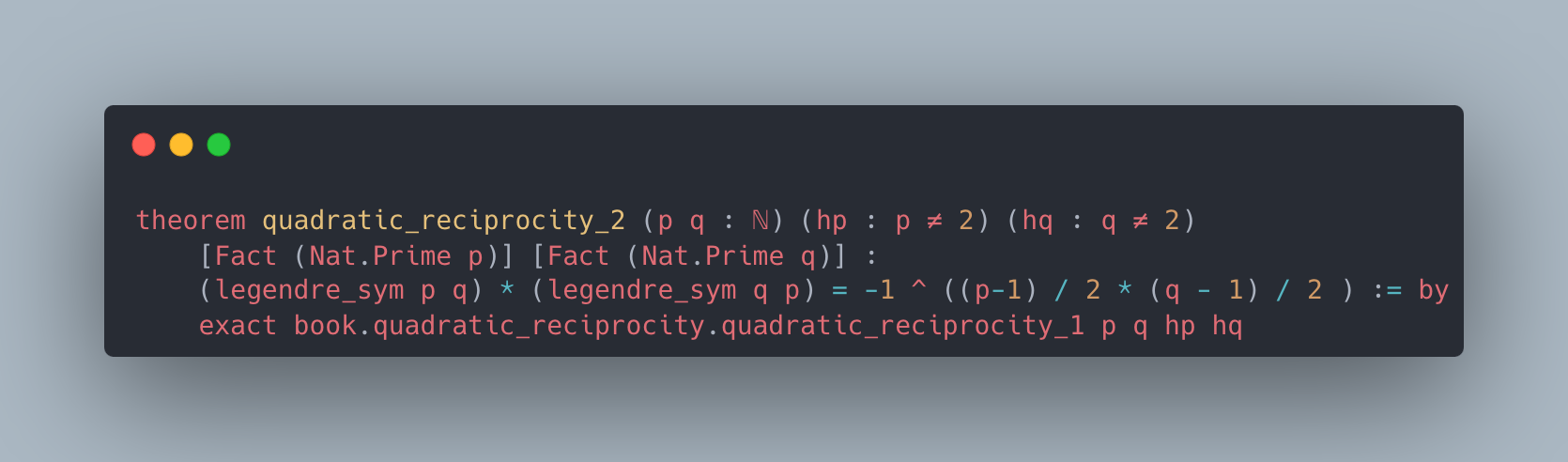
The image is a screenshot of a code snippet, likely from a formal verification system or proof assistant. It defines and proves the quadratic reciprocity theorem.
### Components/Axes
The code snippet includes the following elements:
- **Theorem Declaration:** `theorem quadratic_reciprocity_2`
- **Variables:** `p`, `q` of type `N` (likely natural numbers)
- **Hypotheses:** `hp : p ≠ 2`, `hq : q ≠ 2` (p and q are not equal to 2)
- **Facts:** `Fact (Nat.Prime p)`, `Fact (Nat.Prime q)` (p and q are prime numbers)
- **Equation:** `(legendre_sym p q) * (legendre_sym q p) = -1^((p-1) / 2 * (q - 1) / 2 )`
- **Proof Strategy:** `:= by exact book.quadratic_reciprocity.quadratic_reciprocity_1 p q hp hq`
### Detailed Analysis or ### Content Details
The code defines the quadratic reciprocity theorem, which relates the Legendre symbols `(legendre_sym p q)` and `(legendre_sym q p)`. The theorem states that the product of these symbols is equal to -1 raised to the power of `((p-1) / 2 * (q - 1) / 2 )`. The proof is provided by referencing a pre-existing proof in the `book.quadratic_reciprocity` library.
### Key Observations
- The code uses a formal language for defining mathematical theorems and proofs.
- The theorem is stated in terms of Legendre symbols and prime numbers.
- The proof relies on an existing, verified proof.
### Interpretation
The code snippet demonstrates the formalization of a mathematical theorem (quadratic reciprocity) within a proof assistant or formal verification system. This allows for rigorous verification of mathematical statements and ensures their correctness. The use of existing libraries and proofs promotes code reuse and simplifies the verification process. The theorem relates the Legendre symbols, which are used to determine whether a number is a quadratic residue modulo a prime.