\n
## Screenshot: Code Snippet - Quadratic Reciprocity Theorem
### Overview
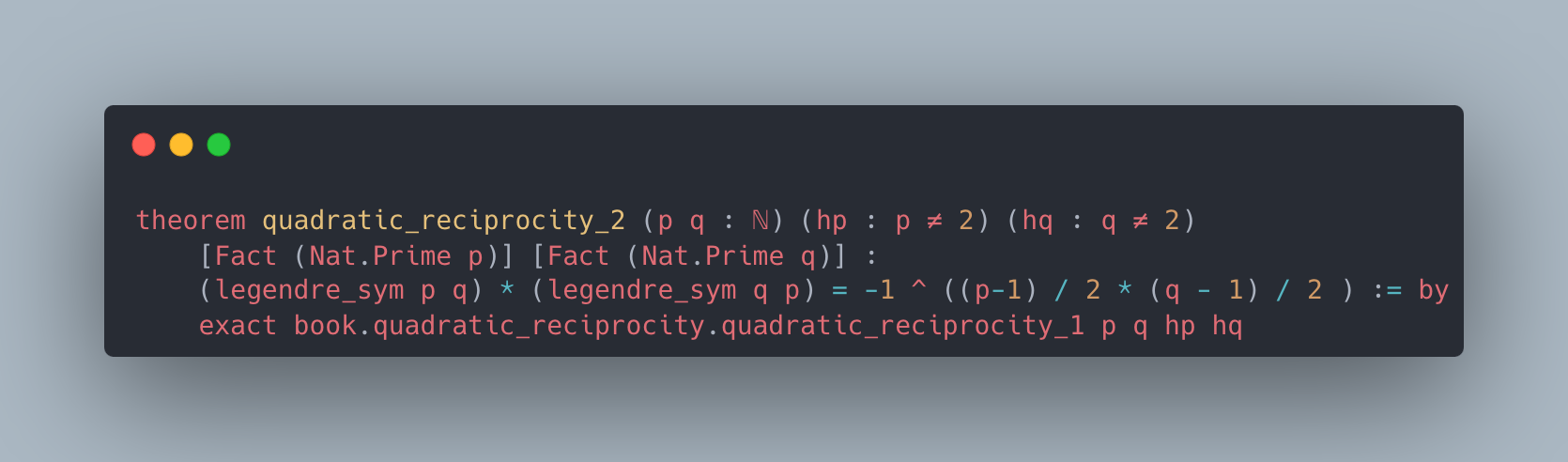
The image is a screenshot of a terminal window displaying a code snippet, likely from a formal proof assistant system (such as Coq or Lean). The code defines a theorem related to quadratic reciprocity. The background is a dark teal color. There are three colored dots in the top-left corner: red, yellow, and green.
### Components/Axes
There are no axes or traditional chart components. The screenshot consists of a single block of text representing the code. The colored dots in the top-left corner do not appear to be part of the code itself, but rather indicators of the terminal or environment.
### Detailed Analysis or Content Details
The code snippet defines a theorem named `quadratic_reciprocity_2`. Here's a transcription of the code:
```
theorem quadratic_reciprocity_2 (p q : ℕ) (hp : p ≠ 2) (hq : q ≠ 2)
[Fact (Nat.Prime p)] [Fact (Nat.Prime q)] :
(legendre_sym p q) * (legendre_sym q p) = -1 ^ ((p-1) / 2 * (q - 1) / 2) := by
exact book.quadratic_reciprocity.quadratic_reciprocity_1 p q hp hq
```
Let's break down the code:
* `theorem quadratic_reciprocity_2 (p q : ℕ) (hp : p ≠ 2) (hq : q ≠ 2)`: This line declares a theorem named `quadratic_reciprocity_2` that takes two natural numbers `p` and `q` as input, along with two hypotheses `hp` and `hq`. The hypotheses state that `p` and `q` are not equal to 2.
* `[Fact (Nat.Prime p)] [Fact (Nat.Prime q)]`: These are type class instances, indicating that `p` and `q` are assumed to be prime numbers. `Nat.Prime` likely refers to a predicate or type class that asserts primality.
* `(legendre_sym p q) * (legendre_sym q p) = -1 ^ ((p-1) / 2 * (q - 1) / 2)`: This is the core statement of the theorem. It states that the product of the Legendre symbols (p/q) and (q/p) is equal to -1 raised to the power of ((p-1)/2 * (q-1)/2). The Legendre symbol (a/p) is 1 if a is a quadratic residue modulo p, -1 if a is a quadratic non-residue modulo p, and 0 if a is divisible by p.
* `:= by exact book.quadratic_reciprocity.quadratic_reciprocity_1 p q hp hq`: This line provides the proof of the theorem. `exact` indicates that the theorem is proven by directly applying a previously proven lemma or theorem. In this case, it's applying `quadratic_reciprocity_1` from the `book.quadratic_reciprocity` module, passing `p`, `q`, `hp`, and `hq` as arguments.
### Key Observations
The code snippet represents a formal statement and proof of the quadratic reciprocity theorem, a fundamental result in number theory. The use of type classes (`Nat.Prime`) and a formal proof assistant suggests a high level of rigor and precision.
### Interpretation
The code snippet demonstrates a formalization of a mathematical theorem within a proof assistant environment. The theorem itself, quadratic reciprocity, relates the solvability of quadratic congruences. The code's structure highlights the importance of precise definitions, hypotheses, and a rigorous proof strategy. The `exact` keyword suggests that the proof relies on a previously established result, indicating a modular approach to theorem proving. The use of a "book" module suggests a library of pre-proven theorems and lemmas. The colored dots in the top-left corner are likely status indicators for the terminal or environment, but are not directly related to the mathematical content.