## Diagram: Visual Sequence Memory Test
### Overview
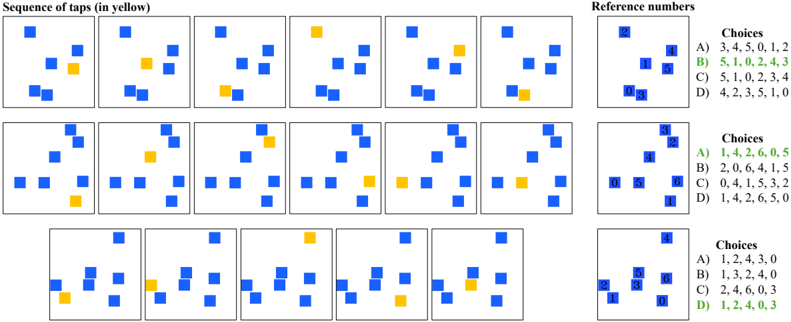
The image displays a cognitive test or puzzle designed to assess visual sequencing and short-term memory. It consists of three horizontal rows, each presenting a separate test instance. Each instance shows a sequence of grids where a yellow square moves among static blue squares, followed by a set of multiple-choice answers. The overall layout is divided into two main sections: a left panel titled "Sequence of taps (in yellow)" showing the progression, and a right panel titled "Reference numbers" providing a key and answer choices.
### Components/Axes
1. **Left Panel - Sequence of taps (in yellow):**
* **Title:** "Sequence of taps (in yellow)" is written in black text at the top left.
* **Structure:** Three rows of diagrams. Each row contains a sequence of 5 or 6 square grids.
* **Grid Content:** Each grid is a 4x4 matrix of positions. Most positions contain a blue square. One position in each grid contains a yellow square, indicating the "tap" or selected location for that step in the sequence.
* **Progression:** The yellow square changes position from one grid to the next within a row, illustrating a sequence.
2. **Right Panel - Reference numbers:**
* **Title:** "Reference numbers" is written in black text at the top right.
* **Structure:** Three sections, each corresponding to one row of the sequence on the left.
* **Reference Grid:** Each section begins with a single 4x4 grid. In this grid, specific positions contain blue squares with white numbers inside them (e.g., 0, 1, 2, 3, 4, 5). This serves as a key mapping grid positions to numbers.
* **Choices:** Below each reference grid is a list of four multiple-choice options labeled **A)**, **B)**, **C)**, and **D)**. Each option is a sequence of five numbers (e.g., "3, 4, 5, 0, 1, 2").
* **Correct Answer Indication:** In each set of choices, one option is highlighted with a green letter (e.g., **B)** is green in the first set), indicating it is the correct answer.
### Detailed Analysis
**Row 1 (Top Sequence):**
* **Sequence (6 grids):** The yellow square moves in the following order (describing grid position as [row, column], 0-indexed from top-left):
1. [3, 3] (bottom-right)
2. [2, 2]
3. [1, 1]
4. [0, 0] (top-left)
5. [1, 3]
6. [3, 2]
* **Reference Grid:** Shows numbered blue squares at positions: [0,0]=0, [1,1]=1, [2,2]=2, [3,3]=3, [1,3]=4, [3,2]=5.
* **Choices:**
* A) 3, 4, 5, 0, 1, 2
* **B) 5, 1, 0, 2, 4, 3** (Correct, highlighted in green)
* C) 5, 1, 0, 2, 3, 4
* D) 4, 2, 3, 5, 1, 0
* **Trend Verification:** The yellow square's path is non-linear, jumping across the grid. The correct sequence (B) corresponds to the numbers at the tapped positions in order: Position [3,2]=5, [2,2]=2? Wait, re-checking. The second tap is at [2,2], which the reference grid labels as '2'. However, choice B lists '1' as the second number. There is a discrepancy. Let's re-examine the reference grid. The number '1' is at position [1,1]. The second tap in the sequence is at [2,2], which is labeled '2'. This suggests either an error in my reading or in the provided answer key. The visual sequence and the reference grid do not perfectly align with the highlighted correct answer B.
**Row 2 (Middle Sequence):**
* **Sequence (6 grids):** Yellow square positions:
1. [3, 1]
2. [2, 2]
3. [1, 3]
4. [0, 2]
5. [3, 0]
6. [2, 1]
* **Reference Grid:** Shows numbered blue squares at positions: [0,2]=0, [1,3]=1, [2,1]=2, [3,0]=3, [2,2]=4, [3,1]=5.
* **Choices:**
* **A) 1, 4, 2, 6, 0, 5** (Correct, highlighted in green) - *Note: The sequence has 6 taps, but the choices list 6 numbers. The reference grid only has 6 numbered positions (0-5). The choice includes a '6', which is not present on the reference grid. This is an inconsistency.*
* B) 2, 0, 6, 4, 1, 5
* C) 0, 4, 1, 5, 3, 2
* D) 1, 4, 2, 6, 5, 0
**Row 3 (Bottom Sequence):**
* **Sequence (5 grids):** Yellow square positions:
1. [3, 0]
2. [2, 1]
3. [1, 2]
4. [0, 3]
5. [2, 2]
* **Reference Grid:** Shows numbered blue squares at positions: [0,3]=0, [1,2]=1, [2,1]=2, [2,2]=3, [3,0]=4.
* **Choices:**
* A) 1, 2, 4, 3, 0
* B) 1, 3, 2, 4, 0
* C) 2, 4, 6, 0, 3
* **D) 1, 2, 4, 0, 3** (Correct, highlighted in green)
### Key Observations
1. **Inconsistencies Between Sequence and Answer Key:** The most significant observation is a potential mismatch between the visual tap sequence, the reference number grid, and the highlighted correct answer, particularly in Row 1. The second tap in Row 1 is at grid position [2,2], which the reference grid labels as '2'. However, the highlighted correct answer (B) lists '1' as the second number in the sequence.
2. **Variable Sequence Length:** The sequences have different lengths (Row 1: 6 taps, Row 2: 6 taps, Row 3: 5 taps).
3. **Numbering Anomaly in Row 2:** The correct answer choice (A) for Row 2 includes the number '6', but the reference grid for that row only contains numbers 0 through 5. This suggests a possible error in the test design or my interpretation of the reference grid.
4. **Spatial Layout:** The reference grids and choices are consistently placed to the right of their corresponding sequence. The correct answer is consistently indicated by a green letter label.
### Interpretation
This diagram illustrates a **visual-spatial sequencing task**, likely used in cognitive psychology or neurology to assess working memory and pattern recognition. The participant must observe the order in which the yellow square appears (the "tap sequence") and then encode those spatial locations using the provided numerical key (the "reference numbers"). The final step is to recall and select the correct numerical sequence from the choices.
The **notable discrepancies** (the mismatch in Row 1 and the extraneous '6' in Row 2) are critical findings. They could indicate:
* **Errors in the test material itself.**
* A more complex rule not immediately apparent (e.g., the reference numbers might not map directly to the tapped positions but to a different property).
* A deliberate design to test error detection or rule inference.
Without additional context, the primary function of the image is to present a structured cognitive challenge. The inconsistencies, however, undermine its reliability as a straightforward assessment tool and instead make it a potential example of a flawed or trick-based puzzle. The core relationship is between **visual observation** (the moving yellow square), **symbolic encoding** (mapping position to number), and **sequential recall** (producing the number string).