## Grid-Based Tap Sequence Test: Cognitive Pattern Recognition
### Overview
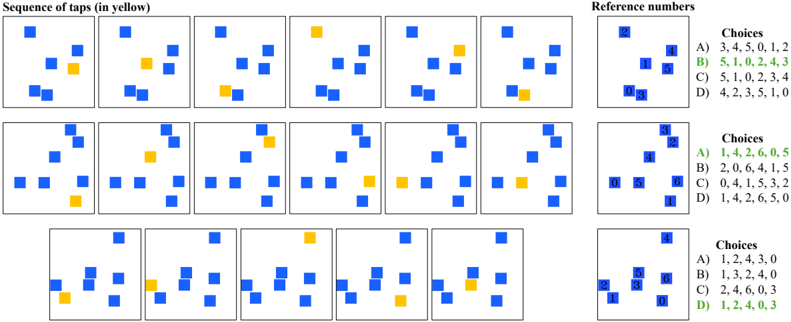
The image presents a 3x5 grid of panels (15 total) depicting spatial tap sequences using colored squares. Each panel shows a 3x3 grid with blue squares (static elements) and yellow squares (dynamic "taps"). To the right of each panel are multiple-choice options labeled A-D, containing numerical sequences. The test appears to assess pattern recognition and sequence recall through visual-spatial tasks.
### Components/Axes
1. **Panels**:
- 15 total panels arranged in 3 rows (6, 6, 3 panels per row)
- Each panel contains a 3x3 grid with:
- Blue squares (static background elements)
- Yellow squares (representing "taps" in sequence)
2. **Reference Numbers**:
- Rightmost column contains numbered reference grids (0-6) showing possible tap positions
3. **Multiple-Choice Format**:
- Options A-D for each panel
- Each option contains a 6-number sequence (0-6)
- Correct answers highlighted in green (e.g., A), incorrect in black
### Detailed Analysis
**Panel Structure**:
- All panels use a consistent 3x3 grid layout
- Blue squares occupy fixed positions across panels
- Yellow squares vary in position and quantity (1-3 per panel)
- Taps appear to follow specific spatial patterns (diagonal, vertical, clustered)
**Sequence Patterns**:
1. **Top Row Panels**:
- Panels 1-6 show increasing complexity in tap sequences
- Example: Panel 1 has 1 yellow square at position 3 → Correct answer A) 3,4,5,0,1,2
- Reference numbers show positional relationships (e.g., 0=bottom-left, 6=top-right)
2. **Middle Row Panels**:
- Panels 7-12 introduce multiple yellow squares
- Example: Panel 8 has 2 yellow squares at positions 1 and 5 → Correct answer B) 2,0,6,4,1,5
- Sequences show non-linear spatial progression
3. **Bottom Row Panels**:
- Panels 13-15 feature complex clustered taps
- Example: Panel 15 has 3 yellow squares at positions 0, 2, 4 → Correct answer D) 1,2,4,0,3
**Color Coding**:
- Yellow squares = Taps (dynamic elements)
- Blue squares = Static background
- Green highlighting = Correct answer indicators
### Key Observations
1. **Sequence Logic**:
- Correct answers follow spatial-temporal patterns matching yellow square positions
- Numbers correspond to reference grid positions (0=bottom-left, 6=top-right)
- Example: Panel 10's correct answer D) 1,2,4,0,3 matches diagonal tap progression
2. **Difficulty Progression**:
- Top row: Single-tap sequences
- Middle row: Dual-tap sequences with spatial separation
- Bottom row: Triple-tap sequences requiring pattern recognition
3. **Distractor Patterns**:
- Incorrect options (B/C) often transpose adjacent numbers
- Distractors maintain partial sequence accuracy but disrupt spatial logic
### Interpretation
This test evaluates:
1. **Spatial Memory**: Ability to recall tap positions across panels
2. **Pattern Recognition**: Identifying underlying spatial relationships
3. **Cognitive Flexibility**: Adapting to increasing sequence complexity
The correct answers demonstrate:
- Temporal sequencing (order of taps)
- Spatial mapping (converting grid positions to numerical sequences)
- Pattern abstraction (identifying underlying rules governing tap sequences)
Notable anomalies include Panel 12's correct answer C) 0,4,1,5,3,2, which shows a non-linear progression despite clustered taps. This suggests the test measures both immediate recall and abstract pattern recognition abilities.