## Diagram: Symbolic Long-Term Memories and Working Memory
### Overview
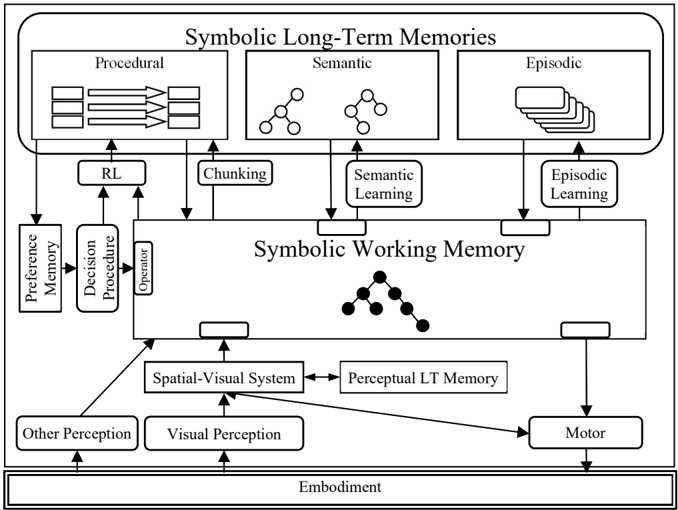
The image is a block diagram illustrating the relationships between different types of symbolic long-term memories (Procedural, Semantic, Episodic) and symbolic working memory, along with other components like perception, motor control, and embodiment. The diagram shows the flow of information and processes between these components.
### Components/Axes
* **Title:** Symbolic Long-Term Memories
* **Long-Term Memories:**
* Procedural
* Semantic
* Episodic
* **Working Memory:** Symbolic Working Memory
* **Other Components:**
* RL (Reinforcement Learning)
* Chunking
* Semantic Learning
* Episodic Learning
* Preference Memory
* Decision Procedure
* Operator
* Spatial-Visual System
* Perceptual LT Memory
* Other Perception
* Visual Perception
* Motor
* Embodiment
### Detailed Analysis
* **Symbolic Long-Term Memories:** This section is at the top of the diagram and contains three sub-sections:
* **Procedural:** Contains a visual representation of three stacks of data or rules, with arrows indicating flow.
* **Semantic:** Contains two tree-like structures, representing semantic networks.
* **Episodic:** Contains a stack of cards or pages, representing episodic memories.
* **Symbolic Working Memory:** Located in the center of the diagram, it receives input from various sources and interacts with long-term memories. It contains a tree-like structure similar to the Semantic memory, but with some nodes filled in black.
* **RL (Reinforcement Learning):** Connected to the Procedural memory and the Symbolic Working Memory.
* **Chunking:** Connects the Procedural memory to the Symbolic Working Memory.
* **Semantic Learning:** Connects the Semantic memory to the Symbolic Working Memory.
* **Episodic Learning:** Connects the Episodic memory to the Symbolic Working Memory.
* **Preference Memory and Decision Procedure:** These are connected in series, with Preference Memory feeding into Decision Procedure, which then feeds into the Symbolic Working Memory via the "Operator".
* **Spatial-Visual System:** Connected to the Symbolic Working Memory and the Perceptual LT Memory.
* **Perceptual LT Memory:** Connected to the Spatial-Visual System and the Motor component.
* **Other Perception and Visual Perception:** Both feed into the Spatial-Visual System.
* **Motor:** Receives input from the Perceptual LT Memory.
* **Embodiment:** Located at the bottom of the diagram, encompassing the entire system.
### Key Observations
* The diagram emphasizes the interaction between long-term and working memory.
* Perception (Visual and Other) feeds into the Spatial-Visual System, which then interacts with Working Memory.
* The Motor component is influenced by Perceptual LT Memory, suggesting a link between perception and action.
* The "Embodiment" label suggests that the entire system is grounded in a physical body or environment.
### Interpretation
The diagram represents a cognitive architecture, illustrating how different memory systems and cognitive processes interact. It suggests a flow of information from perception to working memory, then to long-term memory, and finally to action via the motor system. The presence of "RL," "Chunking," "Semantic Learning," and "Episodic Learning" indicates that the system is capable of learning and adapting over time. The "Embodiment" label highlights the importance of physical interaction with the environment in shaping cognition. The diagram implies a hierarchical structure, with long-term memories providing a foundation for working memory, which in turn drives action. The diagram does not provide specific data or numerical values, but rather a conceptual framework for understanding the relationships between different cognitive components.