\n
## Diagram: Cognitive Architecture Model
### Overview
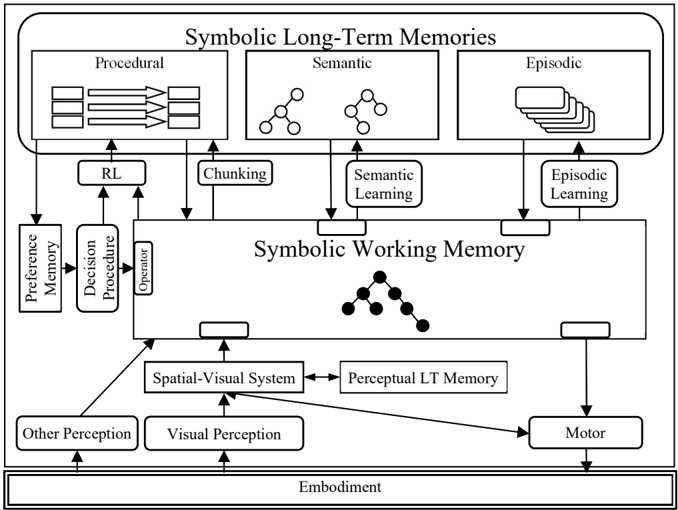
The image depicts a cognitive architecture model illustrating the interaction between different memory systems, perceptual systems, and motor control. It's a block diagram showing information flow between various cognitive components. The diagram is grayscale.
### Components/Axes
The diagram is organized into three main sections: Symbolic Long-Term Memories (top), Symbolic Working Memory (center), and Embodiment (bottom). Key components include:
* **Symbolic Long-Term Memories:** Procedural, Semantic, Episodic
* **Symbolic Working Memory:** Contains a network of nodes.
* **Embodiment:** Includes Other Perception, Visual Perception, and Motor.
* **Perceptual Systems:** Spatial-Visual System, Perceptual LT Memory
* **Processes:** RL (Reinforcement Learning), Chunking, Semantic Learning, Episodic Learning, Preference Memory, Decision Procedure, Operator.
There are no explicit axes or scales in this diagram. The relationships are shown through arrows indicating information flow.
### Detailed Analysis or Content Details
**Symbolic Long-Term Memories:**
* **Procedural Memory:** Represented by stacks of books.
* **Semantic Memory:** Represented by interconnected nodes.
* **Episodic Memory:** Represented by stacks of papers.
**Symbolic Working Memory:**
* A network of interconnected nodes.
**Embodiment:**
* **Other Perception:** A rectangular block.
* **Visual Perception:** A rectangular block.
* **Motor:** A rectangular block.
**Information Flow:**
* **Preference Memory** sends information to **Decision Procedure** and **Operator**.
* **Decision Procedure** and **Operator** send information to **Symbolic Working Memory**.
* **RL** connects **Procedural Memory** to **Symbolic Working Memory**.
* **Chunking** connects **Symbolic Working Memory** to **Semantic Memory**.
* **Semantic Learning** connects **Symbolic Working Memory** to **Semantic Memory**.
* **Episodic Learning** connects **Symbolic Working Memory** to **Episodic Memory**.
* **Spatial-Visual System** receives input from **Visual Perception** and sends information to **Symbolic Working Memory** and **Perceptual LT Memory**.
* **Perceptual LT Memory** sends information to **Symbolic Working Memory**.
* **Motor** receives input from **Symbolic Working Memory**.
* **Other Perception** sends information to **Symbolic Working Memory**.
### Key Observations
* The diagram emphasizes the interconnectedness of different memory systems and perceptual processes.
* The Symbolic Working Memory appears to be a central hub for information processing.
* The diagram does not provide quantitative data or specific values. It is a qualitative representation of cognitive architecture.
* The diagram uses visual metaphors (books for procedural memory, nodes for semantic memory) to represent abstract cognitive concepts.
### Interpretation
This diagram illustrates a cognitive architecture, likely representing a model of how the human mind processes information. The separation into long-term memories, working memory, and embodiment suggests a modular approach to cognition. The flow of information between these modules highlights the dynamic nature of cognitive processing.
The diagram suggests that perception (both visual and other) feeds into working memory, which then interacts with long-term memories to generate actions via the motor system. The presence of learning mechanisms (RL, Chunking, Semantic Learning, Episodic Learning) indicates that the system is capable of adapting and improving over time.
The use of visual metaphors is a common practice in cognitive science to make complex concepts more accessible. The diagram is a high-level overview and does not delve into the specific algorithms or mechanisms underlying these processes. It's a conceptual model rather than a detailed implementation. The diagram is a representation of a theoretical framework, and its validity would depend on empirical evidence supporting the proposed relationships between the different components.