## Diagram: Cognitive Architecture with Memory Systems and Perception-Motor Integration
### Overview
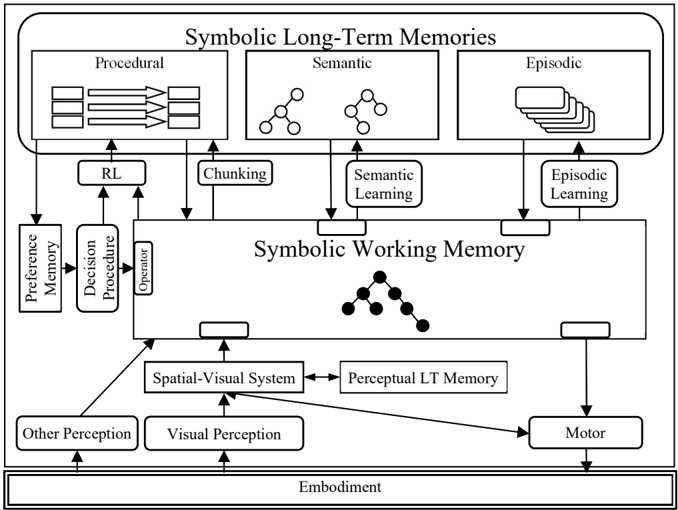
The diagram illustrates a hierarchical cognitive architecture integrating symbolic long-term memory systems, working memory, perceptual processing, and motor output. It emphasizes interactions between memory types (procedural, semantic, episodic), learning mechanisms, and real-time perceptual-motor coordination.
### Components/Axes
1. **Top Section**:
- **Symbolic Long-Term Memories** (boxed header)
- **Procedural**: Rectangular blocks with bidirectional arrows (symbolizing rule-based processes).
- **Semantic**: Network of interconnected circles (conceptual relationships).
- **Episodic**: Stacked rectangles (sequential event storage).
2. **Middle Section**:
- **Symbolic Working Memory**: Central hub with a network of interconnected nodes (active information processing).
- **Key Processes**:
- **RL (Reinforcement Learning)**: Arrows from Procedural Memory to Working Memory.
- **Chunking**: Arrows from Semantic Learning to Working Memory.
- **Semantic Learning**: Arrows from Semantic Memory to Working Memory.
- **Episodic Learning**: Arrows from Episodic Memory to Working Memory.
3. **Lower Section**:
- **Spatial-Visual System**: Connects to **Perceptual LT Memory** (long-term perceptual storage) and **Motor** (output).
- **Input Streams**:
- **Other Perception** and **Visual Perception** feed into the Spatial-Visual System.
- **Embediment**: Bottom-most layer (foundational sensory integration).
4. **Additional Elements**:
- **Preference Memory** → **Decision Procedure** → **Operator** (decision-making pathway).
- **Perceptual LT Memory** ↔ **Spatial-Visual System** (bidirectional interaction).
### Detailed Analysis
- **Memory Hierarchy**:
- Long-term memories (procedural, semantic, episodic) feed into Symbolic Working Memory via learning mechanisms (RL, chunking, etc.).
- Working Memory integrates inputs from long-term systems and perceptual processing.
- **Perception-Motor Loop**:
- Sensory inputs (Other/Visual Perception) → Spatial-Visual System → Perceptual LT Memory and Motor.
- Motor output is influenced by both perceptual data and working memory.
- **Decision-Making Pathway**:
- Preference Memory → Decision Procedure → Operator (likely a control mechanism for action selection).
### Key Observations
- **Bidirectional Flow**:
- Perceptual LT Memory and Spatial-Visual System interact bidirectionally, suggesting dynamic updating of perceptual representations.
- **Central Role of Working Memory**:
- Acts as a hub integrating long-term memory, learning, and real-time perception.
- **Modular Design**:
- Clear separation of memory types (procedural, semantic, episodic) with distinct symbolic representations.
### Interpretation
This architecture models a cognitive system where:
1. **Long-term memories** (procedural, semantic, episodic) are stored symbolically and contribute to working memory through learning processes.
2. **Perception** (visual and other modalities) is processed spatially and integrated into long-term perceptual memory, influencing motor actions.
3. **Decision-making** relies on preference memory and procedural knowledge, mediated by an "Operator" (potentially a rule-based or optimization system).
The diagram emphasizes **modularity** (separate memory systems) and **integration** (working memory as a convergence point). The bidirectional link between Perceptual LT Memory and Spatial-Visual System suggests adaptive updating of perceptual schemas based on experience. The absence of explicit numerical data implies a focus on structural relationships rather than quantitative metrics.