## Hierarchical Diagram: Atmospheric Dynamics (374)
### Overview
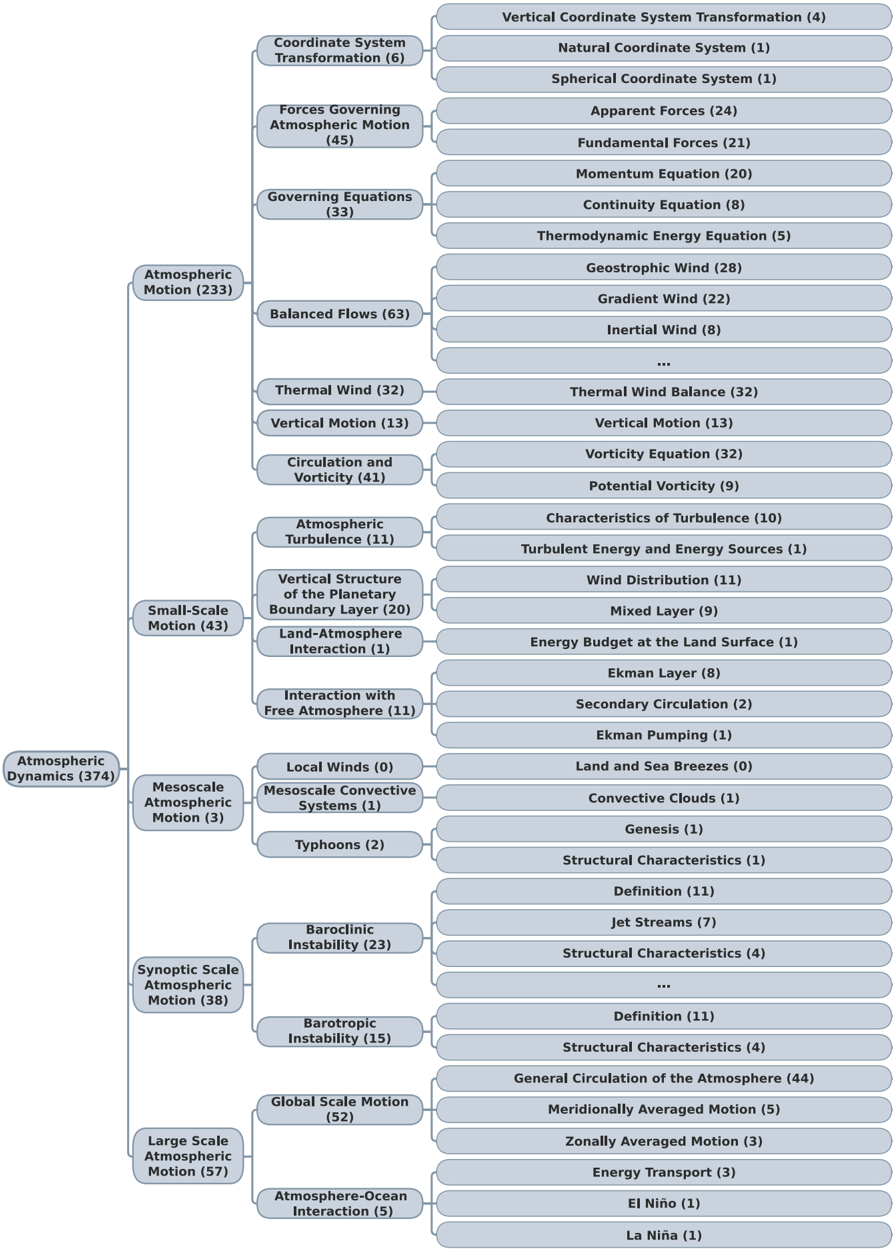
The diagram represents a structured taxonomy of atmospheric dynamics concepts, organized into hierarchical categories with numerical annotations. Each node includes a label and a parenthetical number, likely indicating counts, priorities, or classifications.
### Components/Axes
- **Root Node**: "Atmospheric Dynamics (374)"
- **Primary Branches**:
1. Coordinate System (6)
2. Forces Governing Atmospheric Motion (45)
3. Governing Equations (33)
4. Balanced Flows (63)
5. Vertical Motion (13)
6. Circulation and Vorticity (41)
7. Atmospheric Turbulence (11)
8. Vertical Structure of the Planetary Boundary Layer (20)
9. Land-Atmosphere Interaction (1)
10. Interaction with Free Atmosphere (11)
11. Local Winds (0)
12. Mesoscale Convective Systems (1)
13. Typhoons (2)
14. Baroclinic Instability (23)
15. Barotropic Instability (15)
16. Global Scale Motion (52)
17. Atmosphere-Ocean Interaction (5)
- **Subcategories**: Each primary branch contains nested subcategories (e.g., "Vertical Coordinate System Transformation (4)" under "Coordinate System").
### Detailed Analysis
#### Coordinate System (6)
- Vertical Coordinate System Transformation (4)
- Natural Coordinate System (1)
- Spherical Coordinate System (1)
#### Forces Governing Atmospheric Motion (45)
- Apparent Forces (24)
- Fundamental Forces (21)
- Momentum Equation (20)
- Continuity Equation (8)
- Thermodynamic Energy Equation (5)
#### Governing Equations (33)
- Momentum Equation (20)
- Continuity Equation (8)
- Thermodynamic Energy Equation (5)
#### Balanced Flows (63)
- Geostrophic Wind (28)
- Gradient Wind (22)
- Inertial Wind (8)
- Thermal Wind Balance (32)
- Vertical Motion (13)
- Vorticity Equation (32)
- Potential Vorticity (9)
#### Vertical Motion (13)
#### Circulation and Vorticity (41)
- Vorticity Equation (32)
- Potential Vorticity (9)
#### Atmospheric Turbulence (11)
- Characteristics of Turbulence (10)
- Turbulent Energy and Energy Sources (1)
#### Vertical Structure of the Planetary Boundary Layer (20)
- Wind Distribution (11)
- Mixed Layer (9)
#### Land-Atmosphere Interaction (1)
- Energy Budget at the Land Surface (1)
#### Interaction with Free Atmosphere (11)
- Ekman Layer (8)
- Secondary Circulation (2)
- Ekman Pumping (1)
#### Local Winds (0)
- Land and Sea Breezes (0)
#### Mesoscale Convective Systems (1)
- Convective Clouds (1)
#### Typhoons (2)
- Genesis (1)
- Structural Characteristics (1)
#### Baroclinic Instability (23)
- Structural Characteristics (4)
#### Barotropic Instability (15)
- Structural Characteristics (4)
#### Global Scale Motion (52)
- Meridionally Averaged Motion (5)
- Zonally Averaged Motion (3)
- Energy Transport (3)
#### Atmosphere-Ocean Interaction (5)
- El Niño (1)
- La Niña (1)
### Key Observations
1. **Hierarchical Depth**: Subcategories are nested under primary branches, with numbers decreasing as specificity increases (e.g., "Geostrophic Wind (28)" under "Balanced Flows (63)").
2. **Numerical Annotations**: Numbers may represent conceptual groupings, study frequencies, or classification codes. For example, "Balanced Flows (63)" has the highest subcategory count.
3. **Zero-Count Nodes**: "Local Winds (0)" and "Land and Sea Breezes (0)" suggest these topics are either excluded or underrepresented in this framework.
### Interpretation
The diagram illustrates a comprehensive framework for atmospheric dynamics, emphasizing:
- **Scale Hierarchy**: From global processes (e.g., El Niño) to localized phenomena (e.g., convective clouds).
- **Interconnected Systems**: Links between forces, equations, and motion types (e.g., vorticity equations under both "Balanced Flows" and "Circulation and Vorticity").
- **Research Focus**: Higher numbers in categories like "Balanced Flows" and "Forces Governing Atmospheric Motion" suggest these are central to atmospheric science.
- **Gaps**: Zero counts for local winds and land-sea breezes may indicate omitted subtopics or a focus on larger-scale dynamics.
This structure likely serves as a reference for organizing research, educational content, or modeling priorities in atmospheric science.