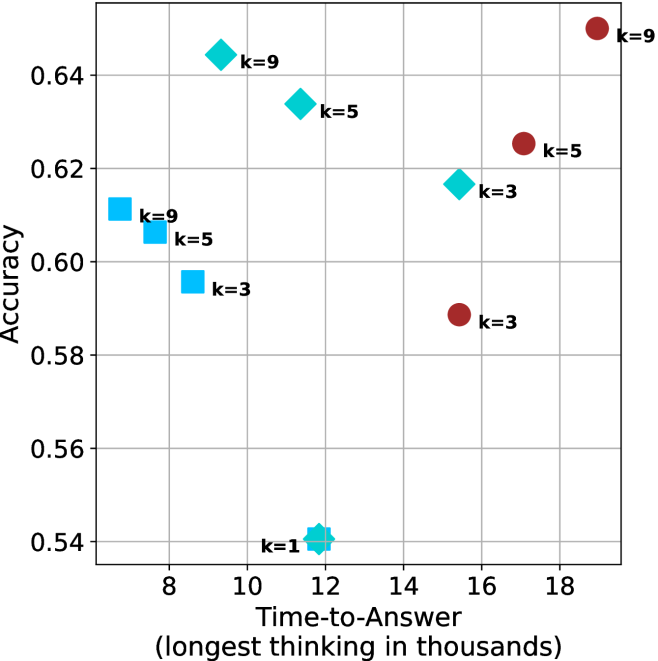
## Scatter Plot: Accuracy vs. Time-to-Answer with varying k values
### Overview
This image presents a scatter plot illustrating the relationship between Accuracy and Time-to-Answer for different values of 'k'. The 'k' parameter likely represents a configuration setting or a model parameter. Each data point represents a specific configuration, and the color of the point indicates the value of 'k'.
### Components/Axes
* **X-axis:** Time-to-Answer (longest thinking in thousands) - ranging from approximately 7.5 to 19.
* **Y-axis:** Accuracy - ranging from approximately 0.54 to 0.65.
* **Data Series:** Multiple data series, each representing a different value of 'k'.
* **Legend:** Located in the top-right corner, indicating the color mapping for each 'k' value:
* k=1 (Dark Red)
* k=3 (Red)
* k=5 (Blue)
* k=9 (Cyan)
* **Data Point Labels:** Each data point is labeled with its corresponding 'k' value.
### Detailed Analysis
The plot shows data points for k=1, k=3, k=5, and k=9.
* **k=1 (Dark Red):** A single data point at approximately (12, 0.54).
* **k=3 (Red):** Three data points:
* Approximately (8.5, 0.59)
* Approximately (15.5, 0.58)
* Approximately (13.5, 0.62)
* **k=5 (Blue):** Three data points:
* Approximately (8.2, 0.60)
* Approximately (10.2, 0.63)
* Approximately (17.2, 0.62)
* **k=9 (Cyan):** Three data points:
* Approximately (8.0, 0.61)
* Approximately (10.0, 0.65)
* Approximately (18.0, 0.64)
**Trends:**
* **k=1:** The single point suggests a low accuracy and moderate time-to-answer.
* **k=3:** The points show a moderate spread in time-to-answer (8.5 to 15.5) with accuracy fluctuating around 0.58-0.62.
* **k=5:** The points show a moderate spread in time-to-answer (8.2 to 17.2) with accuracy fluctuating around 0.60-0.63.
* **k=9:** The points show a moderate spread in time-to-answer (8.0 to 18.0) with accuracy fluctuating around 0.61-0.65.
Generally, as 'k' increases, the accuracy tends to increase, and the time-to-answer also tends to increase.
### Key Observations
* Higher values of 'k' (5 and 9) generally exhibit higher accuracy compared to lower values (1 and 3).
* There's a positive correlation between 'k' and both accuracy and time-to-answer.
* The data points for k=9 show the highest accuracy values, reaching approximately 0.65.
* The data points for k=1 show the lowest accuracy values, at approximately 0.54.
* There is significant variance in time-to-answer for each 'k' value, suggesting that other factors influence processing time.
### Interpretation
The data suggests that increasing the value of 'k' improves the accuracy of the system, but also increases the time it takes to generate an answer. 'k' likely controls the breadth of the search or the complexity of the model. A higher 'k' allows for a more thorough search or a more complex model, leading to better accuracy, but at the cost of increased processing time.
The spread of data points for each 'k' value indicates that the relationship between 'k', accuracy, and time-to-answer is not strictly deterministic. Other factors, such as the specific input or the underlying hardware, likely play a role.
The single data point for k=1 suggests that this value is insufficient to achieve high accuracy, and may be a lower bound for practical use. The optimal value of 'k' would likely be a trade-off between accuracy and time-to-answer, depending on the specific application requirements. Further investigation could involve analyzing the distribution of time-to-answer for each 'k' value and performing statistical tests to determine the significance of the observed trends.