## Diagram: Neural Network Pipeline Architecture and Processing Flow
### Overview
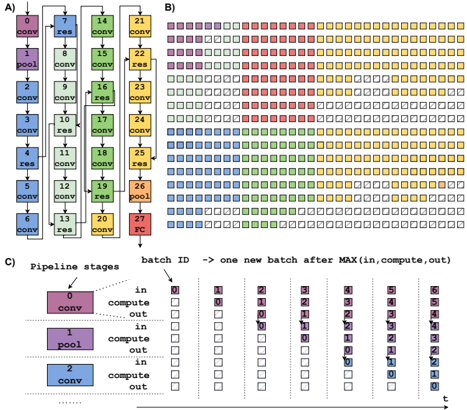
The image depicts a technical diagram of a neural network pipeline architecture, divided into three sections (A, B, C). It combines a vertical operation sequence (A), a heatmap-style grid (B), and a temporal pipeline visualization (C). The diagram uses color-coded elements to represent computational operations, activation maps, and batch processing timelines.
### Components/Axes
**Section A (Vertical Operation Sequence):**
- **Vertical Axis:** Labeled with sequential numbers 0-27, representing operation stages.
- **Horizontal Axis:** Unlabeled, but operations are stacked vertically.
- **Legend:**
- Purple = "conv" (convolution)
- Green = "res" (residual connection)
- Orange = "pool" (pooling)
- Red = "RC" (Receptive Field?)
- **Key Elements:**
- Operation blocks labeled with numbers (e.g., "conv 0", "res 1", "pool 6")
- Color-coded operations follow a pattern: conv → res → conv → res → pool → conv → res → RC
**Section B (Heatmap Grid):**
- **Grid Structure:** 28 columns (0-27) × 7 rows (0-6)
- **Color Coding:** Matches Section A's legend (purple=conv, green=res, orange=pool, red=RC)
- **Spatial Pattern:**
- Top rows dominated by purple/green (conv/res)
- Middle rows show orange/green (pool/res)
- Bottom rows feature red/orange (RC/pool)
- **Legend Position:** Right-aligned, matching Section A's color scheme
**Section C (Temporal Pipeline):**
- **Axes:**
- Vertical: Time steps (t=0 to t=6)
- Horizontal: Batch IDs (0-6)
- **Stages:**
- Purple = "conv" (input → compute → output)
- Green = "pool" (input → compute → output)
- Blue = "compute" (input → compute → output)
- **Batch Processing:**
- Each time step shows active stages for specific batches
- Example: At t=0, batch 0 is in "conv" stage
### Detailed Analysis
**Section A Trends:**
- Operation sequence follows: conv → res → conv → res → pool → conv → res → RC
- Numbers increase sequentially (0-27) with repeating patterns every 3 operations
- "pool" operations occur at positions 6, 12, 18, 24
- "RC" (Receptive Field?) appears only at position 27
**Section B Heatmap Patterns:**
- Color distribution suggests:
- Early stages (columns 0-6) dominated by conv/res operations
- Middle stages (columns 7-18) show increased pooling
- Later stages (columns 19-27) feature more RC operations
- Spatial correlation between Section A's operation sequence and B's column colors
**Section C Pipeline Dynamics:**
- Each time step processes multiple batches simultaneously
- Stages overlap temporally (e.g., conv stage active for batches 0-1 at t=0)
- Compute stages show delayed processing (batch 0 compute starts at t=1)
- Pooling stages have longer active periods (3 time steps per batch)
### Key Observations
1. **Operation Hierarchy:** Conv → res → pool → RC forms the core processing path
2. **Temporal Parallelism:** Multiple batches process through different stages simultaneously
3. **Receptive Field Timing:** RC operation occurs only at the final time step (t=6)
4. **Batch Processing Latency:** Each batch takes 6 time steps to complete full pipeline
5. **Color Consistency:** All sections use identical color coding for operations
### Interpretation
This diagram illustrates a convolutional neural network's processing pipeline with explicit temporal and spatial dimensions:
1. **Architectural Flow (A→B):** The vertical sequence in A maps directly to the heatmap columns in B, showing how operations propagate through the network
2. **Temporal Execution (C):** The pipeline visualization reveals how batches are processed through successive operations over time, with compute stages introducing latency
3. **Receptive Field Timing:** The delayed RC operation at t=6 suggests it aggregates features from all preceding operations
4. **Parallel Processing:** The grid in B demonstrates spatial activation patterns corresponding to the temporal pipeline in C
The diagram emphasizes both the computational graph structure (A) and its dynamic execution characteristics (C), with B serving as a spatial activation map correlating to the temporal pipeline. The consistent color coding across all sections enables cross-referencing of operations across spatial and temporal dimensions.