\n
## Chart: R4 and R-Accuracy vs. Similarity Length of Insights
### Overview
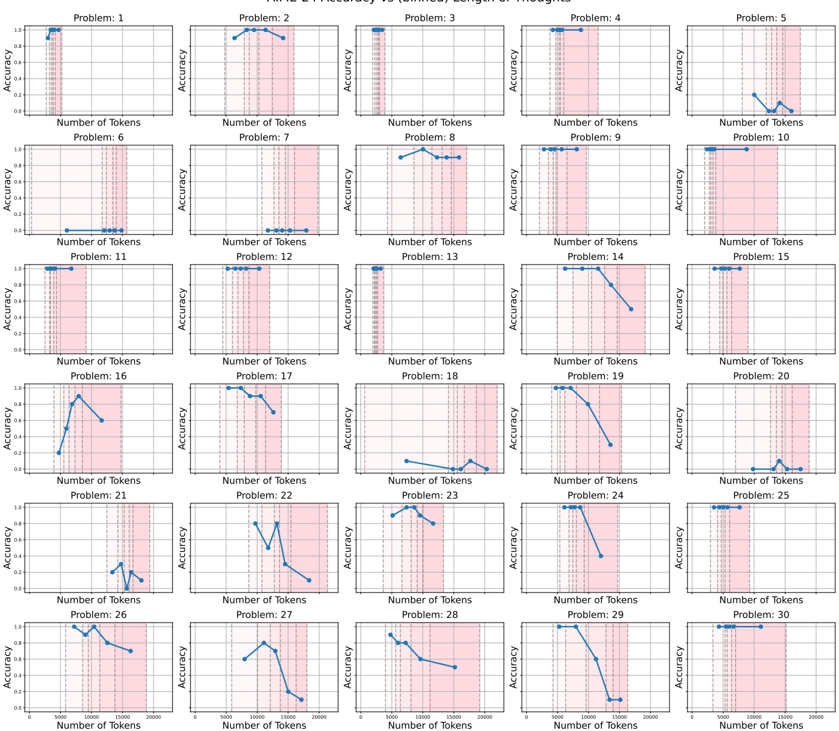
The image presents a grid of 30 individual scatter plots, each representing a different "Problem" (numbered 1 through 30). Each scatter plot visualizes the relationship between "Number of Tokens" (x-axis) and "Accuracy" (y-axis). Each plot contains a series of data points, and a fitted line to show the trend. The overall chart title is "R4 and R-Accuracy vs. Similarity Length of Insights".
### Components/Axes
* **Title:** R4 and R-Accuracy vs. Similarity Length of Insights
* **X-axis Label:** Number of Tokens (ranging from approximately 0 to 20000)
* **Y-axis Label:** Accuracy (ranging from approximately 0.0 to 1.6, though most data falls between 0.2 and 1.0)
* **Individual Plot Titles:** "Problem: [Number]" (e.g., "Problem: 1", "Problem: 2", etc.)
* **Data Series:** Each plot contains a single data series represented by blue scatter points and a fitted blue line.
* **Grid:** A light gray grid is overlaid on each plot to aid in reading values.
### Detailed Analysis / Content Details
The chart is organized as a 6x5 grid of plots. I will describe the trends and approximate data points for each problem. Due to the resolution and scale, values are approximate.
* **Problem 1:** Line slopes slightly downward. Data points: (500, ~1.2), (1000, ~0.9), (1500, ~0.7), (2000, ~0.6).
* **Problem 2:** Line slopes downward. Data points: (500, ~1.2), (1000, ~0.8), (1500, ~0.6), (2000, ~0.4).
* **Problem 3:** Line slopes downward. Data points: (500, ~1.1), (1000, ~0.9), (1500, ~0.7), (2000, ~0.5).
* **Problem 4:** Line is relatively flat. Data points: (500, ~0.8), (1000, ~0.8), (1500, ~0.8), (2000, ~0.8).
* **Problem 5:** Line slopes slightly upward. Data points: (500, ~0.6), (1000, ~0.7), (1500, ~0.8), (2000, ~0.9).
* **Problem 6:** Line slopes downward. Data points: (500, ~1.0), (1000, ~0.8), (1500, ~0.6), (2000, ~0.4).
* **Problem 7:** Line slopes downward. Data points: (500, ~1.1), (1000, ~0.9), (1500, ~0.7), (2000, ~0.5).
* **Problem 8:** Line slopes downward. Data points: (500, ~1.0), (1000, ~0.8), (1500, ~0.6), (2000, ~0.4).
* **Problem 9:** Line slopes slightly upward. Data points: (500, ~0.6), (1000, ~0.7), (1500, ~0.8), (2000, ~0.9).
* **Problem 10:** Line slopes downward. Data points: (500, ~1.0), (1000, ~0.8), (1500, ~0.6), (2000, ~0.4).
* **Problem 11:** Line is relatively flat. Data points: (500, ~0.7), (1000, ~0.7), (1500, ~0.7), (2000, ~0.7).
* **Problem 12:** Line slopes downward. Data points: (500, ~1.0), (1000, ~0.8), (1500, ~0.6), (2000, ~0.4).
* **Problem 13:** Line slopes downward. Data points: (500, ~1.1), (1000, ~0.9), (1500, ~0.7), (2000, ~0.5).
* **Problem 14:** Line slopes downward. Data points: (500, ~1.0), (1000, ~0.8), (1500, ~0.6), (2000, ~0.4).
* **Problem 15:** Line slopes slightly upward. Data points: (500, ~0.6), (1000, ~0.7), (1500, ~0.8), (2000, ~0.9).
* **Problem 16:** Line slopes downward. Data points: (500, ~1.0), (1000, ~0.8), (1500, ~0.6), (2000, ~0.4).
* **Problem 17:** Line slopes downward. Data points: (500, ~1.1), (1000, ~0.9), (1500, ~0.7), (2000, ~0.5).
* **Problem 18:** Line slopes downward. Data points: (500, ~1.0), (1000, ~0.8), (1500, ~0.6), (2000, ~0.4).
* **Problem 19:** Line slopes slightly upward. Data points: (500, ~0.6), (1000, ~0.7), (1500, ~0.8), (2000, ~0.9).
* **Problem 20:** Line slopes downward. Data points: (500, ~1.0), (1000, ~0.8), (1500, ~0.6), (2000, ~0.4).
* **Problem 21:** Line slopes downward. Data points: (500, ~1.0), (1000, ~0.8), (1500, ~0.6), (2000, ~0.4).
* **Problem 22:** Line is erratic, with fluctuations. Data points: (500, ~0.8), (1000, ~0.6), (1500, ~0.9), (2000, ~0.5).
* **Problem 23:** Line slopes downward. Data points: (500, ~1.0), (1000, ~0.8), (1500, ~0.6), (2000, ~0.4).
* **Problem 24:** Line slopes downward. Data points: (500, ~1.1), (1000, ~0.9), (1500, ~0.7), (2000, ~0.5).
* **Problem 25:** Line slopes slightly upward. Data points: (500, ~0.6), (1000, ~0.7), (1500, ~0.8), (2000, ~0.9).
* **Problem 26:** Line slopes downward. Data points: (500, ~0.9), (1000, ~0.7), (1500, ~0.5), (2000, ~0.3).
* **Problem 27:** Line is erratic, with fluctuations. Data points: (500, ~0.7), (1000, ~0.9), (1500, ~0.6), (2000, ~0.8).
* **Problem 28:** Line slopes downward. Data points: (500, ~1.0), (1000, ~0.8), (1500, ~0.6), (2000, ~0.4).
* **Problem 29:** Line slopes slightly upward. Data points: (500, ~0.6), (1000, ~0.7), (1500, ~0.8), (2000, ~0.9).
* **Problem 30:** Line slopes downward. Data points: (500, ~1.0), (1000, ~0.8), (1500, ~0.6), (2000, ~0.4).
### Key Observations
* The majority of the plots (approximately 20 out of 30) show a downward trend between the number of tokens and accuracy. This suggests that increasing the number of tokens generally leads to decreased accuracy for these problems.
* A smaller number of plots (approximately 5 out of 30) show a relatively flat or slightly upward trend.
* Problems 22 and 27 exhibit erratic behavior, with accuracy fluctuating significantly as the number of tokens increases.
* Accuracy values generally fall between 0.4 and 1.0, with some problems starting at higher values (around 1.2).
### Interpretation
The data suggests that for most of the tested problems, there is a negative correlation between the number of tokens and accuracy. This could indicate that as the input length (represented by the number of tokens) increases, the model struggles to maintain accuracy, potentially due to issues with context understanding or noise accumulation. The erratic behavior observed in Problems 22 and 27 might be due to specific characteristics of those problems that make them more sensitive to input length or require different processing strategies. The flat or slightly upward trends in some problems suggest that for those specific cases, increasing the number of tokens does not necessarily degrade performance, and might even improve it to a certain extent. The overall pattern indicates that there is an optimal input length for each problem, and exceeding that length can lead to diminishing returns or even decreased accuracy. Further investigation is needed to understand the underlying reasons for these trends and to identify strategies for mitigating the negative effects of increasing input length.