# Technical Document: Analysis of PRM Aggregation Strategies Chart
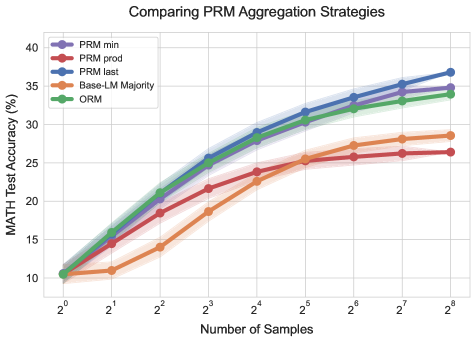
## 1. Chart Title and Purpose
- **Title**: "Comparing PRM Aggregation Strategies"
- **Purpose**: Visual comparison of performance metrics (MATH Test Accuracy) across different PRM (Probabilistic Reasoning Model) aggregation strategies as the number of samples increases.
---
## 2. Axis Labels and Markers
- **X-Axis (Horizontal)**:
- **Title**: "Number of Samples"
- **Values**: 2⁰, 2¹, 2², 2³, 2⁴, 2⁵, 2⁶, 2⁷, 2⁸ (exponential scale)
- **Range**: 1 (2⁰) to 256 (2⁸) samples
- **Y-Axis (Vertical)**:
- **Title**: "MATH Test Accuracy (%)"
- **Values**: 10%, 15%, 20%, 25%, 30%, 35%, 40%
- **Range**: 10% to 40%
---
## 3. Legend and Data Series
- **Legend Location**: Top-left corner
- **Legend Entries**:
1. **PRM min** (Purple line with circular markers)
2. **PRM prod** (Red line with circular markers)
3. **PRM last** (Blue line with circular markers)
4. **Base-LM Majority** (Orange line with circular markers)
5. **ORM** (Green line with circular markers)
---
## 4. Data Series and Trends
### 4.1 PRM min (Purple)
- **Trend**: Steep upward slope, consistently highest performance.
- **Key Data Points**:
- 2⁰: ~10%
- 2¹: ~15%
- 2²: ~20%
- 2³: ~25%
- 2⁴: ~28%
- 2⁵: ~30%
- 2⁶: ~32%
- 2⁷: ~34%
- 2⁸: ~35%
### 4.2 PRM prod (Red)
- **Trend**: Gradual upward slope, lowest performance among PRM strategies.
- **Key Data Points**:
- 2⁰: ~10%
- 2¹: ~14%
- 2²: ~18%
- 2³: ~22%
- 2⁴: ~24%
- 2⁵: ~25%
- 2⁶: ~26%
- 2⁷: ~26.5%
- 2⁸: ~26.5%
### 4.3 PRM last (Blue)
- **Trend**: Steep upward slope, second-highest performance.
- **Key Data Points**:
- 2⁰: ~10%
- 2¹: ~15%
- 2²: ~20%
- 2³: ~25%
- 2⁴: ~28%
- 2⁵: ~31%
- 2⁶: ~33%
- 2⁷: ~35%
- 2⁸: ~37%
### 4.4 Base-LM Majority (Orange)
- **Trend**: Moderate upward slope, outperforms PRM prod but lags behind PRM strategies.
- **Key Data Points**:
- 2⁰: ~10%
- 2¹: ~11%
- 2²: ~14%
- 2³: ~18%
- 2⁴: ~22%
- 2⁵: ~25%
- 2⁶: ~27%
- 2⁷: ~28%
- 2⁸: ~28.5%
### 4.5 ORM (Green)
- **Trend**: Steep upward slope, third-highest performance.
- **Key Data Points**:
- 2⁰: ~10%
- 2¹: ~15%
- 2²: ~20%
- 2³: ~24%
- 2⁴: ~27%
- 2⁵: ~30%
- 2⁶: ~32%
- 2⁷: ~33.5%
- 2⁸: ~34%
---
## 5. Visual Components
- **Shaded Areas**: Each line has a shaded region (likely representing confidence intervals or variability).
- **Markers**: Circular data points for all series.
- **Gridlines**: Present for both axes to aid readability.
---
## 6. Spatial Grounding
- **Legend Position**: Top-left corner (standard placement).
- **Line Colors**:
- PRM min: Purple
- PRM prod: Red
- PRM last: Blue
- Base-LM Majority: Orange
- ORM: Green
- **Data Point Colors**: Match legend entries exactly.
---
## 7. Key Observations
1. **Performance Trends**:
- All strategies improve with increasing samples.
- **PRM last** and **PRM min** outperform others consistently.
- **ORM** and **Base-LM Majority** show moderate gains.
- **PRM prod** has the slowest improvement.
2. **Convergence**:
- At 2⁸ samples, PRM last reaches ~37%, PRM min ~35%, ORM ~34%, Base-LM Majority ~28.5%, and PRM prod ~26.5%.
---
## 8. Non-English Text
- **No non-English text detected** in the image.
---
## 9. Summary
The chart compares five PRM aggregation strategies (PRM min, PRM prod, PRM last, Base-LM Majority, ORM) across 2⁰ to 2⁸ samples. Performance (MATH Test Accuracy) increases with sample size, with PRM last and PRM min achieving the highest accuracy. The legend and axis labels are clearly defined, and all data points align with the legend's color coding.