TECHNICAL ASSET FINGERPRINT
cbd06b793900305767a380bf
Click to view fullscreen
Press ESC or click to close
FOUND IN PAPERS
EXPERT: gemini-2.0-flash VERSION 1
RUNTIME: nugit/gemini/gemini-2.0-flash
INTEL_VERIFIED
## Diagram: Real-World Applications of AI Agents
### Overview
The image is a diagram illustrating real-world applications of AI agents across various domains, along with associated impact metrics and implementation challenges. The diagram uses a central node representing "AI Agents" and connects it to various application areas and challenges via lines. The diagram also includes percentage ranges indicating the measured impact across different domains.
### Components/Axes
* **Title:** Real-World Applications of AI Agents
* **Central Node:** AI Agents
* **Application Domains (arranged radially around "AI Agents"):**
* Software Development (Pink)
* Debugging
* Documentation
* Testing
* Urban Planning (Dark Blue)
* Infrastructure management
* Transportation optimization
* Energy usage
* Public services
* Enterprise Applications (Light Blue)
* Business process automation
* Decision support
* Supply chain optimization
* Personal Assistance (Green)
* Information retrieval
* Creative collaboration
* Communication assistance
* Education (Purple)
* Personalized tutoring
* Content creation
* Assessment
* Learning analytics
* Financial Services (Teal)
* Investment analysis
* Risk assessment
* Fraud detection
* Regulatory compliance
* Healthcare (Red)
* Clinical decision support
* Patient monitoring
* Treatment planning
* Medical research
* Scientific Research (Orange)
* Hypothesis generation
* Experiment design
* Data analysis
* Literature synthesis
* **Implementation Challenges (located below "AI Agents"):**
* Data Privacy (Gray)
* Cost-Benefit Balance (Gray)
* User Adoption (Gray)
* Integration Complexity (Gray)
* **Measured Impact Across Domains (located at the bottom):**
* Productivity Enhancement: +35-70% (Blue)
* Cost Reduction: -25-50% (Green)
* Error Rate Reduction: -40-85% (Red)
* User Satisfaction: +45-80% (Orange)
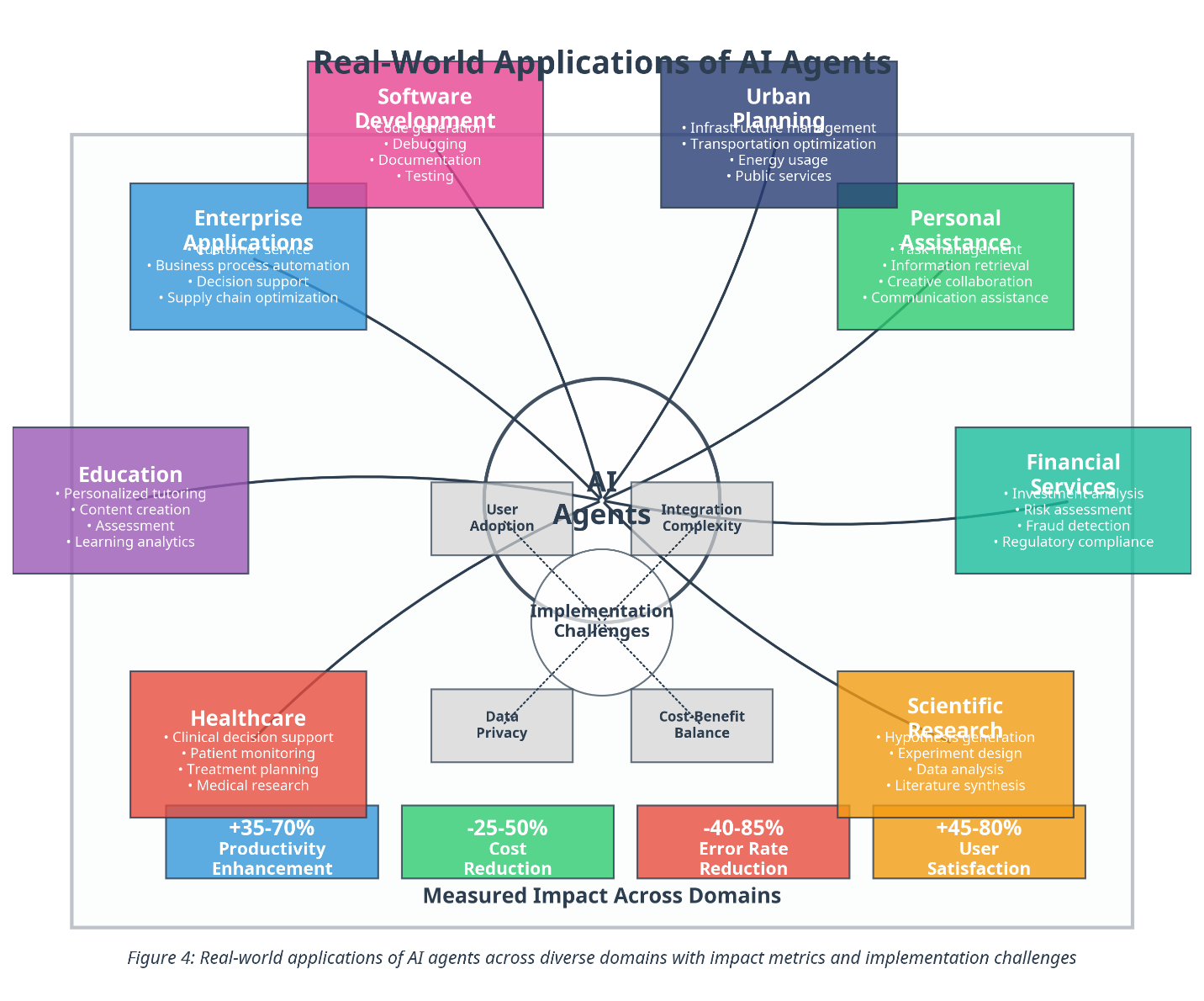
* **Figure Caption:** Figure 4: Real-world applications of AI agents across diverse domains with impact metrics and implementation challenges
### Detailed Analysis
* **Software Development (Pink):** Lists debugging, documentation, and testing as applications.
* **Urban Planning (Dark Blue):** Lists infrastructure management, transportation optimization, energy usage, and public services as applications.
* **Enterprise Applications (Light Blue):** Lists business process automation, decision support, and supply chain optimization as applications.
* **Personal Assistance (Green):** Lists information retrieval, creative collaboration, and communication assistance as applications.
* **Education (Purple):** Lists personalized tutoring, content creation, assessment, and learning analytics as applications.
* **Financial Services (Teal):** Lists investment analysis, risk assessment, fraud detection, and regulatory compliance as applications.
* **Healthcare (Red):** Lists clinical decision support, patient monitoring, treatment planning, and medical research as applications.
* **Scientific Research (Orange):** Lists hypothesis generation, experiment design, data analysis, and literature synthesis as applications.
* **Implementation Challenges:** Data Privacy, Cost-Benefit Balance, User Adoption, and Integration Complexity are identified as challenges.
* **Measured Impact:**
* Productivity Enhancement: +35-70% (Blue)
* Cost Reduction: -25-50% (Green)
* Error Rate Reduction: -40-85% (Red)
* User Satisfaction: +45-80% (Orange)
### Key Observations
* The diagram visually connects AI agents to various application domains and highlights the potential impact and challenges associated with their implementation.
* The measured impact is presented as percentage ranges, indicating the variability or uncertainty in the reported benefits.
* The diagram provides a high-level overview and does not delve into the specifics of how AI agents are implemented in each domain.
### Interpretation
The diagram illustrates the broad applicability of AI agents across diverse sectors. It suggests that AI agents can contribute to productivity enhancement, cost reduction, error rate reduction, and user satisfaction. However, it also acknowledges the presence of implementation challenges such as data privacy, cost-benefit balance, user adoption, and integration complexity. The diagram serves as a visual summary of the potential benefits and challenges associated with deploying AI agents in real-world scenarios. The ranges provided for "Measured Impact Across Domains" suggest that the impact of AI agents can vary significantly depending on the specific application and context.
DECODING INTELLIGENCE...
EXPERT: gemini-3-pro VERSION 1
RUNTIME: nugit/gemini/gemini-3-pro-preview
INTEL_VERIFIED
## Diagram: Real-World Applications of AI Agents
### Overview
This image is a complex infographic diagram titled "Real-World Applications of AI Agents." It visually maps the central concept of "AI Agents" to eight distinct industry domains (represented as colored boxes radiating from the center) and four implementation challenges (represented as grey boxes near the center). Additionally, the bottom of the diagram features a section titled "Measured Impact Across Domains" displaying four key performance metrics. The entire diagram is enclosed in a light grey border, and a figure caption is present at the very bottom.
### Components/Structure
**1. Central Hub:**
* **Core Concept:** "AI Agents" is written in the geometric center of the diagram.
* **Visual Metaphor:** A circle surrounds the text "AI Agents," acting as a hub. Lines radiate outward from this hub to connect to the various application domains.
**2. Application Domains (Radiating Boxes):**
There are eight colored rectangular boxes arranged in a circular pattern around the center. Each box represents a sector and lists specific use cases.
* **Top-Left (Pink):** Software Development
* **Top-Right (Dark Blue):** Urban Planning
* **Right-Top (Green):** Personal Assistance
* **Right-Bottom (Teal):** Financial Services
* **Bottom-Right (Orange/Yellow):** Scientific Research
* **Bottom-Left (Red/Coral):** Healthcare
* **Left (Purple):** Education
* **Top-Left (Blue):** Enterprise Applications
**3. Implementation Challenges (Inner Cluster):**
Surrounding the central "AI Agents" text are four grey rectangular boxes labeled "Implementation Challenges." These are connected by dotted lines to a central node labeled "Implementation Challenges."
* **Top-Left:** User Adoption
* **Top-Right:** Integration Complexity
* **Bottom-Left:** Data Privacy
* **Bottom-Right:** Cost-Benefit Balance
**4. Measured Impact Metrics (Bottom Row):**
A row of four colored boxes at the bottom provides quantitative data ranges.
* **Blue Box:** Productivity Enhancement
* **Green Box:** Cost Reduction
* **Red Box:** Error Rate Reduction
* **Yellow/Orange Box:** User Satisfaction
**5. Footer Caption:**
* **Text:** "Figure 4: Real-world applications of AI agents across diverse domains with impact metrics and implementation challenges"
---
### Content Details (Transcription)
#### Application Domains (Clockwise from Top)
1. **Software Development** (Pink Box, Top)
* Code generation
* Debugging
* Documentation
* Testing
2. **Urban Planning** (Dark Blue Box, Top Right)
* Infrastructure management
* Transportation optimization
* Energy usage
* Public services
3. **Personal Assistance** (Green Box, Right)
* Task management
* Information retrieval
* Creative collaboration
* Communication assistance
4. **Financial Services** (Teal Box, Right)
* Investment analysis
* Risk assessment
* Fraud detection
* Regulatory compliance
5. **Scientific Research** (Orange Box, Bottom Right)
* Hypothesis generation
* Experiment design
* Data analysis
* Literature synthesis
6. **Healthcare** (Red Box, Bottom Left)
* Clinical decision support
* Patient monitoring
* Treatment planning
* Medical research
7. **Education** (Purple Box, Left)
* Personalized tutoring
* Content creation
* Assessment
* Learning analytics
8. **Enterprise Applications** (Blue Box, Top Left)
* Customer service
* Business process automation
* Decision support
* Supply chain optimization
#### Implementation Challenges (Central Grey Boxes)
* **User Adoption**
* **Integration Complexity**
* **Data Privacy**
* **Cost-Benefit Balance**
#### Measured Impact Across Domains (Bottom Row Data)
* **+35-70%** Productivity Enhancement
* **-25-50%** Cost Reduction
* **-40-85%** Error Rate Reduction
* **+45-80%** User Satisfaction
---
### Key Observations
* **Symmetry:** The diagram is balanced, with four domains on the upper half and four on the lower half.
* **Connectivity:** Solid black lines connect the central "AI Agents" hub to the outer application domains, indicating a direct relationship. Dotted lines connect the "Implementation Challenges" text to the four specific challenge boxes, indicating a sub-category relationship.
* **Color Coding:** Each domain has a distinct color, likely for visual separation. The impact metrics at the bottom use colors that roughly correspond to positive (Blue/Green/Yellow) and negative/reduction (Red/Green) indicators, though the color choice for "Error Rate Reduction" (Red) is interesting as red usually implies danger, but here it signifies a positive reduction in errors.
* **Overlapping Text:** In the "Urban Planning" box, the text "Infrastructure management" appears slightly garbled or overlapped with the box header. Similarly, in "Personal Assistance," "Task management" is slightly obscured. In "Financial Services," "Investment analysis" is overlapped. In "Scientific Research," "Hypothesis generation" is overlapped. This suggests a rendering issue in the source image.
### Interpretation
This diagram serves as a comprehensive overview of the current state of AI Agent technology. It argues that AI Agents are not limited to a single niche but are a horizontal technology impacting nearly every major sector of the economy.
1. **Breadth of Application:** The diagram demonstrates versatility. From creative tasks (Personal Assistance) to highly regulated technical fields (Healthcare, Finance), AI agents are depicted as having specific, actionable roles (e.g., "Fraud detection" vs. "Creative collaboration").
2. **Balanced Viewpoint:** The inclusion of "Implementation Challenges" in the center suggests a realistic perspective. While the outer ring shows the *potential* and *applications*, the inner ring acknowledges the *barriers* (Privacy, Complexity, Cost, Adoption) that must be overcome to realize that potential.
3. **Quantifiable Value:** The bottom section moves from qualitative descriptions to quantitative claims. The ranges are quite wide (e.g., 35-70% productivity), which implies that results vary significantly by implementation or industry, but the direction of impact is consistently positive (higher productivity/satisfaction, lower costs/errors).
4. **Strategic Focus:** The "Enterprise Applications" and "Software Development" sections highlight the B2B and technical utility of these agents, moving beyond simple consumer chatbots (though "Personal Assistance" covers that).
**Summary:** The diagram is a "Figure 4" from a larger document, likely a white paper or technical report, intended to justify investment in or adoption of AI agents by showcasing their wide utility and measurable positive impact, while transparently acknowledging the hurdles involved.
DECODING INTELLIGENCE...
EXPERT: nemotron-free VERSION 1
RUNTIME: free/nvidia/nemotron-nano-12b-v2-vl:free
INTEL_VERIFIED
## Diagram: Real-World Applications of AI Agents
### Overview
The diagram illustrates the deployment of AI agents across diverse domains, highlighting their applications, implementation challenges, and measurable impacts. Central to the diagram is the "AI Agents" node, connected to eight domains (Healthcare, Education, Financial Services, etc.), each with subcategories and impact metrics. A secondary circle labeled "Implementation Challenges" links to the core node, while a "Measured Impact Across Domains" section quantifies outcomes.
---
### Components/Axes
1. **Central Node**:
- **AI Agents** (black text, central position).
- Connected to eight domains via lines.
2. **Domains**:
- **Healthcare** (red), **Education** (purple), **Financial Services** (teal), **Scientific Research** (orange), **Personal Assistance** (green), **Urban Planning** (dark blue), **Software Development** (pink), **Enterprise Applications** (blue).
- Each domain has 3–4 subcategories (e.g., Healthcare includes "Clinical decision support," "Patient monitoring").
3. **Implementation Challenges** (gray circle):
- **Data Privacy**, **User Adoption**, **Integration Complexity**, **Cost-Benefit Balance**.
- Connected to the central "AI Agents" node.
4. **Measured Impact Across Domains** (bottom section):
- **Productivity Enhancement**: +35–70% (blue).
- **Cost Reduction**: -25–50% (green).
- **Error Rate Reduction**: -40–85% (red).
- **User Satisfaction**: +45–80% (orange).
---
### Detailed Analysis
#### Domains and Subcategories
- **Healthcare** (red):
- Clinical decision support
- Patient monitoring
- Treatment planning
- Medical research
- **Education** (purple):
- Personalized tutoring
- Content creation
- Assessment
- Learning analytics
- **Financial Services** (teal):
- Investment analysis
- Risk assessment
- Fraud detection
- Regulatory compliance
- **Scientific Research** (orange):
- Hypothesis generation
- Experiment design
- Data analysis
- Literature synthesis
- **Personal Assistance** (green):
- Task management
- Information retrieval
- Creative collaboration
- Communication assistance
- **Urban Planning** (dark blue):
- Infrastructure management
- Transportation optimization
- Energy usage
- Public services
- **Software Development** (pink):
- Code generation
- Debugging
- Documentation
- Testing
- **Enterprise Applications** (blue):
- Customer service automation
- Business process automation
- Decision support
- Supply chain optimization
#### Implementation Challenges
- **Data Privacy**: Linked to AI Agents, emphasizing security concerns.
- **User Adoption**: Highlighted as a barrier to widespread implementation.
- **Integration Complexity**: Reflects technical hurdles in adopting AI systems.
- **Cost-Benefit Balance**: Addresses economic feasibility.
#### Measured Impact Metrics
- **Productivity Enhancement**: Highest in Healthcare (+35–70%).
- **Cost Reduction**: Most significant in Financial Services (-25–50%).
- **Error Rate Reduction**: Dominant in Scientific Research (-40–85%).
- **User Satisfaction**: Strongest in Personal Assistance (+45–80%).
---
### Key Observations
1. **High-Impact Domains**:
- Healthcare and Scientific Research show the greatest productivity and error rate improvements.
- Personal Assistance excels in user satisfaction, likely due to intuitive task management.
2. **Challenges**:
- Data Privacy and Integration Complexity are central barriers, affecting all domains.
- User Adoption is a cross-cutting issue, suggesting cultural or technical resistance.
3. **Metric Variability**:
- Productivity and cost metrics are quantified as absolute changes (e.g., +35–70%), while error rates and satisfaction use relative reductions.
---
### Interpretation
The diagram underscores AI agents' transformative potential across sectors, with Healthcare and Scientific Research leading in operational efficiency. However, implementation challenges like Data Privacy and Integration Complexity act as systemic bottlenecks. The emphasis on User Satisfaction in Personal Assistance highlights the importance of human-centric design. Notably, the absence of a "Legends" section in the diagram complicates cross-referencing color-coded data, though the spatial arrangement (e.g., red for Healthcare, orange for Scientific Research) aids intuitive navigation. The quantified impacts suggest AI agents are most effective in automating high-stakes, data-intensive tasks, but their success hinges on resolving technical and ethical challenges.
DECODING INTELLIGENCE...