## Diagram: Real-World Applications of AI Agents
### Overview
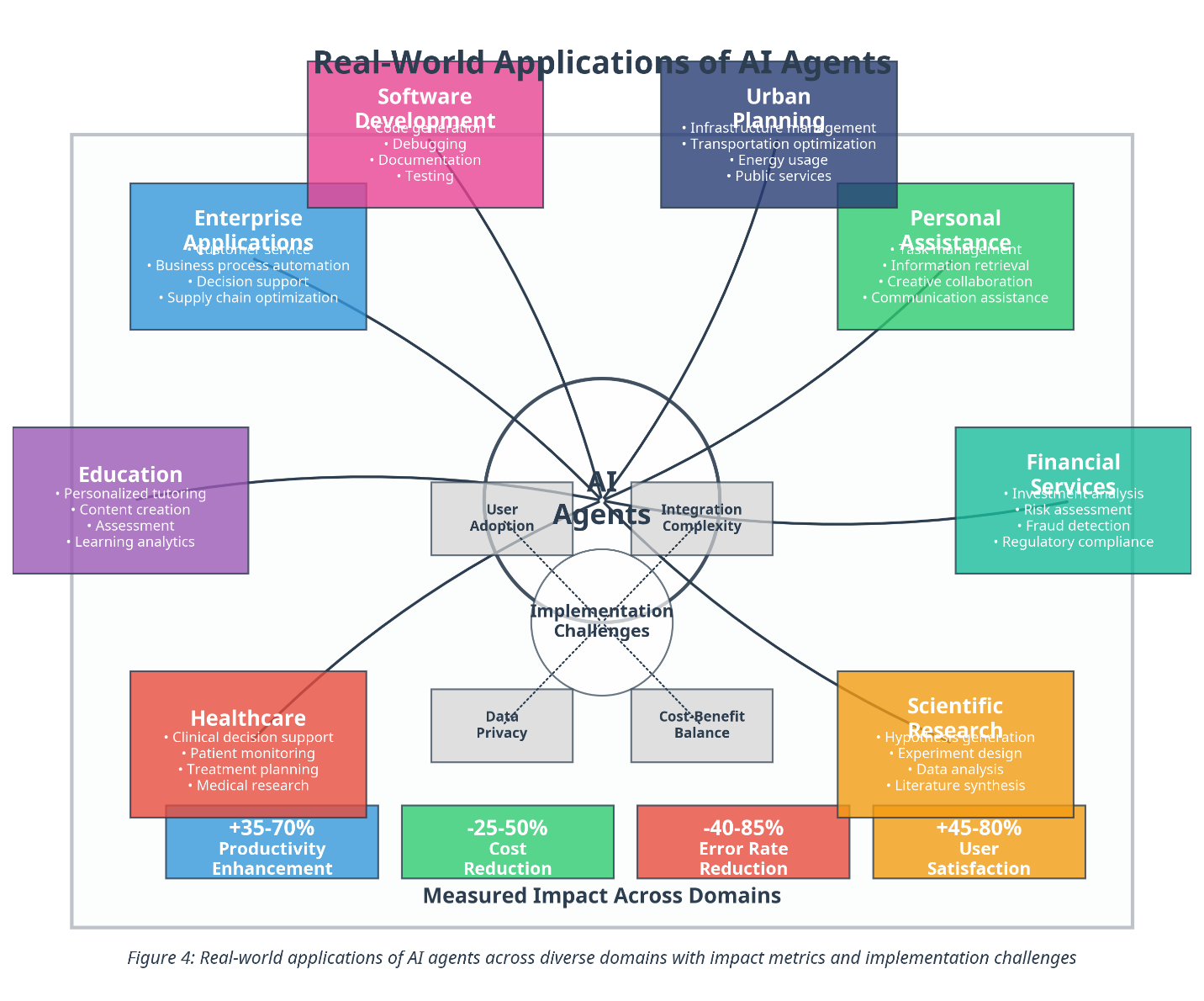
The image is a diagram illustrating real-world applications of AI agents across various domains, along with associated impact metrics and implementation challenges. The diagram uses a central node representing "AI Agents" and connects it to various application areas and challenges via lines. The diagram also includes percentage ranges indicating the measured impact across different domains.
### Components/Axes
* **Title:** Real-World Applications of AI Agents
* **Central Node:** AI Agents
* **Application Domains (arranged radially around "AI Agents"):**
* Software Development (Pink)
* Debugging
* Documentation
* Testing
* Urban Planning (Dark Blue)
* Infrastructure management
* Transportation optimization
* Energy usage
* Public services
* Enterprise Applications (Light Blue)
* Business process automation
* Decision support
* Supply chain optimization
* Personal Assistance (Green)
* Information retrieval
* Creative collaboration
* Communication assistance
* Education (Purple)
* Personalized tutoring
* Content creation
* Assessment
* Learning analytics
* Financial Services (Teal)
* Investment analysis
* Risk assessment
* Fraud detection
* Regulatory compliance
* Healthcare (Red)
* Clinical decision support
* Patient monitoring
* Treatment planning
* Medical research
* Scientific Research (Orange)
* Hypothesis generation
* Experiment design
* Data analysis
* Literature synthesis
* **Implementation Challenges (located below "AI Agents"):**
* Data Privacy (Gray)
* Cost-Benefit Balance (Gray)
* User Adoption (Gray)
* Integration Complexity (Gray)
* **Measured Impact Across Domains (located at the bottom):**
* Productivity Enhancement: +35-70% (Blue)
* Cost Reduction: -25-50% (Green)
* Error Rate Reduction: -40-85% (Red)
* User Satisfaction: +45-80% (Orange)
* **Figure Caption:** Figure 4: Real-world applications of AI agents across diverse domains with impact metrics and implementation challenges
### Detailed Analysis
* **Software Development (Pink):** Lists debugging, documentation, and testing as applications.
* **Urban Planning (Dark Blue):** Lists infrastructure management, transportation optimization, energy usage, and public services as applications.
* **Enterprise Applications (Light Blue):** Lists business process automation, decision support, and supply chain optimization as applications.
* **Personal Assistance (Green):** Lists information retrieval, creative collaboration, and communication assistance as applications.
* **Education (Purple):** Lists personalized tutoring, content creation, assessment, and learning analytics as applications.
* **Financial Services (Teal):** Lists investment analysis, risk assessment, fraud detection, and regulatory compliance as applications.
* **Healthcare (Red):** Lists clinical decision support, patient monitoring, treatment planning, and medical research as applications.
* **Scientific Research (Orange):** Lists hypothesis generation, experiment design, data analysis, and literature synthesis as applications.
* **Implementation Challenges:** Data Privacy, Cost-Benefit Balance, User Adoption, and Integration Complexity are identified as challenges.
* **Measured Impact:**
* Productivity Enhancement: +35-70% (Blue)
* Cost Reduction: -25-50% (Green)
* Error Rate Reduction: -40-85% (Red)
* User Satisfaction: +45-80% (Orange)
### Key Observations
* The diagram visually connects AI agents to various application domains and highlights the potential impact and challenges associated with their implementation.
* The measured impact is presented as percentage ranges, indicating the variability or uncertainty in the reported benefits.
* The diagram provides a high-level overview and does not delve into the specifics of how AI agents are implemented in each domain.
### Interpretation
The diagram illustrates the broad applicability of AI agents across diverse sectors. It suggests that AI agents can contribute to productivity enhancement, cost reduction, error rate reduction, and user satisfaction. However, it also acknowledges the presence of implementation challenges such as data privacy, cost-benefit balance, user adoption, and integration complexity. The diagram serves as a visual summary of the potential benefits and challenges associated with deploying AI agents in real-world scenarios. The ranges provided for "Measured Impact Across Domains" suggest that the impact of AI agents can vary significantly depending on the specific application and context.