## Chart: Harmfulness Score and Harmful Rate vs. Recurrent Steps
### Overview
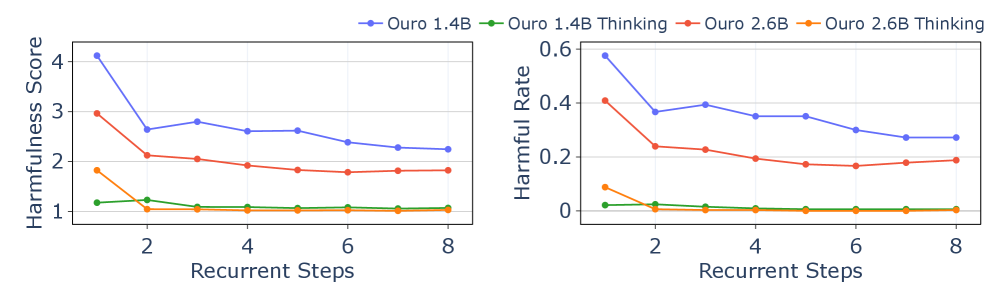
The image presents two line charts side-by-side. The left chart displays "Harmfulness Score" against "Recurrent Steps," while the right chart shows "Harmful Rate" against "Recurrent Steps." Both charts compare four data series: "Ouro 1.4B," "Ouro 1.4B Thinking," "Ouro 2.6B," and "Ouro 2.6B Thinking." The x-axis, "Recurrent Steps," ranges from 0 to 8 in both charts.
### Components/Axes
**Left Chart:**
* **Y-axis Title:** Harmfulness Score
* **Y-axis Scale:** 1 to 4, with gridlines at each integer value.
* **X-axis Title:** Recurrent Steps
* **X-axis Scale:** 2, 4, 6, 8
* **Legend:** Located at the top of the image.
* Blue: Ouro 1.4B
* Green: Ouro 1.4B Thinking
* Red: Ouro 2.6B
* Orange: Ouro 2.6B Thinking
**Right Chart:**
* **Y-axis Title:** Harmful Rate
* **Y-axis Scale:** 0 to 0.6, with gridlines at intervals of 0.2.
* **X-axis Title:** Recurrent Steps
* **X-axis Scale:** 2, 4, 6, 8
* **Legend:** Located at the top of the image (shared with the left chart).
* Blue: Ouro 1.4B
* Green: Ouro 1.4B Thinking
* Red: Ouro 2.6B
* Orange: Ouro 2.6B Thinking
### Detailed Analysis
**Left Chart (Harmfulness Score):**
* **Ouro 1.4B (Blue):** The line starts at approximately 4.1 at Recurrent Step 1, decreases to about 2.6 at Step 2, then increases slightly to approximately 2.8 at Step 4, before decreasing again to around 2.6 at Step 6, and finally to approximately 2.3 at Step 8.
* **Ouro 2.6B (Red):** The line starts at approximately 3.0 at Step 1, decreases to about 2.1 at Step 2, and then gradually decreases to approximately 1.9 at Step 4, 1.8 at Step 6, and 1.8 at Step 8.
* **Ouro 1.4B Thinking (Green):** The line starts at approximately 1.1 at Step 1, increases slightly to about 1.2 at Step 2, and then remains relatively stable at approximately 1.0 for Steps 4, 6, and 8.
* **Ouro 2.6B Thinking (Orange):** The line starts at approximately 1.8 at Step 1, decreases to about 1.0 at Step 2, and then remains relatively stable at approximately 1.0 for Steps 4, 6, and 8.
**Right Chart (Harmful Rate):**
* **Ouro 1.4B (Blue):** The line starts at approximately 0.58 at Step 1, decreases to about 0.37 at Step 2, then increases slightly to approximately 0.39 at Step 4, before decreasing again to around 0.32 at Step 6, and finally to approximately 0.28 at Step 8.
* **Ouro 2.6B (Red):** The line starts at approximately 0.40 at Step 1, decreases to about 0.24 at Step 2, and then gradually decreases to approximately 0.21 at Step 4, 0.17 at Step 6, and 0.17 at Step 8.
* **Ouro 1.4B Thinking (Green):** The line starts at approximately 0.02 at Step 1, decreases to about 0.00 at Step 2, and then remains relatively stable at approximately 0.00 for Steps 4, 6, and 8.
* **Ouro 2.6B Thinking (Orange):** The line starts at approximately 0.09 at Step 1, decreases to about 0.00 at Step 2, and then remains relatively stable at approximately 0.00 for Steps 4, 6, and 8.
### Key Observations
* In both charts, the "Thinking" variants (Ouro 1.4B Thinking and Ouro 2.6B Thinking) consistently exhibit lower harmfulness scores and harmful rates compared to their non-"Thinking" counterparts (Ouro 1.4B and Ouro 2.6B).
* The "Ouro 1.4B" series (blue) generally has the highest harmfulness score and harmful rate across all recurrent steps.
* The harmfulness score and harmful rate tend to decrease as the number of recurrent steps increases, particularly in the "Ouro 1.4B" and "Ouro 2.6B" series. The "Thinking" variants stabilize quickly at low values.
### Interpretation
The data suggests that the "Thinking" variants of both Ouro 1.4B and Ouro 2.6B models are more effective at reducing harmfulness, as indicated by their lower scores and rates. The decrease in harmfulness with increasing recurrent steps implies that the models may be learning to mitigate harmful outputs over time. The "Ouro 1.4B" model appears to be more prone to generating harmful content compared to "Ouro 2.6B," regardless of the "Thinking" variant. The "Thinking" variants converge to a near-zero harmful rate after only a few recurrent steps, indicating a significant improvement in safety.