\n
## Sequential Action States in a Box-Opening Game
### Overview
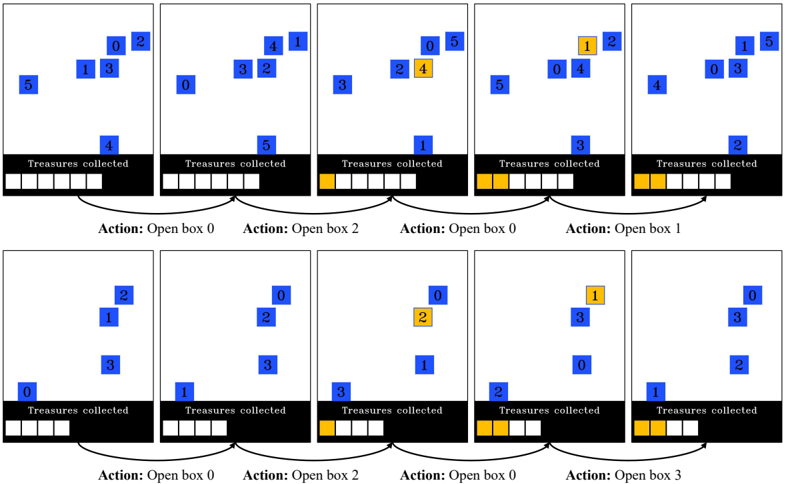
The image displays two horizontal sequences (top and bottom rows), each containing five panels. Each panel represents a discrete state in a game or process where numbered boxes are present, and a "Treasures collected" progress bar is shown at the bottom. Arrows between panels indicate the action taken to transition from one state to the next. The diagram illustrates how the state of the boxes and the collected treasures evolve based on a series of actions.
### Components/Axes
* **Panels:** 10 total panels, arranged in two rows of five. Each panel is a square frame.
* **Grid Elements:** Within each panel, there are several small, colored squares (boxes) containing numbers. Most boxes are blue, but some are yellow/orange.
* **Progress Bar:** Located at the bottom of each panel, labeled "Treasures collected". It consists of 5 segments. Some segments are filled with yellow, indicating collected treasures.
* **Action Labels:** Text placed on the arrows connecting the panels, specifying the action taken (e.g., "Action: Open box 0").
* **Numbered Boxes:** The boxes are labeled with integers from 0 to 6. Their positions within the panel grid vary.
* **Color Coding:** Blue boxes appear to be unopened or inactive. Yellow/orange boxes likely indicate a box that has been opened or is currently active, often correlating with a treasure being collected.
### Detailed Analysis
**Top Row Sequence (Left to Right):**
1. **Panel 1 (Initial State):**
* Boxes: Blue boxes numbered 0, 3 (top-right cluster); 1, 3 (middle-left cluster); 5 (far left); 4 (bottom-center).
* Treasures Collected: 0 out of 5 segments filled.
* Action to next: "Action: Open box 0"
2. **Panel 2:**
* Boxes: Blue boxes numbered 4, 1 (top-right); 3, 2 (middle-left); 0 (far left); 5 (bottom-center).
* Treasures Collected: 0 out of 5 segments filled.
* Action to next: "Action: Open box 2"
3. **Panel 3:**
* Boxes: Blue box 0, **Yellow box 5** (top-right); Blue box 2, **Yellow box 4** (middle-left); Blue box 3 (far left); Blue box 1 (bottom-center).
* Treasures Collected: 1 out of 5 segments filled (first segment is yellow).
* Action to next: "Action: Open box 0"
4. **Panel 4:**
* Boxes: **Yellow box 1**, Blue box 3 (top-right); Blue box 0, Blue box 4 (middle-left); Blue box 5 (far left); Blue box 3 (bottom-center).
* Treasures Collected: 2 out of 5 segments filled.
* Action to next: "Action: Open box 1"
5. **Panel 5 (Final State of Top Row):**
* Boxes: Blue box 1, Blue box 5 (top-right); Blue box 0, Blue box 3 (middle-left); Blue box 4 (far left); Blue box 2 (bottom-center).
* Treasures Collected: 3 out of 5 segments filled.
**Bottom Row Sequence (Left to Right):**
1. **Panel 6 (Initial State):**
* Boxes: Blue box 2 (top-right); Blue box 1 (middle-left); Blue box 3 (bottom-center); Blue box 0 (far left).
* Treasures Collected: 0 out of 5 segments filled.
* Action to next: "Action: Open box 0"
2. **Panel 7:**
* Boxes: Blue box 0 (top-right); Blue box 2 (middle-left); Blue box 3 (bottom-center); Blue box 1 (far left).
* Treasures Collected: 0 out of 5 segments filled.
* Action to next: "Action: Open box 2"
3. **Panel 8:**
* Boxes: Blue box 0 (top-right); **Yellow box 2**, Blue box 1 (middle-left); Blue box 3 (bottom-center); Blue box 3 (far left).
* Treasures Collected: 1 out of 5 segments filled.
* Action to next: "Action: Open box 0"
4. **Panel 9:**
* Boxes: **Yellow box 1** (top-right); Blue box 3 (middle-left); Blue box 0 (bottom-center); Blue box 2 (far left).
* Treasures Collected: 2 out of 5 segments filled.
* Action to next: "Action: Open box 3"
5. **Panel 10 (Final State of Bottom Row):**
* Boxes: Blue box 0 (top-right); Blue box 3 (middle-left); Blue box 2 (bottom-center); Blue box 1 (far left).
* Treasures Collected: 3 out of 5 segments filled.
### Key Observations
1. **Action-Treasure Correlation:** A treasure is collected (a progress bar segment turns yellow) immediately after an action is taken, but only in the *following* state. For example, after "Open box 2" in Panel 2, Panel 3 shows one treasure collected and box 4 is yellow.
2. **Color Change Logic:** The box that is the target of an "Open" action does not necessarily turn yellow in the next state. Instead, a *different* box often becomes yellow. This suggests the action might trigger a change elsewhere in the system.
3. **Identical Outcomes:** Both sequences, despite starting with different box configurations and taking different action paths (Top: 0, 2, 0, 1; Bottom: 0, 2, 0, 3), result in the same final state: 3 treasures collected.
4. **Box Number Persistence:** The set of box numbers {0,1,2,3,4,5,6} appears in the top row, while the bottom row uses a subset {0,1,2,3}. The positions and roles of these numbers change with each action.
5. **Spatial Layout:** The boxes are arranged in a loose grid with clusters in the top-right, middle-left, far left, and bottom-center positions. This layout is consistent across panels.
### Interpretation
This diagram likely visualizes the state transitions of a **Markov Decision Process (MDP)** or a similar reinforcement learning environment. The numbered boxes represent states or features of the environment. The "Open box X" actions are the agent's decisions. The "Treasures collected" bar is the cumulative reward.
The key insight is that the environment's response to an action is **stochastic or state-dependent**. Opening a specific box number does not guarantee a treasure or a predictable change to that same box. Instead, it alters the overall configuration, sometimes revealing a treasure (turning a box yellow and filling a progress segment) in a subsequent step. The fact that two different action sequences lead to the same reward outcome (3 treasures) suggests there may be multiple optimal or viable paths to achieve a goal in this environment. The diagram serves to document the specific mechanics and outcomes of a particular episode or set of episodes within this game or simulation.