TECHNICAL ASSET FINGERPRINT
cc235853bf51ee433c9aacd7
Click to view fullscreen
Press ESC or click to close
FOUND IN PAPERS
EXPERT: healer-alpha-free VERSION 1
RUNTIME: free/openrouter/healer-alpha
INTEL_VERIFIED
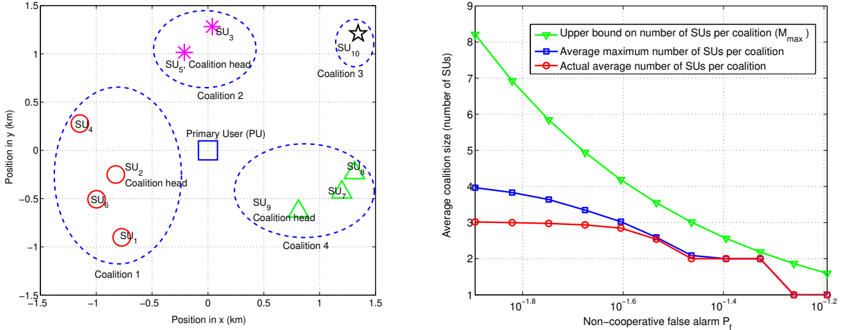
## Spatial Diagram & Line Chart: Coalition Formation in Cognitive Radio Networks
### Overview
The image consists of two distinct panels. The left panel is a spatial diagram illustrating the positions of Primary Users (PU) and Secondary Users (SU) organized into coalitions within a 2D area. The right panel is a line chart plotting the average coalition size against a non-cooperative false alarm probability parameter.
### Left Panel: Spatial Diagram of User Positions and Coalitions
#### Components/Axes
* **Axes:**
* **X-axis:** "Position in x (km)" ranging from -1.5 to 1.5.
* **Y-axis:** "Position in y (km)" ranging from -1.5 to 1.5.
* **Legend/Key (Implicit):** User types and roles are distinguished by symbol shape and color.
* **Primary User (PU):** Blue square.
* **Secondary User (SU):** Various shapes (circle, triangle, star, pentagram) in different colors (red, green, magenta, black).
* **Coalition Head:** Indicated by a larger, hollow version of the user's symbol.
* **Coalition Boundary:** Dashed blue ellipse enclosing members of a coalition.
#### Detailed Analysis
The diagram shows one Primary User and ten Secondary Users grouped into four coalitions.
1. **Primary User (PU):**
* **Position:** Located at the center of the diagram, approximately at coordinates (0, 0).
* **Symbol:** Blue square.
2. **Coalition 1 (Bottom-Left):**
* **Boundary:** A large dashed blue ellipse centered roughly at (-0.75, -0.5).
* **Members (Red Circles):**
* `SU₁`: Positioned at approximately (-0.8, -1.0).
* `SU₂` (Coalition Head): Positioned at approximately (-0.8, -0.4). Represented by a larger, hollow red circle.
* `SU₄`: Positioned at approximately (-1.2, -0.6).
* `SU₅`: Positioned at approximately (-1.2, 0.2).
3. **Coalition 2 (Top-Center):**
* **Boundary:** A dashed blue ellipse centered roughly at (0.25, 1.0).
* **Members (Magenta Pentagrams):**
* `SU₆` (Coalition Head): Positioned at approximately (0.2, 0.9). Represented by a larger, hollow magenta pentagram.
* `SU₃`: Positioned at approximately (0.3, 1.3).
4. **Coalition 3 (Top-Right):**
* **Boundary:** A small dashed blue ellipse centered roughly at (1.25, 1.25).
* **Members (Black Stars):**
* `SU₁₀`: Positioned at approximately (1.3, 1.3). This appears to be a single-member coalition.
5. **Coalition 4 (Bottom-Right):**
* **Boundary:** A dashed blue ellipse centered roughly at (1.0, -0.5).
* **Members (Green Triangles):**
* `SU₇` (Coalition Head): Positioned at approximately (0.8, -0.5). Represented by a larger, hollow green triangle.
* `SU₈`: Positioned at approximately (1.2, -0.4).
* `SU₉`: Positioned at approximately (1.2, -0.6).
### Right Panel: Line Chart of Average Coalition Size
#### Components/Axes
* **Chart Type:** Line chart with markers.
* **X-axis:**
* **Label:** "Non-cooperative false alarm P_f"
* **Scale:** Logarithmic (base 10).
* **Range:** Approximately 10⁻¹.⁹ to 10⁻¹.².
* **Major Ticks:** 10⁻¹.⁸, 10⁻¹.⁶, 10⁻¹.⁴, 10⁻¹.².
* **Y-axis:**
* **Label:** "Average coalition size (number of SUs)"
* **Scale:** Linear.
* **Range:** 1 to 9.
* **Major Ticks:** 1, 2, 3, 4, 5, 6, 7, 8, 9.
* **Legend (Top-Left Corner):**
* **Green line with downward-pointing triangle markers:** "Upper bound on number of SUs per coalition (M_max^c)"
* **Blue line with square markers:** "Average maximum number of SUs per coalition"
* **Red line with circle markers:** "Actual average number of SUs per coalition"
#### Detailed Analysis
The chart plots three data series against the non-cooperative false alarm probability (P_f).
**Trend Verification & Data Points (Approximate):**
1. **Green Line (Upper Bound - M_max^c):**
* **Trend:** Steep, consistent downward slope from left to right.
* **Data Points:**
* At P_f ≈ 10⁻¹.⁸⁵: y ≈ 8.2
* At P_f ≈ 10⁻¹.⁸: y ≈ 6.8
* At P_f ≈ 10⁻¹.⁷: y ≈ 5.8
* At P_f ≈ 10⁻¹.⁶: y ≈ 4.2
* At P_f ≈ 10⁻¹.⁵: y ≈ 3.2
* At P_f ≈ 10⁻¹.⁴: y ≈ 2.2
* At P_f ≈ 10⁻¹.³: y ≈ 1.8
* At P_f ≈ 10⁻¹.²: y ≈ 1.5
2. **Blue Line (Average Maximum Size):**
* **Trend:** Gradual downward slope, converging with the red line at higher P_f values.
* **Data Points:**
* At P_f ≈ 10⁻¹.⁸⁵: y ≈ 3.9
* At P_f ≈ 10⁻¹.⁸: y ≈ 3.8
* At P_f ≈ 10⁻¹.⁷: y ≈ 3.5
* At P_f ≈ 10⁻¹.⁶: y ≈ 3.0
* At P_f ≈ 10⁻¹.⁵: y ≈ 2.5
* At P_f ≈ 10⁻¹.⁴: y ≈ 2.0
* At P_f ≈ 10⁻¹.³: y ≈ 2.0
* At P_f ≈ 10⁻¹.²: y ≈ 1.5
3. **Red Line (Actual Average Size):**
* **Trend:** Relatively flat initially, then decreases to converge with the blue line.
* **Data Points:**
* At P_f ≈ 10⁻¹.⁸⁵: y ≈ 3.0
* At P_f ≈ 10⁻¹.⁸: y ≈ 3.0
* At P_f ≈ 10⁻¹.⁷: y ≈ 2.9
* At P_f ≈ 10⁻¹.⁶: y ≈ 2.8
* At P_f ≈ 10⁻¹.⁵: y ≈ 2.0
* At P_f ≈ 10⁻¹.⁴: y ≈ 2.0
* At P_f ≈ 10⁻¹.³: y ≈ 1.0
* At P_f ≈ 10⁻¹.²: y ≈ 1.0
### Key Observations
1. **Spatial Clustering:** Secondary Users form geographically clustered coalitions, with a designated head in each (except the singleton coalition).
2. **Hierarchy of Metrics:** The "Upper bound" (green) is always greater than or equal to the "Average maximum" (blue), which is always greater than or equal to the "Actual average" (red). This is a logical consistency check.
3. **Convergence:** All three metrics converge as the non-cooperative false alarm probability (P_f) increases (moves right on the x-axis). At the highest P_f value shown (10⁻¹.²), the average maximum and actual average coalition sizes are both approximately 1.5 SUs.
4. **Critical Threshold:** There is a notable drop in the "Actual average" (red line) between P_f values of 10⁻¹.⁶ and 10⁻¹.⁵, and again between 10⁻¹.⁴ and 10⁻¹.³, where it falls to 1.
### Interpretation
This data illustrates the performance and limits of a coalition formation algorithm in a cognitive radio network. The **spatial diagram** shows the algorithm's output: it successfully groups nearby secondary users to likely improve spectrum sensing or sharing efficiency, with one user per coalition acting as a head.
The **line chart** provides a quantitative analysis of the algorithm's behavior under varying network conditions (represented by P_f). The key insight is that as the non-cooperative false alarm probability increases—implying a less reliable or more "selfish" sensing environment—the system's ability to form large, beneficial coalitions degrades significantly. The theoretical upper bound (green) shrinks rapidly. More importantly, the actual average coalition size (red) drops to near 1, indicating that in high-interference or high-error regimes, cooperation breaks down, and secondary users operate almost entirely alone. The convergence of the blue and red lines suggests that under these poor conditions, the maximum possible coalition size and the average realized size become the same, implying a lack of diversity or optimization in coalition formation. The system transitions from a cooperative state with coalitions of 3-4 users to a non-cooperative state with mostly single users.
DECODING INTELLIGENCE...