## Diagram: Dynamic System Evolution Over Time
### Overview
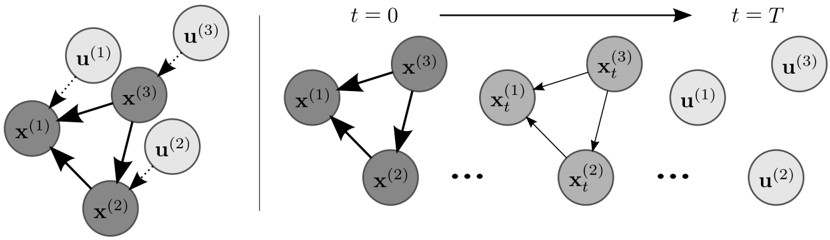
The diagram illustrates a dynamic system evolving from an initial state at time `t = 0` to a final state at time `t = T`. It depicts nodes labeled `x(1)`, `x(2)`, `x(3)` (system states) and `u(1)`, `u(2)`, `u(3)` (external inputs or controls), connected by directional arrows indicating transitions or dependencies. The system progresses through discrete time steps, with intermediate states marked as `x_t(1)`, `x_t(2)`, `x_t(3)` at time `t`.
---
### Components/Axes
- **Nodes**:
- **System States**: `x(1)`, `x(2)`, `x(3)` (dark gray circles at `t = 0`; lighter gray circles at `t = T`).
- **Inputs/Controls**: `u(1)`, `u(2)`, `u(3)` (light gray circles at `t = 0` and `t = T`).
- **Arrows**:
- Solid arrows: Represent deterministic transitions between system states (e.g., `x(1) → x(2)`).
- Dashed arrows: Represent probabilistic or external influences from inputs (e.g., `u(1) → x(3)`).
- **Timeline**:
- Horizontal axis labeled `t = 0` (left) to `t = T` (right), indicating temporal progression.
- Intermediate states at time `t` are denoted as `x_t(1)`, `x_t(2)`, `x_t(3)`.
---
### Detailed Analysis
1. **Initial State (`t = 0`)**:
- System states `x(1)`, `x(2)`, `x(3)` are interconnected via solid arrows, suggesting internal dynamics.
- Inputs `u(1)`, `u(2)`, `u(3)` are connected to system states via dashed arrows, indicating external perturbations.
2. **Intermediate State (`t`)**:
- System states evolve to `x_t(1)`, `x_t(2)`, `x_t(3)`, maintaining the same connectivity pattern as `t = 0`.
- Inputs remain active, influencing the system via dashed arrows.
3. **Final State (`t = T`)**:
- System states `x(1)`, `x(2)`, `x(3)` reappear, implying cyclical or steady-state behavior.
- Inputs `u(1)`, `u(2)`, `u(3)` persist, maintaining their influence.
4. **Flow Direction**:
- Arrows point from left (`t = 0`) to right (`t = T`), emphasizing temporal progression.
- Dashed arrows from inputs to states suggest feedback loops or external dependencies.
---
### Key Observations
- **Cyclical Behavior**: The system returns to its initial state at `t = T`, suggesting periodic or recurrent dynamics.
- **Input Influence**: External inputs (`u(1)`, `u(2)`, `u(3)`) consistently affect system states across all time steps.
- **State Transitions**: Solid arrows between `x(1)`, `x(2)`, `x(3)` imply deterministic relationships (e.g., state `x(1)` transitions to `x(2)` and `x(3)`).
---
### Interpretation
This diagram likely represents a **state-space model** or **Markov process**, where:
- **System states** (`x`) evolve deterministically over time, influenced by internal rules.
- **Inputs** (`u`) act as stochastic or external drivers, perturbing the system at each time step.
- The cyclical return to `t = T` suggests the system may be part of a feedback loop or control system designed to stabilize or repeat behavior.
The structure aligns with applications in **control theory**, **machine learning** (e.g., recurrent neural networks), or **system dynamics**, where states and inputs interact over time. The absence of numerical values implies a conceptual or schematic representation rather than a quantitative analysis.