## Diagram: Language Model Processing Workflow with GPU Cluster
### Overview
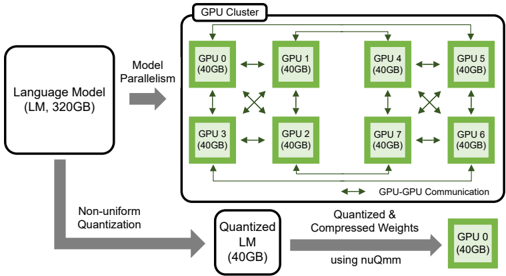
The diagram illustrates a technical workflow for processing a large language model (LM) across a GPU cluster, emphasizing model parallelism, quantization, and compression techniques. The LM (320GB) is distributed across 8 GPUs (each 40GB) via model parallelism, with additional paths for non-uniform quantization and weight compression using nuQmm.
### Components/Axes
- **Language Model (LM)**: 320GB, input to the workflow.
- **Model Parallelism**: Splits the LM across 8 GPUs (GPU 0–7), each with 40GB capacity.
- **GPU Cluster**: Contains 8 GPUs (GPU 0–7), interconnected with bidirectional communication arrows.
- **Non-uniform Quantization**: Reduces LM size to 40GB.
- **Quantized & Compressed Weights**: Further optimized using nuQmm, stored in GPU 0 (40GB).
- **Arrows**: Indicate data flow (e.g., GPU-GPU communication, quantization paths).
### Detailed Analysis
1. **Model Parallelism**:
- The 320GB LM is split across 8 GPUs (GPU 0–7), each handling 40GB. Arrows show bidirectional communication between GPUs (e.g., GPU 0 ↔ GPU 1, GPU 3 ↔ GPU 2).
- GPUs are arranged in two rows (top: GPU 0–5; bottom: GPU 3–7), with diagonal arrows suggesting inter-GPU data exchange.
2. **Quantization Path**:
- Non-uniform quantization reduces the LM from 320GB to 40GB, bypassing the GPU cluster.
3. **Compression Path**:
- Quantized weights are further compressed using nuQmm, resulting in a 40GB model stored in GPU 0.
### Key Observations
- **Memory Optimization**: The workflow demonstrates how quantization and compression reduce the LM’s memory footprint from 320GB to 40GB, enabling deployment on a single GPU (GPU 0).
- **Parallelism Overhead**: Despite parallelism, GPU-GPU communication is required, implying potential latency or bandwidth constraints.
- **Final Output**: The compressed model resides solely in GPU 0, suggesting a centralized deployment after distributed processing.
### Interpretation
This diagram highlights strategies for deploying large language models on constrained hardware. Model parallelism distributes the workload across GPUs, while quantization and compression optimize memory usage. The bidirectional GPU communication indicates collaborative processing, but the final compressed model’s isolation in GPU 0 suggests a trade-off between distributed training and centralized inference. The use of nuQmm for compression implies a focus on efficiency without sacrificing model performance. The workflow underscores the balance between scalability (parallelism) and resource constraints (quantization/compression).