## Text Block: Ball Collision Problem Setup
### Overview
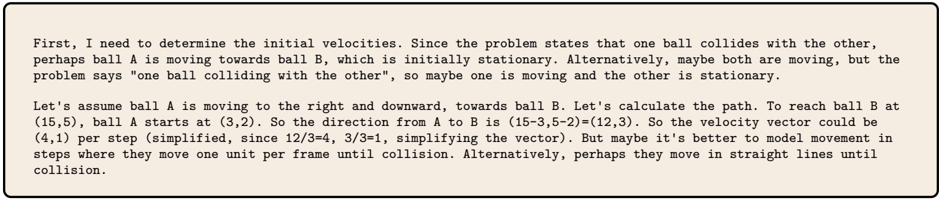
The image contains a block of text describing the initial setup and assumptions for a ball collision problem. It outlines the possible scenarios for the balls' initial velocities and proposes a method for calculating the path of ball A towards ball B.
### Components/Axes
There are no axes or scales in this image. The content is purely textual.
### Detailed Analysis or ### Content Details
The text can be transcribed as follows:
"First, I need to determine the initial velocities. Since the problem states that one ball collides with the other, perhaps ball A is moving towards ball B, which is initially stationary. Alternatively, maybe both are moving, but the problem says "one ball colliding with the other", so maybe one is moving and the other is stationary.
Let's assume ball A is moving to the right and downward, towards ball B. Let's calculate the path. To reach ball B at (15,5), ball A starts at (3,2). So the direction from A to B is (15-3,5-2)=(12,3). So the velocity vector could be (4,1) per step (simplified, since 12/3=4, 3/3=1, simplifying the vector). But maybe it's better to model movement in steps where they move one unit per frame until collision. Alternatively, perhaps they move in straight lines until collision."
### Key Observations
* The problem involves two balls, A and B.
* One ball collides with the other.
* Ball B is initially considered stationary, but the text also considers the possibility of both balls moving.
* Ball A is assumed to be moving to the right and downward towards ball B.
* Ball A starts at coordinates (3,2) and ball B is at (15,5).
* The displacement vector from A to B is calculated as (12,3).
* A simplified velocity vector of (4,1) per step is proposed.
* Alternative movement models are considered: one unit per frame or straight lines until collision.
### Interpretation
The text lays out the initial conditions and assumptions for a physics problem involving the collision of two balls. It explores different possibilities for the balls' initial states and proposes a method for calculating the trajectory of ball A. The text also suggests alternative approaches to modeling the movement of the balls, indicating that the problem is still in the initial stages of development. The problem is setting up a simulation or calculation of a collision.