\n
## Text Block: Problem-Solving Notes
### Overview
The image contains a block of text representing handwritten notes, likely related to a physics problem involving colliding balls. The notes detail the thought process of determining initial velocities and calculating the path of one ball towards another.
### Content Details
The text can be transcribed as follows:
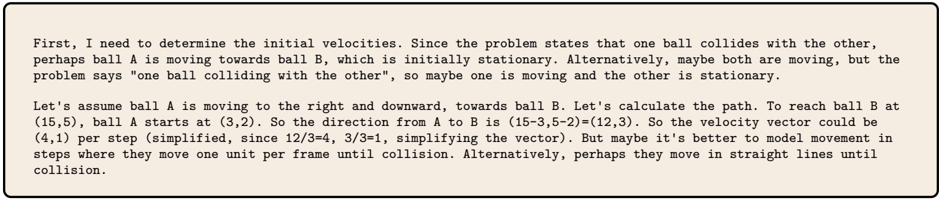
"First, I need to determine the initial velocities. Since the problem states that one ball collides with the other, perhaps ball A is moving towards ball B, which is initially stationary. Alternatively, maybe both are moving, but the problem says "one ball colliding with the other", so maybe one is moving and the other is stationary.
Let's assume ball A is moving to the right and downward, towards ball B. Let's calculate the path. To reach ball B at (15,5), ball A starts at (3,2). So the direction from A to B is (15-3, 5-2)=(12,3). So the velocity vector could be (4,1) per step (simplified, since 12/3=4, 3/3=1, simplifying the vector). But maybe it's better to model movement in steps where they move one unit per frame until collision. Alternatively, perhaps move in straight lines until collision."
### Key Observations
The notes demonstrate a step-by-step approach to problem-solving, including considering different scenarios and simplifying calculations. The coordinates (3,2) and (15,5) are explicitly mentioned, representing the starting and ending positions of ball A and B respectively. The velocity vector (4,1) is proposed as a simplified solution.
### Interpretation
The text represents a preliminary stage of solving a physics problem. The author is exploring different assumptions about the initial conditions (whether one or both balls are moving) and attempting to calculate the velocity vector needed for ball A to reach ball B. The notes highlight the iterative nature of problem-solving, where initial assumptions are tested and refined. The mention of "simplifying the vector" suggests an attempt to find a more manageable representation of the motion. The consideration of different movement models (step-by-step vs. straight lines) indicates an awareness of the potential complexities of the problem. The notes are not a final solution, but rather a record of the thought process involved in approaching the problem.