## Text Block: Physics Problem Reasoning
### Overview
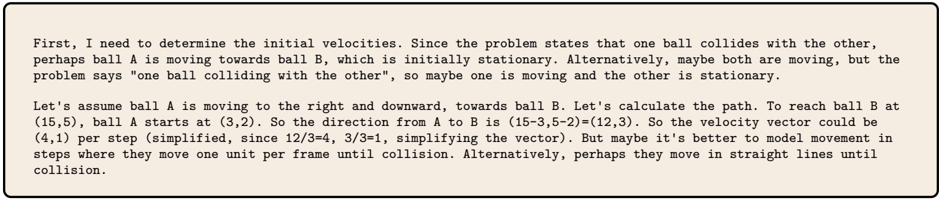
The image displays a block of text, likely from a digital document or note-taking application. The text contains a person's reasoning process for setting up a physics or programming problem involving the collision of two balls. It is a monologue exploring initial conditions, movement vectors, and modeling strategies.
### Content Details
The text is in English and is transcribed verbatim below:
**First Paragraph:**
"First, I need to determine the initial velocities. Since the problem states that one ball collides with the other, perhaps ball A is moving towards ball B, which is initially stationary. Alternatively, maybe both are moving, but the problem says "one ball colliding with the other", so maybe one is moving and the other is stationary."
**Second Paragraph:**
"Let's assume ball A is moving to the right and downward, towards ball B. Let's calculate the path. To reach ball B at (15,5), ball A starts at (3,2). So the direction from A to B is (15-3,5-2)=(12,3). So the velocity vector could be (4,1) per step (simplified, since 12/3=4, 3/3=1, simplifying the vector). But maybe it's better to model movement in steps where they move one unit per frame until collision. Alternatively, perhaps they move in straight lines until collision."
### Key Observations
1. **Problem Context:** The text is not a solution but a *reasoning process* about how to model a problem. The core problem involves two balls (A and B) and a collision.
2. **Assumptions:** The author makes and questions several assumptions:
* Initial state: One ball moving, one stationary vs. both moving.
* Direction: Ball A moves "right and downward" from (3,2) towards Ball B at (15,5).
* Movement Model: Discrete steps per frame vs. continuous straight-line motion.
3. **Mathematical Content:**
* Coordinates are given as ordered pairs: Ball A start `(3,2)`, Ball B target `(15,5)`.
* A displacement vector is calculated: `(15-3, 5-2) = (12, 3)`.
* A simplified velocity vector is proposed: `(4, 1)` per step, derived by dividing the displacement vector components by 3.
4. **Language & Style:** The writing is informal, first-person, and exploratory, using phrases like "perhaps," "maybe," and "let's assume." It reads like a developer's or student's working notes.
### Interpretation
This text captures the **initial, exploratory phase of problem-solving** for a simulation or physics calculation. The author is translating a vague problem statement ("one ball colliding with the other") into concrete, computable parameters.
* **What it demonstrates:** The process of moving from an abstract concept to a defined model. Key decisions being grappled with include: defining initial states, choosing a coordinate system, and selecting a movement algorithm (discrete vs. continuous).
* **Relationship between elements:** The text shows a logical flow: 1) Identify the core question (initial velocities), 2) Propose scenarios based on the problem statement, 3) Select one scenario to explore numerically, 4) Calculate derived values (direction vector), 5) Propose a simplified model (velocity vector), and 6) Immediately question that model in favor of alternatives.
* **Notable Insight:** The simplification of the vector `(12,3)` to `(4,1)` by dividing by 3 is interesting. It suggests the author might be thinking in terms of a greatest common divisor (GCD) to find a minimal integer step vector, which is a common technique in grid-based or discrete movement simulations. The immediate consideration of "one unit per frame" movement indicates a preference for, or at least a strong consideration of, a discrete time-step simulation model, which is typical in game development or basic computational physics.