## Text Block: Problem Analysis of Ball Collision Dynamics
### Overview
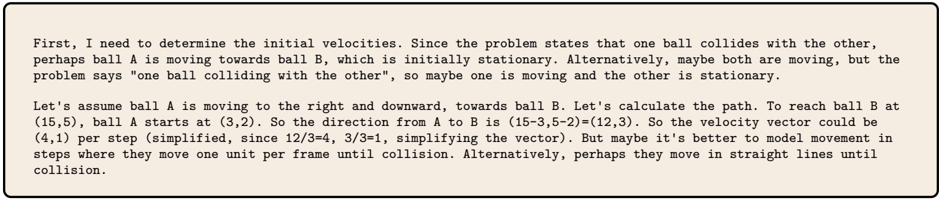
The text describes a physics problem involving two balls (A and B) where one collides with the other. It outlines assumptions about initial velocities, movement directions, and collision dynamics. Key elements include coordinate positions, velocity vector calculations, and assumptions about motion (e.g., straight-line paths until collision).
### Components/Axes
- **No axes, legends, or numerical scales** present in the text block.
- **Key terms**: "velocity vector," "collision," "stationary," "direction," "coordinates."
### Detailed Analysis
1. **Problem Setup**:
- Ball A is assumed to move toward Ball B, which is initially stationary.
- Coordinates: Ball A starts at (3,2); Ball B is at (15,5).
- Direction vector from A to B: (15−3, 5−2) = (12,3).
- Simplified velocity vector: (4,1) per step (derived from 12/3=4, 3/3=1).
2. **Motion Assumptions**:
- Movement modeled in discrete steps (1 unit per frame) along straight lines until collision.
- Alternate interpretation: Both balls may move, but the problem specifies "one ball colliding with the other," implying one is stationary.
3. **Calculations**:
- Direction vector simplification: (12,3) → (4,1) by dividing by 3.
- No explicit time or velocity magnitude provided; focus on directional ratios.
### Key Observations
- The problem emphasizes directional ratios over absolute velocity values.
- Ambiguity exists about whether both balls move or only one (Ball A).
- Coordinates and vector simplification are central to solving the collision dynamics.
### Interpretation
The text outlines a foundational physics problem where spatial relationships and vector simplification are critical. The assumption of straight-line motion until collision suggests a simplified model, likely for educational purposes. The lack of explicit time or energy considerations implies the focus is on kinematic analysis rather than dynamic forces. The directional vector (4,1) highlights the proportional movement required for Ball A to intercept Ball B, emphasizing geometric reasoning over real-world physics complexities.