## Workflow Diagram: Nixpkgs Build Analysis
### Overview
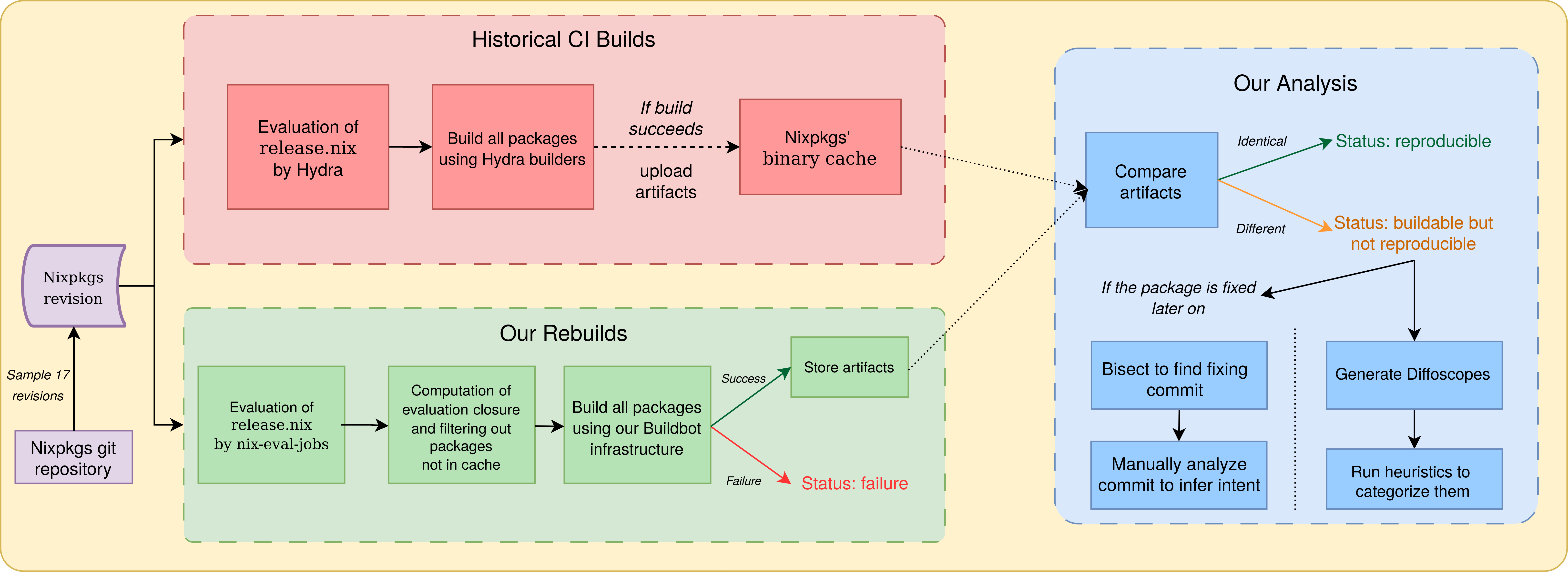
The image is a workflow diagram illustrating the process of analyzing Nixpkgs builds, comparing historical CI builds with rebuilds, and diagnosing issues. It outlines the steps from obtaining Nixpkgs revisions to categorizing differences and determining reproducibility.
### Components/Axes
* **Overall Structure**: The diagram is divided into three main sections: "Historical CI Builds" (top, red), "Our Rebuilds" (bottom, green), and "Our Analysis" (right, blue). A starting point on the left shows the "Nixpkgs revision" and "Nixpkgs git repository" (purple).
* **Nodes**: The diagram uses rectangular boxes to represent processes or data stores. Arrows indicate the flow of information or actions.
* **Decision Points**: Conditional statements are included, such as "If build succeeds" and "If the package is fixed later on."
* **Status Indicators**: Color-coded status indicators are used, such as "Status: reproducible" (green), "Status: buildable but not reproducible" (orange), and "Status: failure" (red).
### Detailed Analysis or ### Content Details
1. **Nixpkgs Revision Source (Left)**:
* "Nixpkgs revision" (purple box)
* "Sample 17 revisions" text pointing to "Nixpkgs git repository" (purple box)
2. **Historical CI Builds (Top, Red)**:
* "Evaluation of release.nix by Hydra"
* "Build all packages using Hydra builders"
* "If build succeeds upload artifacts"
* "Nixpkgs' binary cache"
3. **Our Rebuilds (Bottom, Green)**:
* "Evaluation of release.nix by nix-eval-jobs"
* "Computation of evaluation closure and filtering out packages not in cache"
* "Build all packages using our Buildbot infrastructure"
* "Success" (green arrow) -> "Store artifacts"
* "Failure" (red arrow) -> "Status: failure" (red text)
4. **Our Analysis (Right, Blue)**:
* "Compare artifacts"
* "Identical" (green arrow) -> "Status: reproducible" (green text)
* "Different" (orange arrow) -> "Status: buildable but not reproducible" (orange text)
* "If the package is fixed later on"
* "Bisect to find fixing commit"
* "Manually analyze commit to infer intent"
* "Generate Diffoscopes"
* "Run heuristics to categorize them"
### Key Observations
* The diagram contrasts historical CI builds with a rebuild process to identify and analyze differences.
* The analysis focuses on determining whether builds are reproducible.
* The workflow includes steps to diagnose and categorize issues when builds are not reproducible.
### Interpretation
The diagram illustrates a systematic approach to ensuring the reproducibility of Nixpkgs builds. It starts with obtaining Nixpkgs revisions, comparing historical builds with rebuilds, and then analyzing any discrepancies. The "Our Analysis" section provides a detailed process for identifying the root causes of non-reproducible builds, including bisecting to find the fixing commit, manually analyzing commits, generating diffoscopes, and running heuristics to categorize the issues. The ultimate goal is to improve the reliability and consistency of Nixpkgs builds.