\n
## Diagram: Nixpkgs Build and Analysis Workflow
### Overview
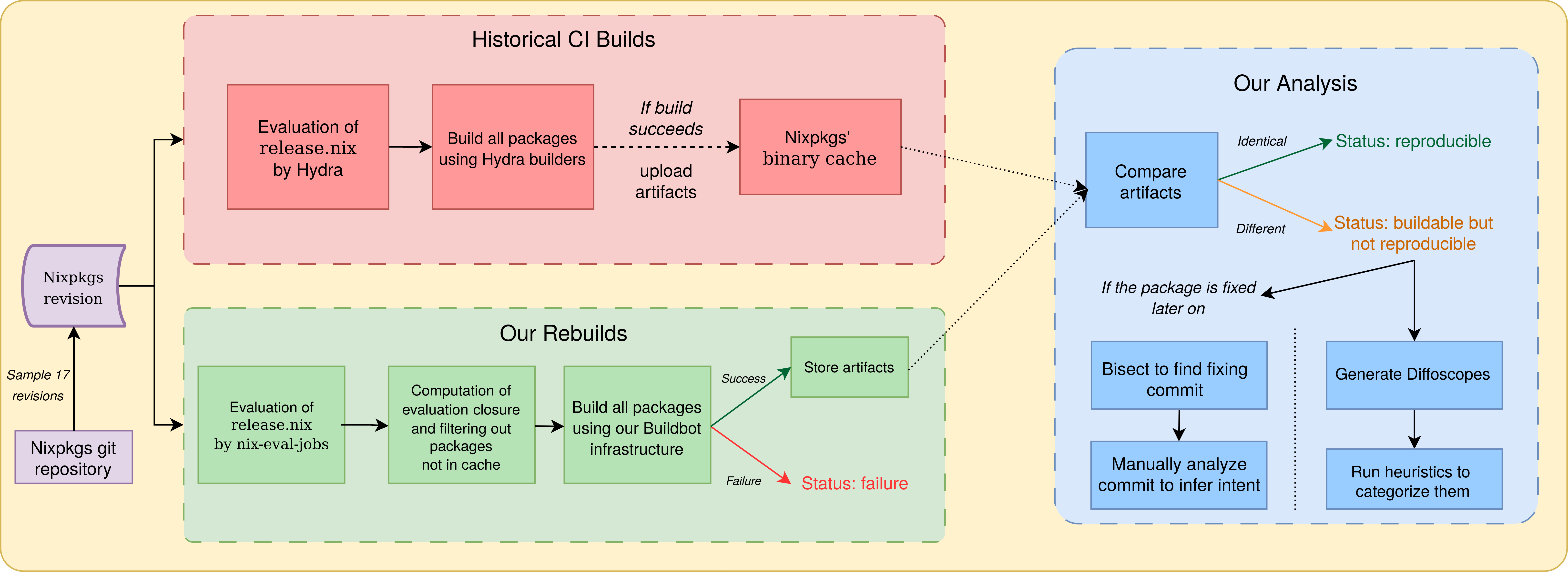
This diagram illustrates the workflow for evaluating Nixpkgs revisions, including historical CI builds and a new analysis pipeline. It details the process from revision sampling to artifact comparison and failure analysis. The diagram is divided into three main sections: "Historical CI Builds", "Our Rebuilds", and "Our Analysis", with connections showing data flow between them.
### Components/Axes
The diagram consists of rectangular blocks representing processes or states, connected by arrows indicating the flow of data or control. Key components include:
* **Nixpkgs revision:** The starting point, with a note indicating "Sample 17 revisions" from the "Nixpkgs git repository".
* **Evaluation of release.nix by Hydra:** A process within "Historical CI Builds".
* **Build all packages using Hydra builders:** A process within "Historical CI Builds".
* **Nixpkgs' binary cache:** A storage location within "Historical CI Builds".
* **Evaluation of release.nix by nix-eval-jobs:** A process within "Our Rebuilds".
* **Computation of evaluation closure and filtering out packages not in cache:** A process within "Our Rebuilds".
* **Build all packages using Buildbot infrastructure:** A process within "Our Rebuilds".
* **Compare artifacts:** A process within "Our Analysis".
* **Bisect to find fixing commit:** A process within "Our Analysis".
* **Generate Diffoscopes:** A process within "Our Analysis".
* **Manually analyze commit to infer intent:** A process within "Our Analysis".
* **Run heuristics to categorize them:** A process within "Our Analysis".
* **Status indicators:** "Reproducible", "Buildable but not reproducible", "Failure".
### Detailed Analysis or Content Details
The diagram shows the following flow:
1. **Historical CI Builds:**
* Nixpkgs revisions are sampled from the Nixpkgs git repository (17 revisions).
* These revisions are evaluated by Hydra.
* Hydra builds all packages using Hydra builders.
* If the build succeeds, artifacts are uploaded to the Nixpkgs' binary cache.
2. **Our Rebuilds:**
* Nixpkgs revisions are evaluated by nix-eval-jobs.
* The evaluation closure is computed, filtering out packages not in the cache.
* All packages are built using Buildbot infrastructure.
* The process has a "Success" or "Failure" status indicator.
3. **Our Analysis:**
* Artifacts from the Historical CI Builds and Our Rebuilds are compared.
* If the artifacts are identical, the status is "reproducible".
* If the artifacts are different, the status is "buildable but not reproducible".
* If the package is fixed later on, a bisect is performed to find the fixing commit.
* Diffoscopes are generated.
* The commit is manually analyzed to infer intent.
* Heuristics are run to categorize the commits.
The diagram uses dashed arrows to indicate asynchronous or less direct data flow. The "If build succeeds" and "If the package is fixed later on" branches indicate conditional paths.
### Key Observations
* The diagram highlights a comparison between historical builds (Hydra) and a new rebuild process (Buildbot).
* The "Our Analysis" section focuses on identifying reproducibility issues.
* The workflow includes both automated (artifact comparison, bisecting) and manual (intent analysis) steps.
* The diagram emphasizes the importance of the Nixpkgs binary cache in the build process.
### Interpretation
The diagram represents a quality assurance and reproducibility pipeline for Nixpkgs. The core goal is to ensure that builds are reproducible over time. The comparison of artifacts from historical and rebuilt packages is crucial for identifying regressions or inconsistencies. The inclusion of manual analysis suggests that automated tools alone are insufficient for fully understanding the reasons behind build failures or reproducibility issues. The bisecting process and diffoscope generation are standard techniques for pinpointing the source of changes and understanding their impact. The overall workflow demonstrates a commitment to maintaining the integrity and reliability of the Nixpkgs package collection. The diagram suggests a shift from relying solely on historical CI builds to a more proactive rebuild and analysis approach.