## Flowchart: CI/CD Pipeline Analysis and Rebuild Process
### Overview
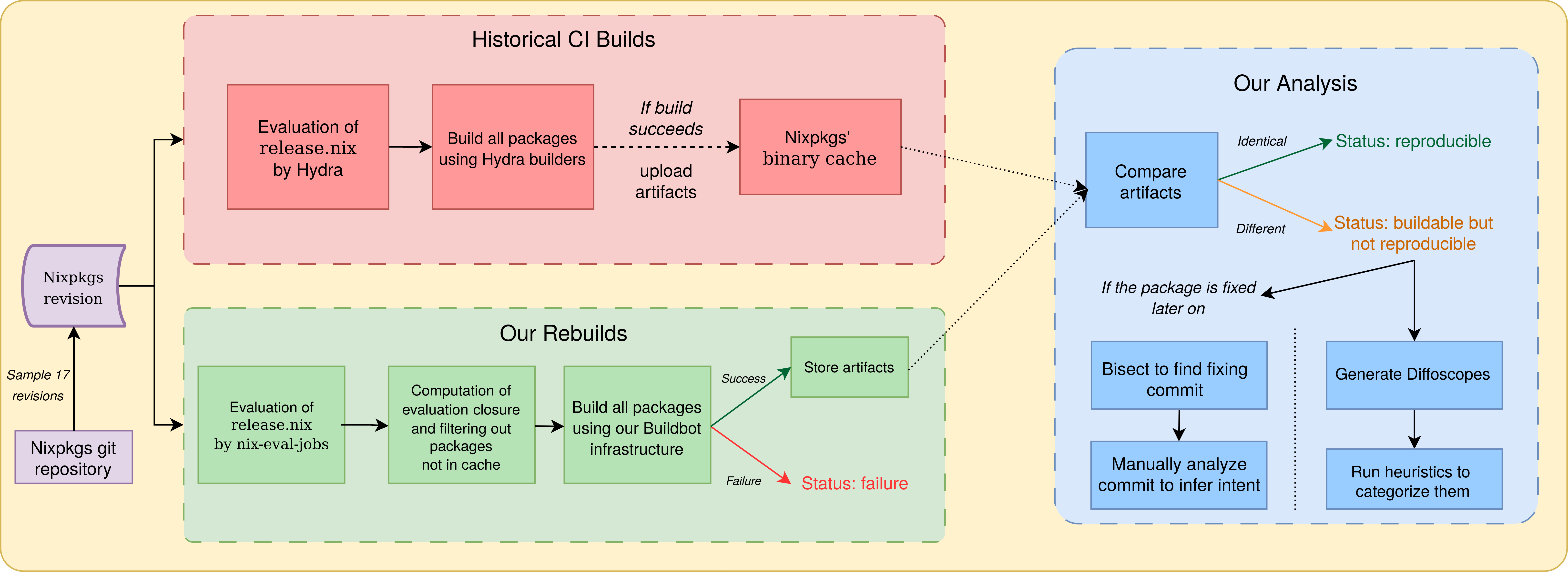
The flowchart illustrates a comparative analysis of historical CI builds versus rebuilt packages, focusing on reproducibility and build success. It includes three main sections:
1. **Historical CI Builds** (pink)
2. **Our Rebuilds** (green)
3. **Our Analysis** (blue)
The process begins with sampling 17 revisions from the Nixpkgs git repository and evaluates reproducibility through artifact comparison and heuristic analysis.
---
### Components/Axes
#### Labels and Flow:
- **Historical CI Builds (Top-Left, Pink Boxes):**
- Evaluation of `release.nix` by Hydra
- Build all packages using Hydra builders
- Conditional upload of artifacts to Nixpkgs' binary cache (if build succeeds)
- **Our Rebuilds (Bottom-Left, Green Boxes):**
- Evaluation of `release.nix` by `nix-eval-jobs`
- Computation of evaluation closure and filtering out packages not in cache
- Build all packages using Buildbot infrastructure
- Conditional storage of artifacts (if success) or failure status (if failure)
- **Our Analysis (Top-Right, Blue Boxes):**
- Compare artifacts (from historical vs. rebuilt builds)
- **Identical artifacts:** Status = reproducible
- **Different artifacts:** Status = buildable but not reproducible
- If package is fixed later:
- Bisect to find fixing commit
- Manually analyze commit to infer intent
- Generate Diffscopes
- Run heuristics to categorize them
#### Colors and Placement:
- **Pink:** Historical CI Builds (top-left quadrant)
- **Green:** Our Rebuilds (bottom-left quadrant)
- **Blue:** Our Analysis (top-right quadrant)
- Arrows indicate flow direction, with dotted lines for conditional paths.
---
### Detailed Analysis
#### Historical CI Builds:
1. **Evaluation of `release.nix` by Hydra** →
2. **Build all packages using Hydra builders** →
- If build succeeds: Upload artifacts to Nixpkgs' binary cache.
#### Our Rebuilds:
1. **Evaluation of `release.nix` by `nix-eval-jobs`** →
2. **Computation of evaluation closure and filtering out packages not in cache** →
3. **Build all packages using Buildbot infrastructure** →
- Success: Store artifacts.
- Failure: Status = failure.
#### Our Analysis:
1. **Compare artifacts** →
- **Identical:** Status = reproducible.
- **Different:** Status = buildable but not reproducible.
- If package is fixed later:
- Bisect to find fixing commit.
- Manually analyze commit to infer intent.
- Generate Diffscopes → Run heuristics to categorize them.
---
### Key Observations
1. **Reproducibility Focus:** The process emphasizes identifying whether rebuilt packages match historical builds (reproducible) or diverge (not reproducible).
2. **Conditional Logic:** Artifact upload/storage depends on build success/failure.
3. **Heuristic Analysis:** Diffscopes and manual commit analysis are used to diagnose reproducibility issues.
4. **Sampling:** Only 17 revisions are sampled from the Nixpkgs git repository for evaluation.
---
### Interpretation
- **Purpose:** The flowchart demonstrates a systematic approach to validate CI/CD pipeline reliability by comparing historical and rebuilt artifacts.
- **Key Relationships:**
- Historical builds (Hydra) serve as the baseline for reproducibility checks.
- Rebuilds (Buildbot) are tested against this baseline.
- Analysis steps (bisecting, Diffscopes) address discrepancies to improve future builds.
- **Notable Patterns:**
- Reproducibility is prioritized over mere build success.
- Manual intervention (commit analysis) is reserved for unresolved cases.
- **Anomalies:**
- No explicit metrics (e.g., success rates) are provided, leaving quantitative validation incomplete.
- The flowchart assumes access to Nixpkgs' binary cache and Buildbot infrastructure, which may not be universally applicable.
This diagram provides a high-level workflow but lacks granular data (e.g., failure rates, time metrics) for deeper insights.