## Diagram: Bridge Collapse Scenario with Structural Failure Labels
### Overview
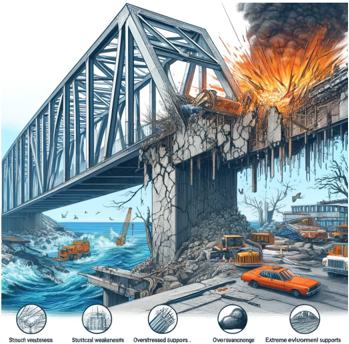
The image depicts a catastrophic bridge collapse scenario. A steel truss bridge is shown mid-collapse into turbulent waters, with debris scattered across the structure and surrounding area. Emergency vehicles (fire trucks, cranes) and an orange car are visible on the collapsed section. The scene includes labeled annotations for structural failure points, positioned at the bottom of the image.
### Components/Axes
**Labels and Descriptions** (bottom of image, circular icons with text):
1. **Structural weaknesses** (repeated twice, left side)
2. **Overstressed supports** (repeated twice, center)
3. **Extreme environmental supports** (right side)
**Spatial Grounding**:
- Labels are arranged horizontally at the bottom of the image.
- Each label is enclosed in a circular icon with a gray background and black text.
- No axis titles, legends, or numerical scales are present.
### Detailed Analysis
- **Structural weaknesses**: Positioned on the left side of the bridge’s collapsed section. The text appears twice, possibly indicating multiple failure points in the bridge’s steel framework.
- **Overstressed supports**: Centered beneath the bridge’s main span. Repeated twice, suggesting critical failure in the concrete pillars or foundational supports.
- **Extreme environmental supports**: Located on the right side, near the explosion. This label may refer to external forces (e.g., wind, water pressure, or seismic activity) exacerbating the collapse.
### Key Observations
- The bridge’s collapse is visually tied to the labeled failure points: structural weaknesses in the truss framework, overstressed supports in the pillars, and environmental stressors.
- The explosion on the right side of the bridge aligns with the "Extreme environmental supports" label, implying a possible trigger (e.g., gas leak, fire, or structural overload).
- No numerical data or quantitative values are provided; the image focuses on qualitative failure modes.
### Interpretation
The diagram illustrates a multi-factor structural failure scenario:
1. **Primary Causes**: Structural weaknesses in the bridge’s steel trusses and overstressed supports in the concrete pillars likely led to initial instability.
2. **Triggering Event**: The explosion on the right side (linked to "Extreme environmental supports") may have acted as a catalyst, overwhelming the already compromised structure.
3. **Secondary Effects**: Debris in the water and emergency vehicles suggest downstream consequences, such as flooding risks or rescue operations.
The image emphasizes the interplay between design flaws, material stress, and external environmental forces in infrastructure failure. The repetition of "Structural weaknesses" and "Overstressed supports" underscores systemic vulnerabilities rather than isolated incidents.