## 4. Model Explanations
### Overview
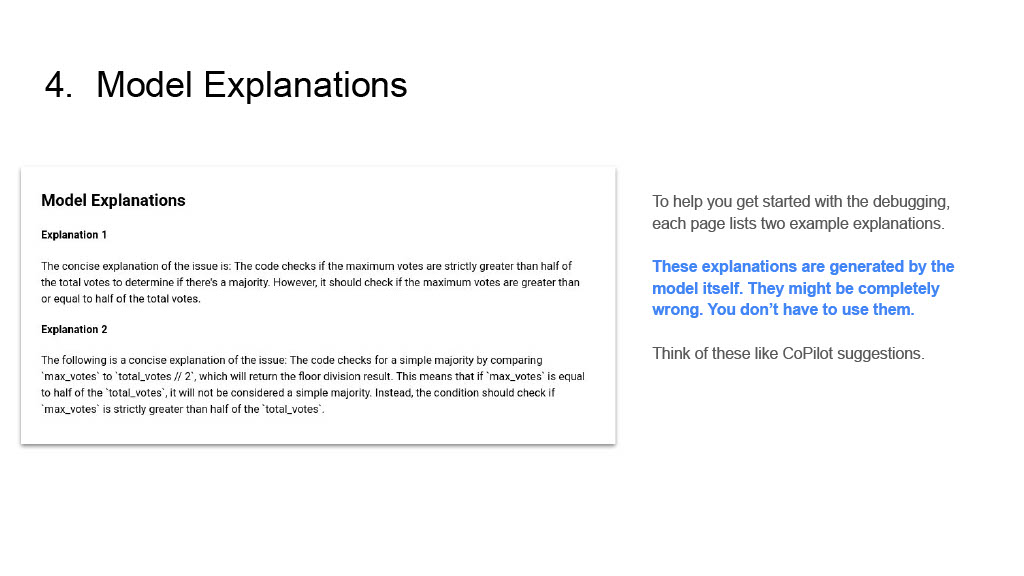
The image contains a section titled "Model Explanations" which provides two explanations for a coding issue related to determining if there is a majority of votes. The explanations are presented in a structured format with clear headings and detailed descriptions.
### Components/Axes
- **Explanation 1**: This explanation discusses the code's logic for checking if the maximum votes are strictly greater than half of the total votes to determine if there is a majority. It also mentions that the code should check if the maximum votes are greater than or equal to half of the total votes.
- **Explanation 2**: This explanation provides a concise explanation of the issue, stating that the code checks for a simple majority by comparing `max_votes` to `total_votes / 2`. It clarifies that if `max_votes` is equal to half of `total_votes`, it will not be considered a simple majority, and the condition should check if `max_votes` is strictly greater than half of `total_votes`.
### Detailed Analysis or ### Content Details
- **Explanation 1**: The explanation emphasizes the importance of checking if the maximum votes are strictly greater than half of the total votes to ensure a clear majority. It also highlights the need to consider the case where the maximum votes are equal to half of the total votes.
- **Explanation 2**: The explanation focuses on the logic of checking for a simple majority by dividing the total votes by 2. It corrects the misconception that a simple majority can be achieved if `max_votes` is equal to half of `total_votes`.
### Key Observations
- **Explanation 1**: The explanation correctly identifies the need for a strict condition to determine a majority.
- **Explanation 2**: The explanation correctly identifies the need for a condition that checks if `max_votes` is strictly greater than half of `total_votes` to determine a simple majority.
### Interpretation
The data suggests that there are two different approaches to determining if there is a majority of votes. Explanation 1 provides a more rigorous approach by checking if the maximum votes are strictly greater than half of the total votes, while Explanation 2 provides a simpler approach by checking if `max_votes` is equal to half of `total_votes`. The interpretation highlights the importance of considering the specific requirements of the problem when determining the appropriate approach.