TECHNICAL ASSET FINGERPRINT
ccc3db56ff19b755a53efdc9
Click to view fullscreen
Press ESC or click to close
FOUND IN PAPERS
EXPERT: healer-alpha-free VERSION 1
RUNTIME: free/openrouter/healer-alpha
INTEL_VERIFIED
## Paper Folding Problem with Cutouts: Technical Document Extraction
### Overview
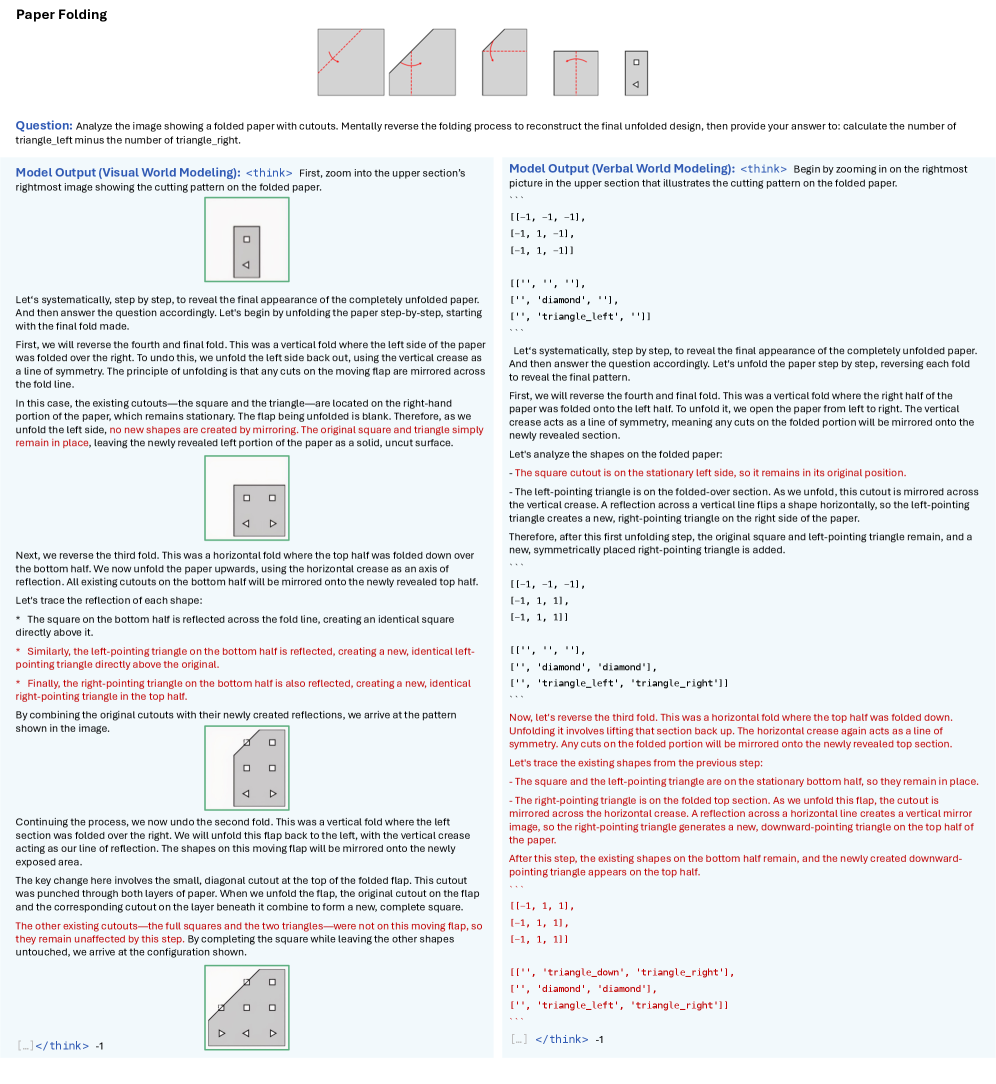
The image presents a spatial reasoning problem titled "Paper Folding." It displays a sequence of diagrams illustrating a piece of paper being folded and cut, followed by a question asking the viewer to mentally reverse the process to determine the final unfolded pattern. The image includes two detailed model outputs ("Visual World Modeling" and "Verbal World Modeling") that provide step-by-step reasoning to solve the problem.
### Components/Axes
The image is structured into three main sections:
1. **Header & Problem Statement:** Contains the title "Paper Folding," a sequence of five diagrams showing the folding and cutting process, and the core question.
2. **Left Column - Model Output (Visual World Modeling):** A detailed, step-by-step visual and textual explanation of the unfolding process, accompanied by four intermediate diagrams showing the paper's state after each unfolding step.
3. **Right Column - Model Output (Verbal World Modeling):** A parallel, text-heavy explanation of the same unfolding process, using descriptive language and grid-based array representations to track the shapes.
**Key Textual Elements:**
* **Title:** "Paper Folding"
* **Question:** "Analyze the image showing a folded paper with cutouts. Mentally reverse the folding process to reconstruct the final unfolded design, then provide your answer to: calculate the number of triangle_left minus the number of triangle_right."
* **Model Output Headers:** "Model Output (Visual World Modeling):" and "Model Output (Verbal World Modeling):"
* **Thinking Tags:** Both models begin with `` tags, indicating an internal reasoning process.
* **Shape Labels:** The text consistently refers to specific cutout shapes: "square," "triangle_left," "triangle_right," "diamond," and "triangle_down."
### Detailed Analysis
#### **Problem Sequence (Top Diagrams):**
The process is shown in five steps from left to right:
1. A square piece of paper.
2. The paper is folded vertically from left to right.
3. The paper is folded horizontally from top to bottom.
4. The paper is folded vertically again from left to right.
5. **Final Folded State & Cutouts:** The final, small rectangular folded paper has three cutouts: a square in the top-left corner and two triangles below it. The left triangle points left (`triangle_left`), and the right triangle points right (`triangle_right`).
#### **Model Output (Visual World Modeling) - Left Column:**
This model describes the unfolding process in reverse order, from the last fold to the first. Each step includes a diagram.
* **Step 1 (Reverse 4th fold):** Unfolds the final vertical fold. The cutouts (square and `triangle_left`) are on the stationary right portion. Unfolding reveals a blank left portion. **Result:** Square and `triangle_left` remain on the right side.
* **Step 2 (Reverse 3rd fold):** Unfolds the horizontal fold upwards. Shapes on the bottom half are mirrored onto the top half. The square and `triangle_left` are reflected, creating duplicates directly above them. A `triangle_right` on the bottom is also reflected, creating a duplicate above it. **Result:** A 2x2 grid: top row has square and `triangle_left`; bottom row has square and `triangle_right`.
* **Step 3 (Reverse 2nd fold):** Unfolds a vertical fold to the left. A key change occurs: a small diagonal cutout at the top of the moving flap combines with its counterpart on the stationary layer to form a complete square. The other shapes (full squares and triangles) are unaffected. **Result:** A pattern with a square in the top-left, a `triangle_left` below it, a square in the top-right, and a `triangle_right` below it.
* **Step 4 (Reverse 1st fold):** The final step is described but the accompanying diagram is cut off in the provided image. The text states the process is completed to arrive at the final configuration.
#### **Model Output (Verbal World Modeling) - Right Column:**
This model uses a more abstract, grid-based notation to track shapes. It represents the paper as a 3x3 grid (though the final paper is 2x2) using arrays. `-1` likely represents an empty cell.
* **Initial State (Folded):** Shows a grid with a `diamond` and `triangle_left`.
* **After Step 1 (Reverse 4th fold):** The grid expands. The `triangle_left` is mirrored, creating a `triangle_right`. The array shows: `[['', 'diamond', ''], ['', 'triangle_left', 'triangle_right']]`.
* **After Step 2 (Reverse 3rd fold):** The `triangle_right` is mirrored vertically across the horizontal fold, creating a `triangle_down`. The array shows: `[['', 'triangle_down', 'triangle_right'], ['', 'diamond', ''], ['', 'triangle_left', 'triangle_right']]`.
* The model's reasoning text mirrors the visual model's logic, describing reflections and symmetry for each unfolding step.
### Key Observations
1. **Dual Representation:** The problem is solved using two complementary methods: one heavily visual with diagrams, and one verbal/abstract using grid arrays.
2. **Consistent Logic:** Both models follow the same core principle: each fold creates a line of symmetry. Unfolding mirrors any cutouts from the moving section onto the newly revealed stationary section.
3. **Shape Transformation:** A critical insight is that a diagonal cut through two layers of paper (during the second fold step) results in a complete square when unfolded, not a triangle.
4. **Final Pattern Inference:** Although the final, fully unfolded diagram is not shown, the step-by-step processes from both models lead to the same conclusion. The final pattern should contain multiple squares and both left- and right-pointing triangles. The question asks for the count of `triangle_left` minus `triangle_right`.
### Interpretation
This image is a technical demonstration of spatial reasoning and procedural problem-solving. It breaks down a complex mental task (reversing a series of folds and cuts) into a verifiable, step-by-step algorithm.
* **What it demonstrates:** The core principle is **symmetry across fold lines**. Every fold creates an axis of reflection. To unfold, one must apply this reflection in reverse, copying features from the folded section to the newly opened section.
* **Relationship between elements:** The diagrams and text are tightly coupled. The visual model provides intuitive, concrete checkpoints, while the verbal model offers a formal, replicable notation. They validate each other.
* **Notable Anomaly/Insight:** The most non-intuitive step is the creation of a square from a diagonal cut. This highlights that a single cut through multiple, misaligned layers can produce unexpected shapes upon unfolding, a key concept in origami and engineering (e.g., kirigami).
* **Purpose:** The problem tests and teaches the ability to mentally manipulate 2D objects in space, a skill crucial in fields like engineering, architecture, chemistry (molecular modeling), and graphic design. The inclusion of two model outputs suggests an analysis of different problem-solving strategies (visual-spatial vs. symbolic-logical).
DECODING INTELLIGENCE...