## Screenshot: Paper Folding Analysis Document
### Overview
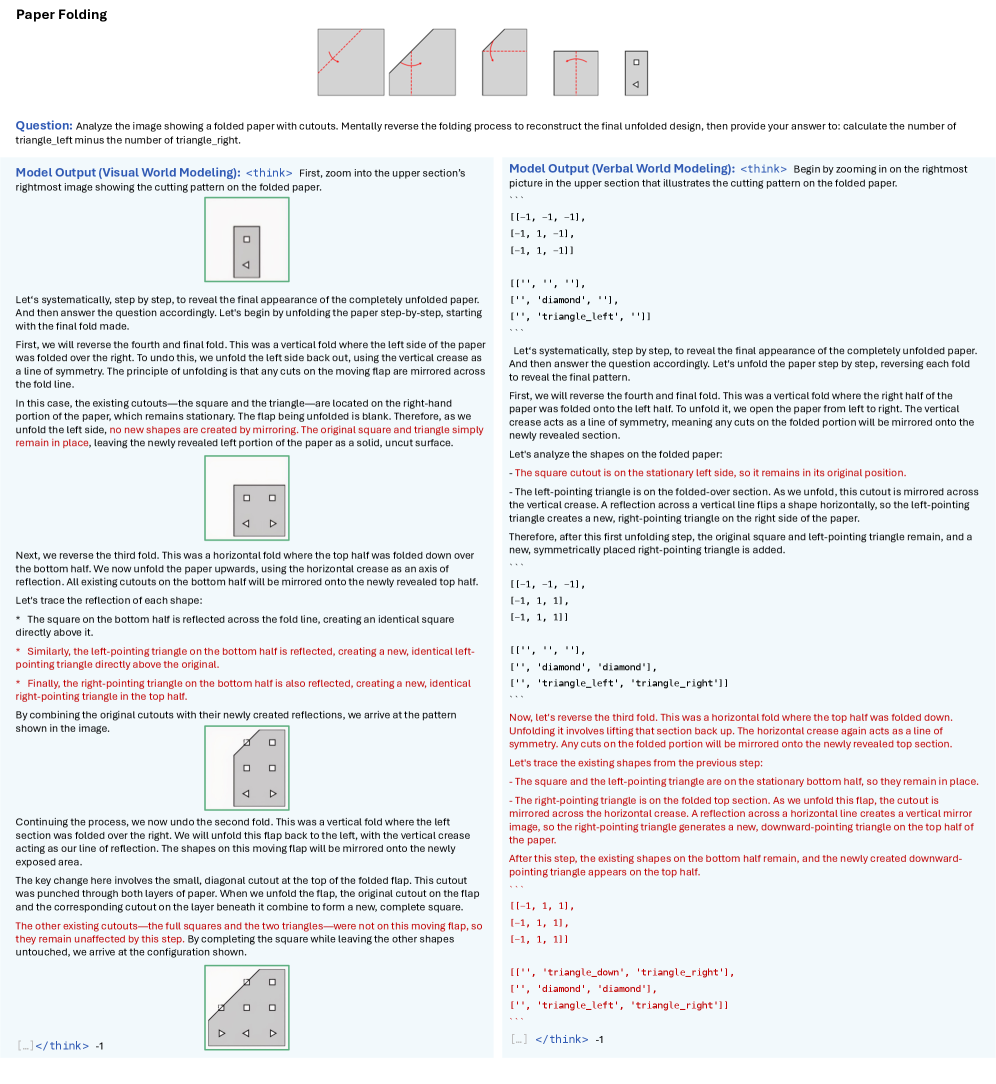
The image is a screenshot of a technical document analyzing a folded paper with cutouts. It includes diagrams illustrating the folding process, textual explanations of the model's reasoning, and code snippets for simulating the unfolding process. The document compares two model outputs: "Visual World Modeling" and "Verbal World Modeling," each with step-by-step explanations and diagrams.
### Components/Axes
- **Diagrams**:
- **Step 1**: A square paper with a vertical cutout (labeled `triangle_left` and `triangle_right`).
- **Step 2**: A folded paper with mirrored cutouts.
- **Step 3**: A partially unfolded paper with a horizontal crease.
- **Step 4**: A fully unfolded paper with mirrored cutouts.
- **Textual Explanations**:
- Descriptions of folding steps, symmetry principles, and mirroring effects.
- Code snippets simulating the unfolding process using Python `print` statements.
- **Code Snippets**:
- Variables like `triangle_down`, `triangle_right`, and `triangle_left` correspond to diagram labels.
- Print statements output labels (e.g., `['triangle_left', 'triangle_right']`).
### Detailed Analysis
#### Visual World Modeling (Left Side)
1. **Step 1**: The model identifies the original square and triangle cutouts.
- Diagram: A square with a vertical cutout labeled `triangle_left` and `triangle_right`.
- Text: "The original square and triangle simply remain in place."
2. **Step 2**: The model reverses the fourth and final fold (vertical fold).
- Diagram: A folded paper with mirrored cutouts.
- Text: "The left side of the paper was folded over the right."
3. **Step 3**: The model unfolds the third fold (horizontal fold).
- Diagram: A partially unfolded paper with a horizontal crease.
- Text: "The top half was folded down over the bottom half."
4. **Step 4**: The model combines reflections to reconstruct the original pattern.
- Diagram: A fully unfolded paper with mirrored cutouts.
- Text: "The square cutout is on the stationary left side."
#### Verbal World Modeling (Right Side)
1. **Step 1**: The model identifies the original square and triangle cutouts.
- Diagram: A square with a vertical cutout labeled `triangle_left` and `triangle_right`.
- Text: "The square cutout is on the stationary left side."
2. **Step 2**: The model reverses the fourth and final fold (vertical fold).
- Diagram: A folded paper with mirrored cutouts.
- Text: "The left side of the paper was folded over the right."
3. **Step 3**: The model unfolds the third fold (horizontal fold).
- Diagram: A partially unfolded paper with a horizontal crease.
- Text: "The top half was folded down over the bottom half."
4. **Step 4**: The model combines reflections to reconstruct the original pattern.
- Diagram: A fully unfolded paper with mirrored cutouts.
- Text: "The square cutout is on the stationary left side."
### Key Observations
- **Diagram Labels**:
- `triangle_left` and `triangle_right` are consistently labeled across diagrams.
- Numbers (e.g., `1`, `-1`) indicate mirrored or reflected positions.
- **Code Logic**:
- The code simulates unfolding by printing labels (e.g., `['triangle_left', 'triangle_right']`).
- Variables like `triangle_down` and `triangle_right` map to diagram elements.
- **Symmetry Principle**:
- The model uses mirroring to reverse folds, ensuring cutouts are repositioned correctly.
### Interpretation
The document demonstrates a method to reverse-engineer folded paper with cutouts by systematically unfolding each step. The "Visual World Modeling" approach uses diagrams to visualize the process, while the "Verbal World Modeling" approach translates this into code. The code snippets simulate the unfolding process by printing labels that correspond to the diagrams, ensuring the final pattern matches the original design. This method is critical for applications in computational geometry, origami design, and automated pattern reconstruction.
**Note**: No numerical data or trends are present; the focus is on textual and diagrammatic reasoning.