\n
## Case Study Document: Knowledge Graph Reasoning Example
### Overview
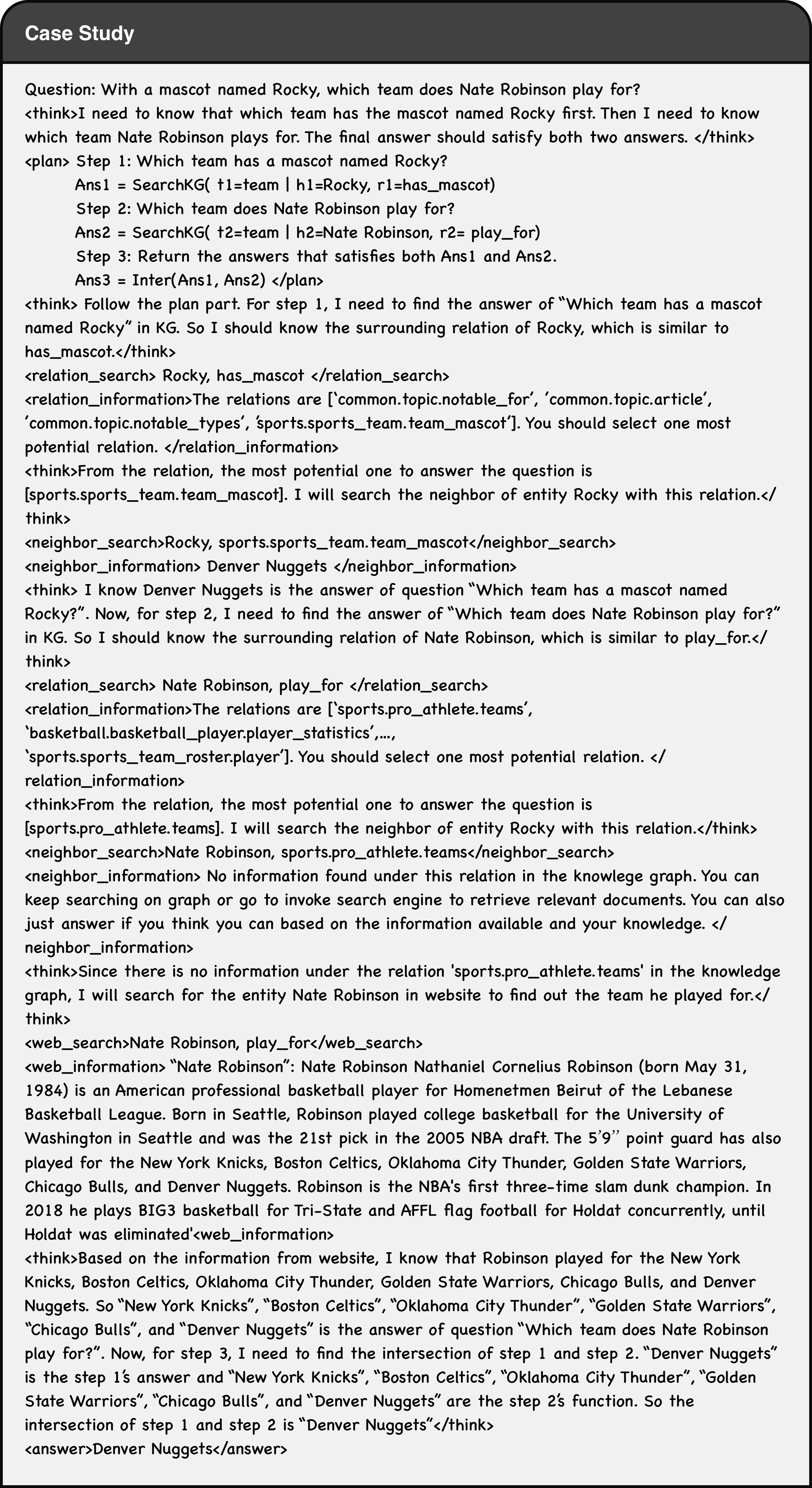
The image displays a technical case study document titled "Case Study". It presents a step-by-step reasoning process for answering a complex question using a combination of knowledge graph (KG) queries and web search. The document is structured with XML-like tags (`<think>`, `<plan>`, `<relation_search>`, etc.) to delineate different stages of the reasoning process. The final answer derived is "Denver Nuggets".
### Components/Axes
The document is a single block of text with the following structural components:
* **Header:** A dark gray bar at the top containing the title "Case Study" in white text.
* **Main Content Area:** A light gray background containing the entire reasoning trace.
* **Structural Tags:** The content is organized using paired XML-style tags that segment the reasoning:
* `<think>`: Internal reasoning and planning.
* `<plan>`: A high-level, three-step plan to answer the question.
* `<relation_search>`: Queries to find relevant relations in the knowledge graph.
* `<relation_information>`: The system's response listing available relations.
* `<neighbor_search>`: Queries to find neighboring entities for a given entity and relation.
* `<neighbor_information>`: The system's response with neighbor entities or a lack of information.
* `<web_search>`: A query sent to a web search engine.
* `<web_information>`: The retrieved information from the web.
* `<answer>`: The final, concluded answer.
### Detailed Analysis
**Question:** "With a mascot named Rocky, which team does Nate Robinson play for?"
**Reasoning Process:**
1. **Plan Formulation (`<plan>`):**
* Step 1: Find the team with mascot "Rocky" (`Ans1`).
* Step 2: Find the team Nate Robinson plays for (`Ans2`).
* Step 3: Return the intersection of `Ans1` and `Ans2` (`Ans3`).
2. **Step 1 Execution (Finding Team with Mascot Rocky):**
* **Relation Search:** The system searches for relations connected to the entity "Rocky" with the intent `has_mascot`.
* **Relation Information:** The KG returns potential relations: `['common.topic.notable_for', 'common.topic.article', 'common.topic.notable_types', 'sports.sports_team.team_mascot']`.
* **Reasoning:** The system selects `sports.sports_team.team_mascot` as the most relevant relation.
* **Neighbor Search:** It searches for neighbors of "Rocky" using the selected relation.
* **Neighbor Information:** The result is "Denver Nuggets".
* **Intermediate Conclusion:** The team with mascot Rocky is the Denver Nuggets.
3. **Step 2 Execution (Finding Nate Robinson's Team):**
* **Relation Search:** The system searches for relations connected to "Nate Robinson" with the intent `play_for`.
* **Relation Information:** The KG returns potential relations: `['sports.pro_athlete.teams', 'basketball.basketball_player.player_statistics',..., 'sports.sports_team_roster.player']`.
* **Reasoning:** The system selects `sports.pro_athlete.teams` as the most relevant relation.
* **Neighbor Search:** It searches for neighbors of "Nate Robinson" using the selected relation.
* **Neighbor Information:** The system reports: "No information found under this relation in the knowledge graph." It suggests continuing the search on the graph, invoking a search engine, or answering based on available knowledge.
* **Fallback Strategy:** The system decides to perform a web search.
* **Web Search:** Query: "Nate Robinson, play_for".
* **Web Information:** A biographical snippet is retrieved. Key extracted facts:
* Nate Robinson is an American professional basketball player.
* He has played for several NBA teams: New York Knicks, Boston Celtics, Oklahoma City Thunder, Golden State Warriors, Chicago Bulls, and Denver Nuggets.
* The snippet also mentions his college, draft position, and other career details.
* **Intermediate Conclusion:** Based on web data, Nate Robinson has played for the Denver Nuggets, among other teams.
4. **Step 3 Execution (Finding the Intersection):**
* **Reasoning:** The system identifies the answer from Step 1 ("Denver Nuggets") and the list of teams from Step 2 (New York Knicks, Boston Celtics, Oklahoma City Thunder, Golden State Warriors, Chicago Bulls, Denver Nuggets).
* **Intersection:** The common element between the two sets is "Denver Nuggets".
5. **Final Answer (`<answer>`):** "Denver Nuggets"
### Key Observations
* **Hybrid Reasoning:** The process demonstrates a hybrid approach, starting with structured knowledge graph queries and falling back to unstructured web search when the KG lacks specific information.
* **Relation Selection:** A critical step involves selecting the most appropriate relation from a list of possibilities provided by the KG (e.g., choosing `sports.sports_team.team_mascot` over `common.topic.notable_for`).
* **KG Limitation:** The knowledge graph contained information about the mascot "Rocky" but did not have the `sports.pro_athlete.teams` relation populated for "Nate Robinson", necessitating the web search.
* **Temporal Context:** The web information describes Nate Robinson's career up to a point, mentioning his play in 2018 for BIG3 and AFFL. The reasoning uses this historical data to conclude he played for the Denver Nuggets, which is factually correct for a period of his career.
### Interpretation
This case study illustrates a **Peircean abductive reasoning** process within an AI system. It starts with an observation (the question) and formulates a plan to find the best explanation (the answer).
1. **Hypothesis Generation:** The initial plan hypothesizes that the answer can be found by intersecting two known facts from a structured knowledge base.
2. **Evidence Gathering:** The system gathers evidence through structured queries. The first query succeeds, providing a clear fact (Rocky -> Denver Nuggets). The second query fails, revealing a gap in the structured knowledge.
3. **Inference to the Best Explanation:** Faced with incomplete structured data, the system abandons the pure KG approach and seeks the best available explanation from a broader, unstructured source (the web). It infers that "plays for" can refer to historical team affiliations, not just current ones.
4. **Conclusion:** The final answer, "Denver Nuggets," is the **abductive conclusion**—the simplest and most plausible explanation that satisfies both conditions of the original question, given the available evidence. The process highlights the importance of fallback mechanisms and the integration of multiple information sources in complex question-answering systems. The notable anomaly is the missing relation in the KG, which the system successfully mitigates.